From Classroom to Civic Space: Fostering Democracy Through Student Councils in Sub-District Small Schools
Keywords:
Student Council, Small-scale School, , Civic Space, Democratic Way of LifeAbstract
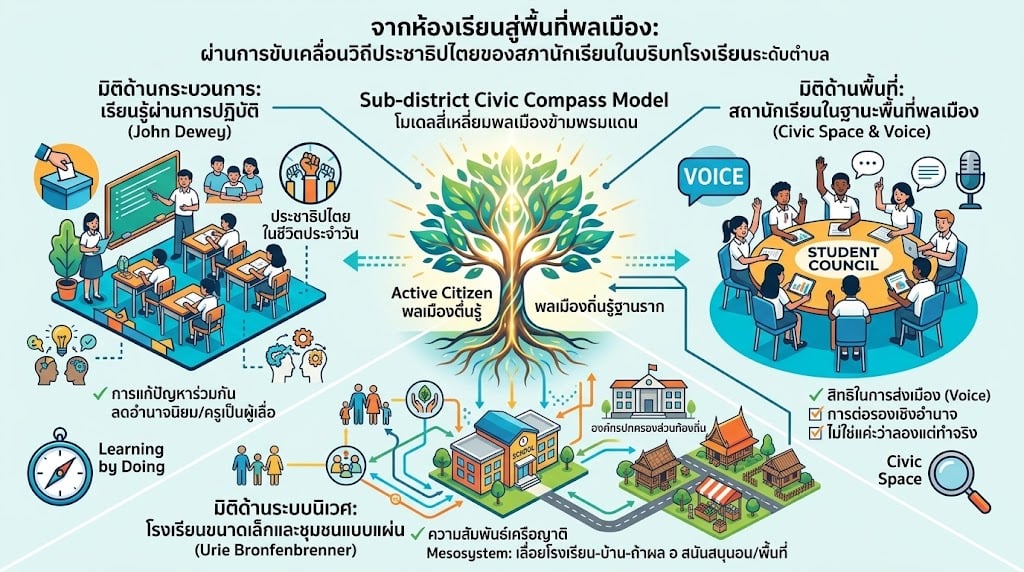
This academic article aims to examine the roles and driving processes of the democratic way of life among student councils within the context of small sub-district schools. It seeks to explain, elevate, and analyze the phenomenon of youth transitioning from passive classroom learners to social drivers through student council mechanisms in local, small-scale educational settings. Specifically, this study focuses on understanding how student council activities can be transformed from mere extracurricular routines dictated by bureaucratic structures into a meaningful and equitable "Civic Space" for participation, despite the geographical, community, and resource constraints inherent to small local schools Furthermore, this study provides an in-depth explanation of the cultivation and internalization of the democratic way of life, which extends beyond conventional textbook definitions of voting, rights, and duties. Instead, it investigates "Everyday Democracy" in students' daily practices through collaborative teamwork, active listening to diverse perspectives, public interest allocation, and power negotiations within the school. Additionally, the article elucidates the dynamic relationship between student councils and sub-district communities, which serve as a vital ecosystem expanding students' learning boundaries to connect with various local social issues, such as culture, environment, and community welfare. Ultimately, it analyzes structural factors, authoritarian culture, budgetary conditions, and staff workloads, which act as both opportunities and significant barriers to fostering youth into active citizens.
References
กระทรวงศึกษาธิการ. (2558). คู่มือแนวทางการปฏิบัติงาน กิจกรรมสภานักเรียน. กรุงเทพฯ : สำนักงานคณะกรรมการการศึกษาขั้นพื้นฐาน.
ปริญญา เทวานฤมิตรกุล. (2555). การศึกษาเพื่อสร้างพลเมือง (Civic Education). กรุงเทพฯ : นานมีบุ๊คส์พับลิเคชั่นส์.
รุจน์ ฦาชา และ วลัย อิศรางกูร ณ อยุธยา. (2560). การดำเนินงานสภานักเรียนเพื่อส่งเสริมประชาธิปไตยในโรงเรียน: กรณีศึกษาโรงเรียนปฏิบัติดีเลิศของไทย. วารสารสุทธิปริทัศน์, 31(100), 45-57.
เลิศพร อุดมพงษ์. (2562). การศึกษากระบวนการเสริมสร้างประชาธิปไตยในโรงเรียน ผ่านกระบวนการสภานักเรียน. สถาบันวิจัยและพัฒนา สถาบันพระปกเกล้า.
สติธร ธนานิธิโชติ. (2561). บทบาทคนรุ่นใหม่กับประชาธิปไตยช่วงเปลี่ยนผ่าน ความหวังหรือความฝัน. ประชาไท.
Bronfenbrenner, U. (1979). The ecology of human development: Experiments by nature and design. Harvard University Press.
CIVICUS. (2020). What is civic space? World Alliance for Citizen Participation. civicus.org
Dewey, J. (1916). Democracy and education: An introduction to the philosophy of education. Macmillan.
Hart, R. A. (1992). Children's participation: From tokenism to citizenship (Innocenti Essays No. 4). UNICEF International Child Development Centre.
Downloads
Published
Issue
Section
License
Copyright (c) 2026 Journal of Sinsothon

This work is licensed under a Creative Commons Attribution-NonCommercial-NoDerivatives 4.0 International License.
Authors who publish with Journal of TCI agree to the following terms:
- Authors retain copyright and grant the journal right of first publication with the work simultaneously licensed under a Attribution-NonCommercial-NoDerivatives 4.0 International (CC BY-NC-ND 4.0) that allows others to share the work with an acknowledgment of the work's authorship and initial publication in this journal.
- Authors are able to enter into separate, additional contractual arrangements for the non-exclusive distribution of the journal's published version of the work (e.g., post it to an institutional repository or publish it in a book), with an acknowledgment of its initial publication in this journal.
- Authors are permitted and encouraged to post their work online (e.g., in institutional repositories or on their website) prior to and during the submission process, as it can lead to productive exchanges, as well as earlier and greater citation of published work.



