Ethics and Morality in Public Administration for Leaders in the VUCA World Era
Keywords:
Virtue, Ethics, Public Administration, VUCA World EraAbstract
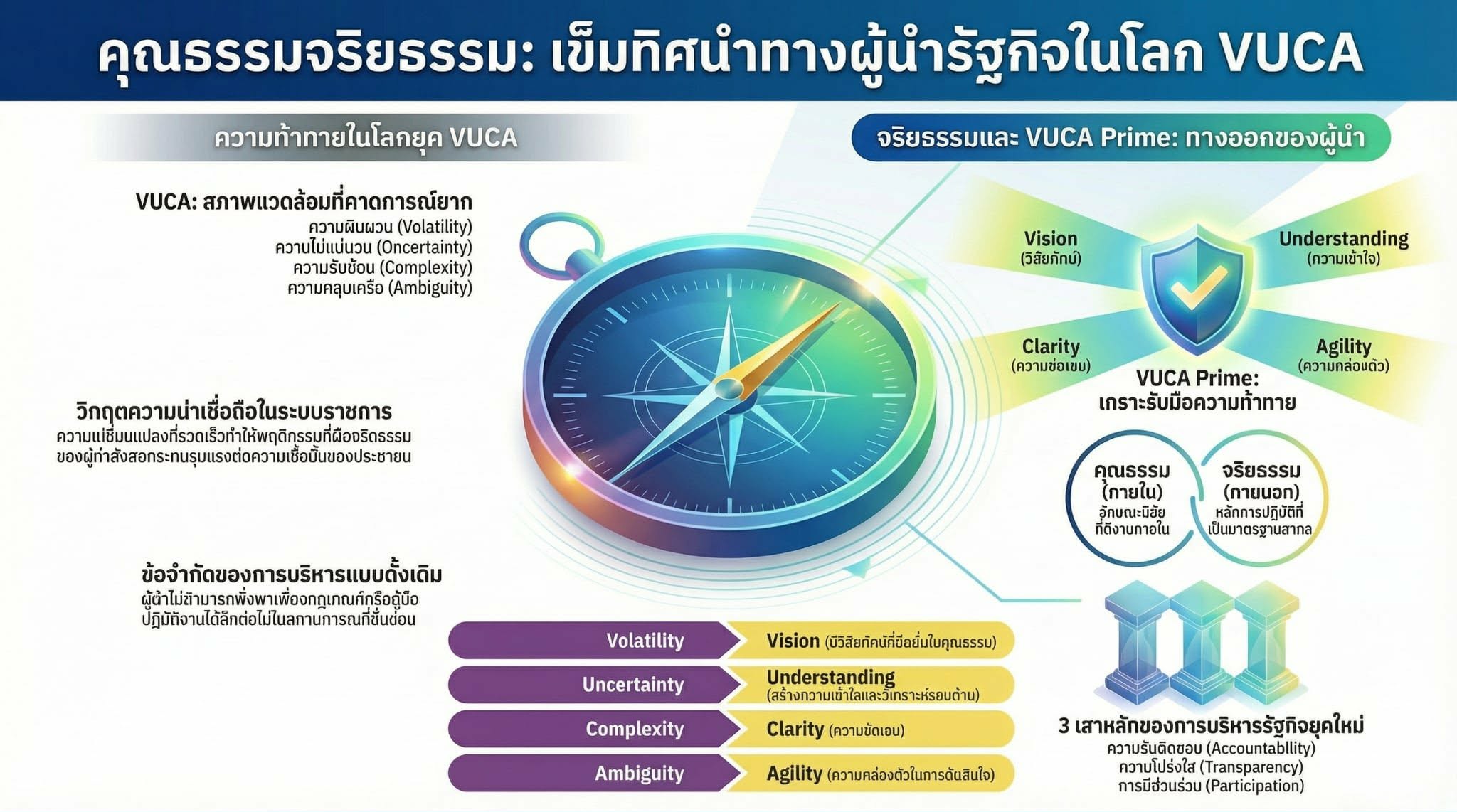
This academic article aims to examine the role of ethics and morality in public administration for leaders in the VUCA World era, characterized by high levels of volatility, uncertainty, complexity, and ambiguity. This study reviews relevant literature and theoretical concepts related to ethics and morality in both Western contexts and Thailand, as well as analyzes the relationship between ethics and public administration in an era of rapid change. The findings indicate that ethics and morality are critically important in building trust and credibility in the public sector, especially in the VUCA World where leaders face complex and unpredictable challenges. Ethics and morality serve as a compass for decision-making and public policy implementation. Leaders with strong ethical foundations can effectively guide organizations through various crises, create sustainability for society, and preserve ethical values amid change.
References
กรมศิลปากร. (2550). ศิลาจารึกสุโขทัย. กรุงเทพฯ: กรมศิลปากร.
บวรศักดิ์ อุวรรณโณ. (2543). ธรรมาภิบาล: หลักการบริหารกิจการบ้านเมืองที่ดี. กรุงเทพฯ: โครงการจัดพิมพ์คบไฟ.
พระธรรมปิฎก (ป.อ. ปยุตฺโต). (2543). พุทธธรรม. กรุงเทพฯ: มหาจุฬาลงกรณราชวิทยาลัย.
สำนักงานคณะกรรมการพิเศษเพื่อประสานงานโครงการอันเนื่องมาจากพระราชดำริ. (2550). เศรษฐกิจพอเพียง. กรุงเทพฯ: สำนักงาน กปร.
Aristotle. (350 BCE). Nicomachean Ethics (W. D. Ross, Trans.). Oxford: Oxford University Press.
Bennett, N., & Lemoine, G. J. (2014). What VUCA really means for you. Harvard Business Review, 92(1/2), 27-35.
Bennis, W., & Nanus, B. (1985). Leaders: The strategies for taking charge. New York: Harper & Row.
Frederickson, H. G. (1997). The spirit of public administration. San Francisco: Jossey-Bass.
Gümüsay, A. A. (2018). Sharing is caring: The role of sharing economy in addressing sustainability paradoxes. Organization & Environment, 31(3), 280-303.
Johansen, B., & Euchner, J. (2013). Navigating the VUCA world. Research-Technology Management, 56(1), 10-15.
Kant, I. (1785). Groundwork of the metaphysics of morals (M. Gregor, Trans.). Cambridge: Cambridge University Press.
Lichtenthaler, U. (2020). Extremes and essentials: Towards a new framework for strategic foresight. Management International Review, 60(1), 139-165.
Mill, J. S. (1863). Utilitarianism. London: Parker, Son, and Bourn.
Plato. (380 BCE). The Republic (G. M. A. Grube, Trans.). Indianapolis: Hackett Publishing.
Rawls, J. (1971). A theory of justice. Cambridge: Harvard University Press.
Thompson, D. F. (2005). Restoring responsibility: Ethics in government, business, and healthcare. Cambridge: Cambridge University Press.
Walzer, M. (1973). Political action: The problem of dirty hands. Philosophy & Public Affairs, 2(2), 160-180.
Wilson, W. (1887). The study of administration. Political Science Quarterly, 2(2), 197-222.
Downloads
Published
Issue
Section
License
Copyright (c) 2026 Journal of Sinsothon

This work is licensed under a Creative Commons Attribution-NonCommercial-NoDerivatives 4.0 International License.
Authors who publish with Journal of TCI agree to the following terms:
- Authors retain copyright and grant the journal right of first publication with the work simultaneously licensed under a Attribution-NonCommercial-NoDerivatives 4.0 International (CC BY-NC-ND 4.0) that allows others to share the work with an acknowledgment of the work's authorship and initial publication in this journal.
- Authors are able to enter into separate, additional contractual arrangements for the non-exclusive distribution of the journal's published version of the work (e.g., post it to an institutional repository or publish it in a book), with an acknowledgment of its initial publication in this journal.
- Authors are permitted and encouraged to post their work online (e.g., in institutional repositories or on their website) prior to and during the submission process, as it can lead to productive exchanges, as well as earlier and greater citation of published work.




