Applying the Four Sublime States of Mind Brahma Vihara 4 to Enhance the Efficiency of Pak Puan Subdistrict Municipality Administration
Keywords:
The Four Sublime States Brahmaviharas, Local Administration, PakPuan Subdistrict MunicipalityAbstract
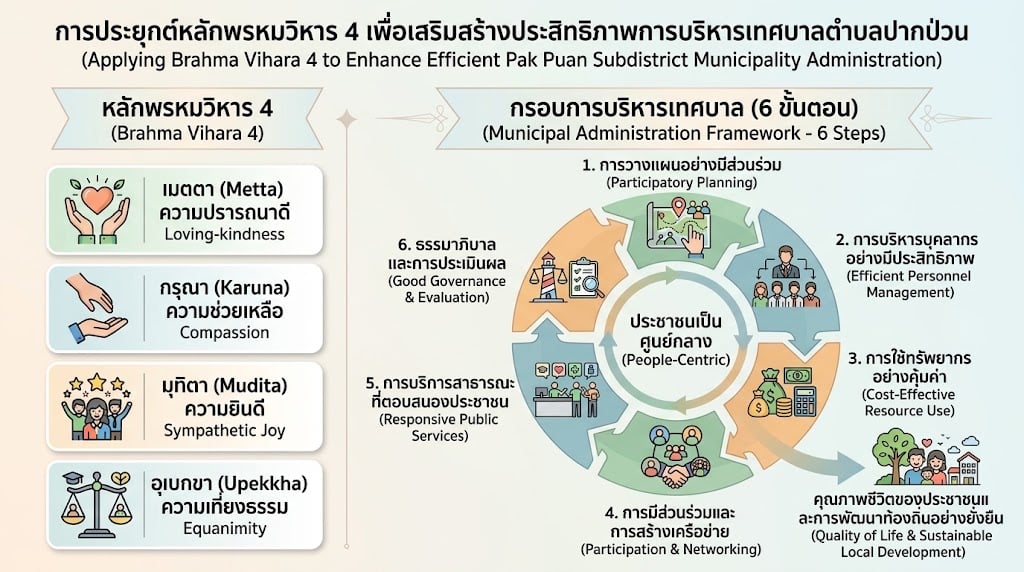
This academic article aims to propose guidelines for applying the Brahmavihara 4 principles (the Four Sublime States of Mind) to enhance the administrative efficiency of Pak Puan Subdistrict Municipality. It synthesizes concepts regarding Brahmavihara 4 comprising Metta (loving-kindness), Karuna (compassion), Mudita (sympathetic joy), and Upekkha (equanimity) with concepts of municipal administrative efficiency and the specific administrative context of Pak Puan Subdistrict Municipality, Wang Saphung District, Loei Province. The synthesis reveals that Brahmavihara 4 can be applied to local government administration: Metta fosters goodwill and positive relationships between personnel and the public; Karuna promotes assistance and the resolution of hardships; Mudita encourages the acknowledgment and support of the successes achieved by personnel and the public; and Upekkha ensures that administration and decision-making are fair, unbiased, and grounded in reason and wisdom. The resulting knowledge has been synthesized into a six-component framework for the efficient administration of Pak Puan Subdistrict Municipality: (1) participatory planning, (2) efficient personnel management, (3) cost-effective resource utilization, (4) public participation and network building, (5) public services that respond to citizens' needs, and (6) good governance and evaluation. Therefore, the application of Brahmavihara 4should be integrated with systematic management, public participation, personnel development, efficient resource use, and good governance principles. This approach enables municipal administration to effectively address the problems and needs of the public, ultimately leading to appropriate and equitable local development.
References
กนกกาญจน์ พวงเพ็ชร, สุนิตดา เทศนิยม, ธีรพล กาญจนากาศ, และสมคิด ดวงจักร. (2568). การบริหารทรัพยากรมนุษย์ที่มีผลต่อประสิทธิภาพการบริหารงานของสำนักงานเทศบาลตำบลบางใหญ่ จังหวัดนนทบุรี. Journal of Spatial Development and Policy, 3(2), 57–68.
กรมพัฒนาที่ดิน. (2567). แผนการใช้ที่ดินตำบลปากปวน อำเภอวังสะพุง จังหวัดเลย. สถานีพัฒนาที่ดินเลย สำนักงานพัฒนาที่ดินเขต 8, กระทรวงเกษตรและสหกรณ์.
โกวิทย์ พวงงาม. (2559). การปกครองท้องถิ่นไทย: หลักการและมิติใหม่ในอนาคต (พิมพ์ครั้งที่ 9 แก้ไขเพิ่มเติม). วิญญูชน.
จุรี สายจันเจียมและคณะ (2560). รูปแบบการบริหารงานบุคคลตามหลักพรหมวิหาร 4 ของผู้บริหารสำนักงานเทศบาลเมือง ภาคตะวันออกเฉียงเหนือตอนกลาง. วารสารการบริหารการปกครองและนวัตกรรมท้องถิ่น, 1(1), 15–28.
ธวัชชัย ตรีวรชัย. (2561). ภาวะผู้นำของผู้บริหารตามหลักพรหมวิหาร 4 ในเทศบาลเมืองลำตาเสา อำเภอวังน้อย จังหวัดพระนครศรีอยุธยา. วารสารปรัชญาปริทรรศน์, 23(1), 71–81
นงลักษณ์ นามวิเศษ, และสมปอง สุวรรณภูมา. (2568). ปัจจัยที่มีอิทธิพลต่อประสิทธิภาพในการบริหารงานของเทศบาลตำบลหนองสังข์ อำเภอแก้งคร้อ จังหวัดชัยภูมิ. เสฏฐวิทย์ปริทัศน์, 5(2), 700–709.
มานิต วัฒนเสน. (2559). การมีส่วนร่วมของประชาชนในการตรวจสอบการบริหารกิจการสาธารณะขององค์กรปกครองส่วนท้องถิ่น. วารสารการบริหารท้องถิ่น, 9(2), 90–107.
ลลดา วฤทธิไกรกิตติ. (2555). การบริหารองค์กรปกครองส่วนท้องถิ่นที่มีประสิทธิภาพ. วารสาร มจร สังคมศาสตร์ปริทรรศน์, 1(1), 110–123.
วรรณา จินดาศักดิ์, และธีรพล กาญจนากาศ. (2568). การบริหารทรัพยากรมนุษย์ที่มีผลต่อประสิทธิภาพการบริหารงาน สำนักงานเทศบาลตำบลบางสมัคร อำเภอบางปะกง จังหวัดฉะเชิงเทรา. วารสารศรีสุวรรณภูมิปริทรรศน์, 3(3), 188–200.
วุฒิสาร ตันไชย. (2547). การกระจายอำนาจและการปกครองท้องถิ่น: ความก้าวหน้าหลังรัฐธรรมนูญ พ.ศ. 2540. สถาบันพระปกเกล้า.
วุฒิสาร ตันไชย. (2548). การกระจายอำนาจสู่องค์กรปกครองส่วนท้องถิ่น (พิมพ์ครั้งที่ 6). บริษัท เอ.พี. กราฟิค ดีไซน์และการพิมพ์ จำกัด.
ศิริชัย เพชรรักษ์. (2553). การมีส่วนร่วมของประชาชนในการตรวจสอบการบริหารงานขององค์การบริหารส่วนตำบลในประเทศไทย. วารสารวิชาการมหาวิทยาลัยอีสเทิร์นเอเชีย ฉบับสังคมศาสตร์และมนุษยศาสตร์, 2(2), 108–117.
สวิตต์ ดีอุดมวงศา, และชาญเดช เจริญวิริยะกุล. (2563). ประสิทธิภาพการบริหารจัดการของเทศบาลตำบลศาลายา อำเภอพุทธมณฑล จังหวัดนครปฐม. วารสารการวิจัยการบริหารการพัฒนา, 10(4), 193–202.
Downloads
Published
Issue
Section
License
Copyright (c) 2026 Journal of Sinsothon

This work is licensed under a Creative Commons Attribution-NonCommercial-NoDerivatives 4.0 International License.
Authors who publish with Journal of TCI agree to the following terms:
- Authors retain copyright and grant the journal right of first publication with the work simultaneously licensed under a Attribution-NonCommercial-NoDerivatives 4.0 International (CC BY-NC-ND 4.0) that allows others to share the work with an acknowledgment of the work's authorship and initial publication in this journal.
- Authors are able to enter into separate, additional contractual arrangements for the non-exclusive distribution of the journal's published version of the work (e.g., post it to an institutional repository or publish it in a book), with an acknowledgment of its initial publication in this journal.
- Authors are permitted and encouraged to post their work online (e.g., in institutional repositories or on their website) prior to and during the submission process, as it can lead to productive exchanges, as well as earlier and greater citation of published work.



