A Development Model of Teacher Competencies in Active Learning Using the PLC-5S Model to Enhance Student Achievement at Anuban Loei School
Keywords:
Development Model, Teacher Competencies, Active Learning, Student AchievementAbstract
The objectives of this research were to : 1) investigate the current condition, desirable condition, and needs for developing teachers’ competencies in Active Learning using the PLC-5S Model to enhance student achievement at Anuban Loei School; 2) develop and validate a model for developing teachers’ competencies in Active Learning using the PLC-5S Model to enhance student achievement at Anuban Loei School; 3) implement the model for developing teachers’ competencies in Active Learning using the PLC-5S Model to enhance student achievement at Anuban Loei School; and 4) evaluate the model for developing teachers’ competencies in Active Learning using the PLC-5S Model to enhance student achievement at Anuban Loei School. The research participants consisted of 61 administrators and teachers at Anuban Loei School, selected through purposive sampling. The research instruments included a questionnaire, a semi-structured interview and evaluation forms. Data were analyzed using descriptive and inferential statistics.
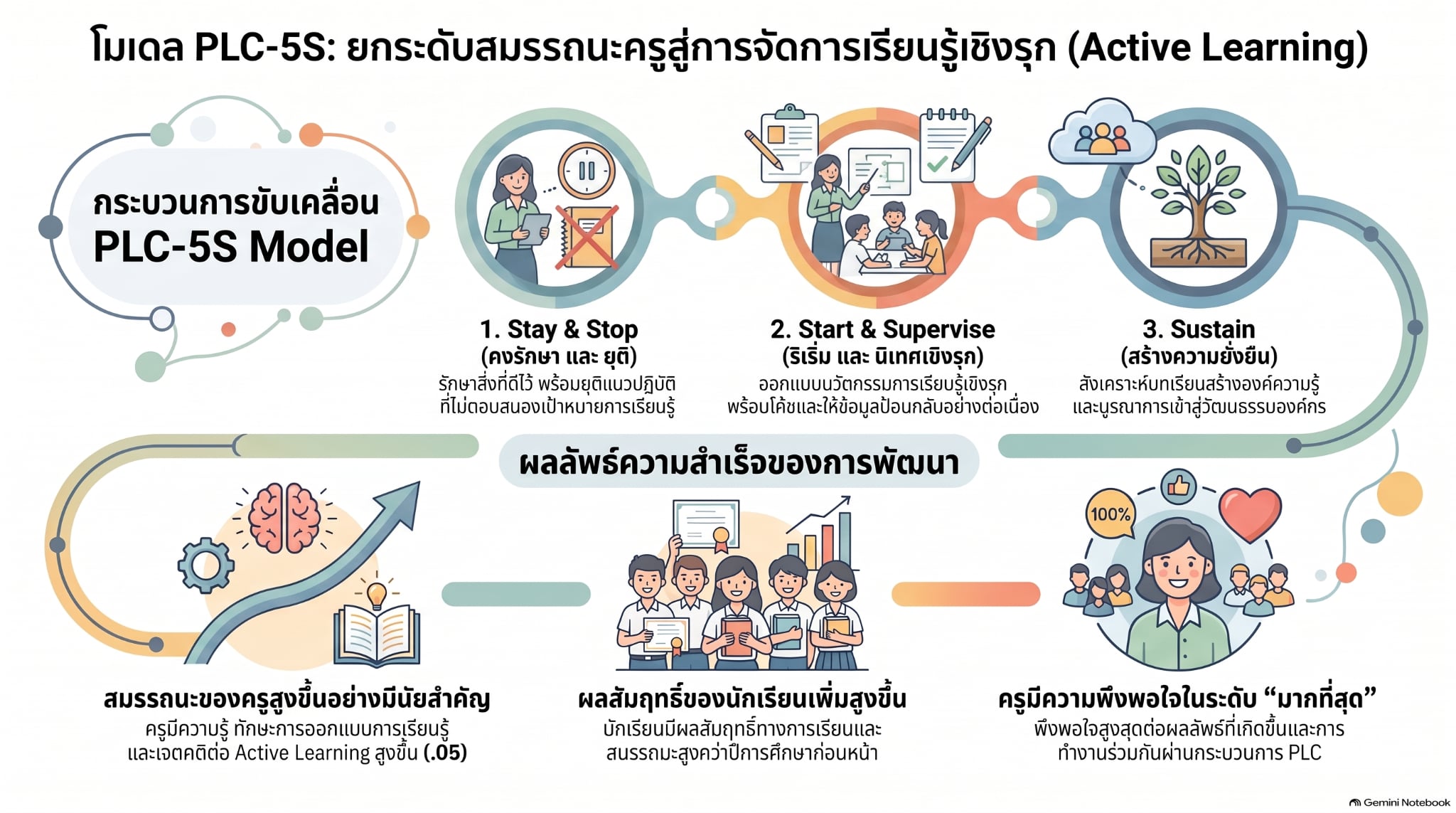
The results show that; 1) the overall current condition of teachers’ competencies in Active Learning was at a high level, whereas the desirable condition was at the highest level. The overall needs index was 0.28. In particular, the competency sub-dimension concerning the organization of learning activities that enabled students to engage in hands-on learning and apply their knowledge in authentic situations, consistent with the principles of Active Learning, had the highest needs index across all competency areas; 2) the model for developing teachers’ competencies in Active Learning through the PLC-5S Model to enhance student achievement at Anuban Loei School consisted of nine components: (1) principles of the model, (2) objectives of the model, (3) inputs, (4) process, (5) outputs, (6) outcomes, (7) feedback, (8) success conditions, and (9) measurement and evaluation; 3) after implementation of the model, teachers demonstrated higher competencies in learning design and planning, as well as more positive attitudes toward Active Learning. In addition, students’ achievement was higher than that in the academic year prior to the implementation of the model. The teachers’ knowledge and understanding of Active Learning before and after implementation of the model differed significantly at the .05 level; and 4) teachers’ overall satisfaction with the model for developing teachers’ competencies in Active Learning through the PLC-5S Model to enhance student achievement at Anuban Loei School was at the highest level. Satisfaction with the outcomes resulting from the implementation of the model was also at the highest level. However, among the process-related aspects, the appropriateness of the duration and procedures in relation to teachers’ workloads received the lowest mean score, as teachers needed to adjust their schedules and allocate additional time to participate in Professional Learning Community (PLC) activities.
References
กระทรวงศึกษาธิการ. (2564). แนวทางการจัดกิจกรรมการเรียนรู้เชิงรุก (Active Learning) เพื่อพัฒนาสมรรถนะผู้เรียน. กรุงเทพมหานคร : โรงพิมพ์ชุมนุมสหกรณ์การเกษตรแห่งประเทศไทย.
สำนักพัฒนาครูและบุคลากรการศึกษาขั้นพื้นฐาน. (2560). คู่มือประกอบการอบรมการขับเคลื่อนกระบวนการ PLC (Professional Learning Community) “ชุมชนการเรียนรู้ทางวิชาชีพ” สู่สถานศึกษา. กรุงเทพมหานคร : เอกสารเผยแพร่ทางวิชาการ สำนักพัฒนาครูและบุคลากรการศึกษาขั้นพื้นฐาน สำนักงานคณะ กรรมการการศึกษาขั้นพื้นฐาน.
Deming, W. E. (2000). Out of the Crisis. MIT Press.
DuFour, R., DuFour, R., Eaker, R., & Many, T. W. (2010). Learning by doing: A handbook for Professional Learning Communities at Work (2nd ed.). Solution Tree Press.
Hord, S. M. (1997). Professional learning communities: Communities of continuous inquiry and improvement. Southwest Educational Development Laboratory.
Prince, M. (2004). Does active learning work? A review of the research. Journal of Engineering Education, 93(3), 223–231.
Downloads
Published
Issue
Section
License
Copyright (c) 2026 Journal of Sinsothon

This work is licensed under a Creative Commons Attribution-NonCommercial-NoDerivatives 4.0 International License.
Authors who publish with Journal of TCI agree to the following terms:
- Authors retain copyright and grant the journal right of first publication with the work simultaneously licensed under a Attribution-NonCommercial-NoDerivatives 4.0 International (CC BY-NC-ND 4.0) that allows others to share the work with an acknowledgment of the work's authorship and initial publication in this journal.
- Authors are able to enter into separate, additional contractual arrangements for the non-exclusive distribution of the journal's published version of the work (e.g., post it to an institutional repository or publish it in a book), with an acknowledgment of its initial publication in this journal.
- Authors are permitted and encouraged to post their work online (e.g., in institutional repositories or on their website) prior to and during the submission process, as it can lead to productive exchanges, as well as earlier and greater citation of published work.



