Schools, State Ideology, and Inequality: A Critical Perspective on Educational Administration
Keywords:
Schools, State Ideology, Educational Inequality, Educational Administration, Critical TheoryAbstract
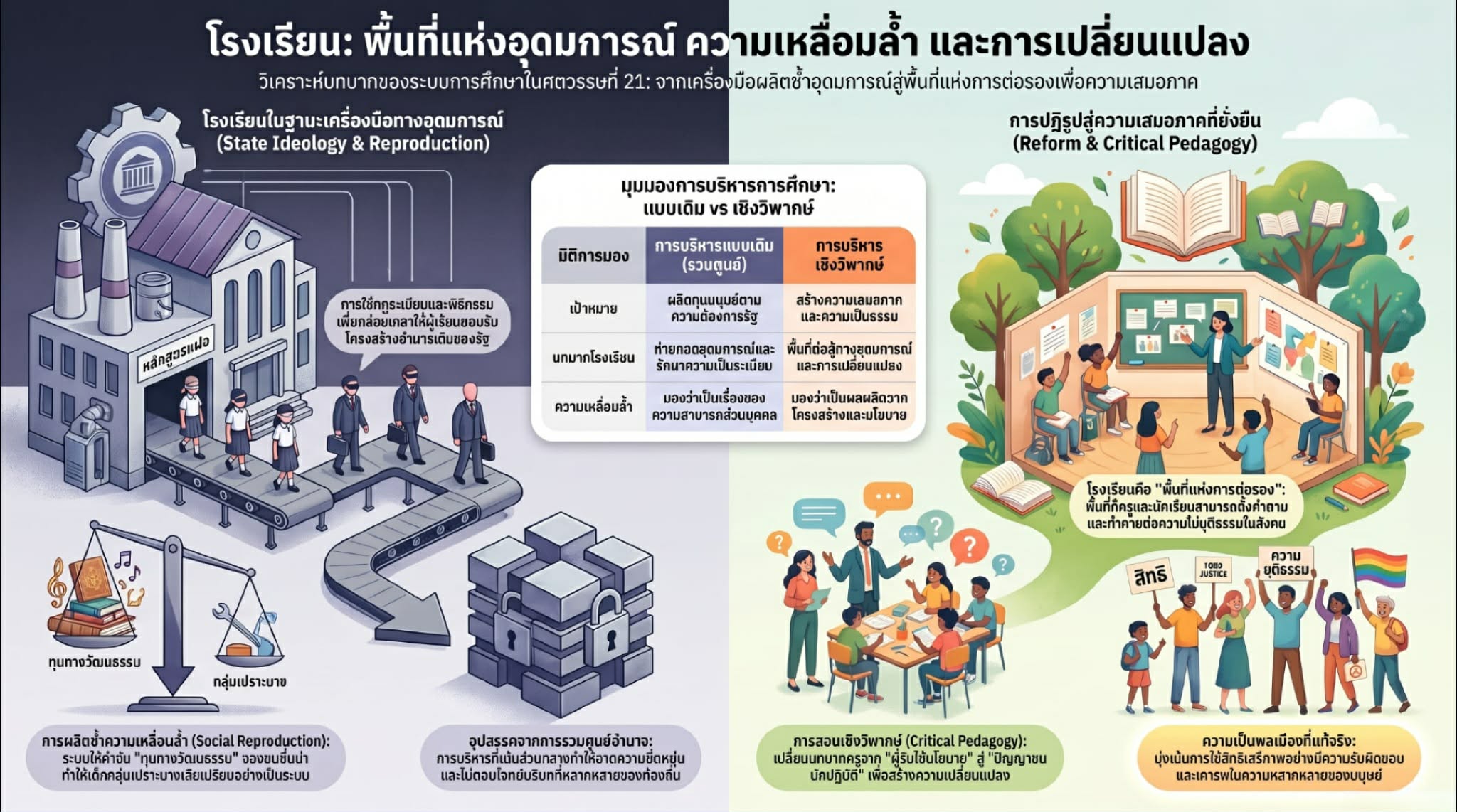
This academic article, entitled "Schools, State Ideology, and Inequality: A Critical Perspective on Educational Administration," aims to analyze the role of the education system in the twenty-first century within the context of state ideology, power structures, and social inequality. It argues that education is not merely a mechanism for developing human resources but also a significant instrument for reproducing dominant ideologies and class structures through curricula, school administration, and learning processes. Contemporary education emphasizes the development of essential competencies, including critical thinking, problem-solving, and technological literacy. Nevertheless, educational inequality persists due to structural factors such as poverty, unequal distribution of educational resources, and inconsistent public policies. These conditions systematically disadvantage learners from vulnerable and marginalized groups. From an educational administration perspective, schools function as institutions that transmit state ideology through the hidden curriculum while reinforcing the cultural capital of dominant social groups. Curriculum design also plays a crucial role in shaping citizens' identities at both national and global levels. However, schools should not be viewed solely as sites of ideological domination; they are also arenas of ideological negotiation, where teachers and school leaders can employ critical pedagogical approaches to promote meaningful social and educational transformation. The article concludes that genuine educational reform requires recognition of the interconnected dimensions of power, ideology, and social structure alongside efforts to enhance the quality of learning. Such an approach is essential for advancing educational equity and social justice in a sustainable manner.
References
ฉัฐวัฒน์ ชัชณฐาภัฏฐ์. (2567). ความเหลื่อมล้ำในสังคมไทย ความท้าทายและการปรับตัวสู่ความเท่าเทียม. วารสารสังคมศึกษาปริทรรศน์, 1(1), 99-114.
ชยานันต์ ปานสอน และ อภิธีร์ ทรงบัณฑิตย์. (2566). บทบาทของผู้บริหารสถานศึกษาที่ส่งผลต่อความสำเร็จการระดมทรัพยากรทางการศึกษาของโรงเรียนในสังกัดสำนักงานเขตพื้นที่การศึกษามัธยมศึกษากรุงเทพมหานคร เขต 2. Rajapark Journal, 17(54), 468-481.
ณฐยา ราชสมบัติ, พระครูศรีสุธรรมนิวิฐ, พระมหาอุดร อุตฺตโร และ ปริญญา นิกรกุล. (2566). เศรษฐศาสตร์การศึกษา: มิติความเหลื่อมล้ำที่ซ่อนตัวอยู่ภายใต้โครงสร้างการศึกษาไทย. วารสาร มจร การพัฒนาสังคม, 8(3), 66-80.
ณดล คุณานนท์. (2568). ปัญหาความเท่าเทียมทางการศึกษาของเด็กไทยในชนบทและเมือง. Thai Social Science Journal, 2(3), 1-10.
ตรีนุช สมแก้ว. (2568). องค์ประกอบของการบริหารสถานศึกษาสู่ความเป็นเลิศของโรงเรียนคุณภาพ ตามนโยบาย 1 อำเภอ 1 โรงเรียนคุณภาพ. วารสารพุทธนวัตกรรมการศึกษา, 1(2), 107-120.
ธีระวัฒน์ สุทธินนท์, ทิพมาศ เศวตวรโชติ และ สันติ อุ่นจะนำ. (2567). กลยุทธ์ในการส่งเสริมคุณธรรมสำหรับครูและผู้บริหารสถานศึกษา โรงเรียนในสังกัดเทศบาลนครตรัง. วารสารพุทธศาสตร์ มจร.อุบลราชธานี, 6(2), 1-16.
ประภาศ ปานเจี้ยง. (2566). อุดมการณ์ความเป็นครู: บ่มเพาะ ผลิต และปลดปล่อยสู่เสรีภาพ. วารสารศึกษาศาสตร์ มหาวิทยาลัยสงขลานครินทร์ วิทยาเขตปัตตานี, 34(1), 20–31.
พระครูปภัสสรกิตติคุณ ชุมโคตร และ วิทยา ทองดี. (2568). แนวทางการสอนศาสนาเพื่อเสริมสร้างความเป็นพลเมืองโลก: บทเรียนสำคัญของครูสังคมศึกษา. วารสารสังคมศาสตร์ปัญญาพัฒน์, 7(1), 535-546.
พระครูสุตสารบัณฑิต (จำนงค์ ผมไผ), พระมหาเกริกเกียรติ นิรุตฺติเมธี (ไพศาลเจริญลาภ) และ พระมหาอำพล ธนปญฺโญ (ชัยสารี). (2567). การศึกษาเรื่องอัตลักษณ์และความหลากหลายในสังคมหลังสมัยใหม่. วารสารกว๊านพะเยา, 1(6), 39-48.
เพชรรัตน์ โนจา และ ขวัญฤดี มีนันท์. (2565). การจัดทำหลักสูตรวิชาพลเมืองเพื่อเสริมสร้างวัฒนธรรมทางการเมืองในระบอบประชาธิปไตยของไทย. วารสารสังคมศาสตร์และศาสตร์รวมสมัย, 3(1), 32-48.
วริศรา พรมวัง และ นัทนิชา โชติพิทยานนท์. (2568). การบริหารจัดการเชิงกลยุทธ์เพื่อพัฒนาการจัดการศึกษาในศตวรรษที่ 21. วารสารการบริหารการจัดการและการพัฒนาที่ยั่งยืน, 3(2), 650-660.
วิโรจน์ สารรัตนะ, พระครูสุธีจริยวัฒน์, พระครูธรรมาภิสมัย, พระมหาศุภชัย สุภกิจฺโจ, วิทูล ทาชา, เอกชาตรี สุขเสน. (2567). ทัศนะเชิงวิชาการและสิ่งท้าทายต่อการบริหารการศึกษาในศตวรรษที่ 21. วารสารมนุษยศาสตร์และสังคมศาสตร์ มมร วิทยาเขตอีสาน, 5(2), 1-16.
สิทธิชัย กฤชวิวรรธน์. (2568). ลดความเหลื่อมล้ำทางการศึกษาไทย นโยบายครูดี เรียนฟรี ใกล้บ้านทั้งระบบ. วารสารวิชาการรัฐศาสตร์และรัฐประศาสนศาสตร์, 7(6), 195-208.
สุทธิพงศ์ เสมสูงเนิน. (2568). การศึกษา คือ ความมั่นคงของชาติ. Journal of Education and Social Agenda, 2(1), 57-72.
อภิญญา อุปวงค์ษา, รักชนกชรินร์ พูลสุวรรณนธี, และ วรรณรี ปานศิริ. (2569). การบริหารการศึกษาตามหลักธรรมาภิบาลด้านคุณธรรมและความโปร่งใส. วารสารวิจยวิชาการ, 9(2), 300-315.
Apple, M. W. (2004). Ideology and curriculum (3rd ed.). Routledge.
Bourdieu, P., & Passeron, J.-C. (1990). Reproduction in education, society and culture (2nd ed.). Sage Publications.
Giroux, H. A. (2001). Theory and resistance in education: Towards a pedagogy for the opposition (Rev. and expanded ed.). Bergin & Garvey.
Downloads
Published
Issue
Section
License
Copyright (c) 2026 Journal of Sinsothon

This work is licensed under a Creative Commons Attribution-NonCommercial-NoDerivatives 4.0 International License.
Authors who publish with Journal of TCI agree to the following terms:
- Authors retain copyright and grant the journal right of first publication with the work simultaneously licensed under a Attribution-NonCommercial-NoDerivatives 4.0 International (CC BY-NC-ND 4.0) that allows others to share the work with an acknowledgment of the work's authorship and initial publication in this journal.
- Authors are able to enter into separate, additional contractual arrangements for the non-exclusive distribution of the journal's published version of the work (e.g., post it to an institutional repository or publish it in a book), with an acknowledgment of its initial publication in this journal.
- Authors are permitted and encouraged to post their work online (e.g., in institutional repositories or on their website) prior to and during the submission process, as it can lead to productive exchanges, as well as earlier and greater citation of published work.




