The ideas of the new generation and the shaping of political discourse in contemporary Thai society
Keywords:
New Generation, Political Discourse, Political Communication, Social MediaAbstract
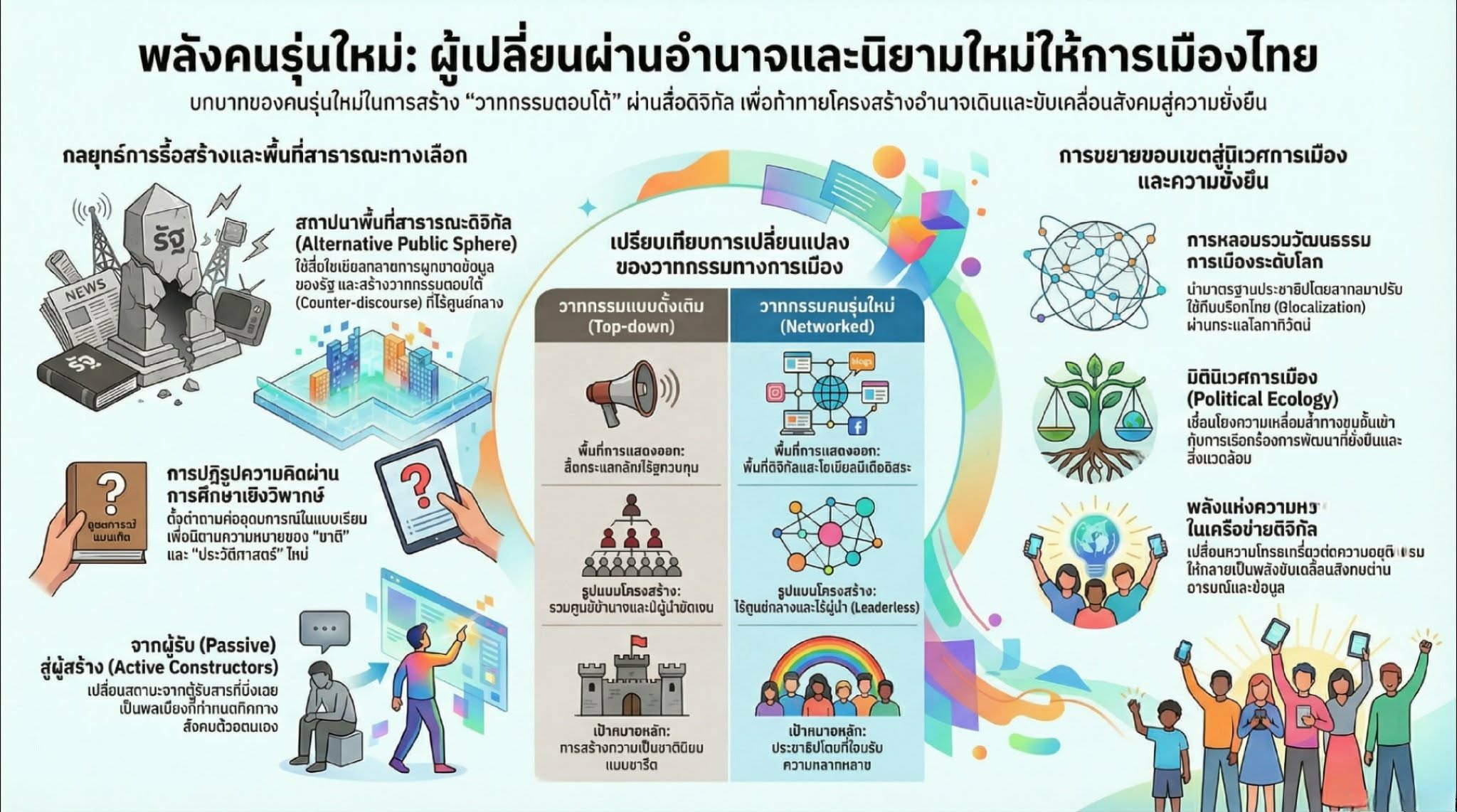
This academic article aims to critically analyze and synthesize knowledge regarding the role of the new generation in shaping and constructing political discourse in contemporary Thai society. Through a literature review grounded in political communication and discourse theory, the study focuses on the dynamics of using online spaces as tools for ideological negotiation. The findings indicate that the new generation has emerged as producers of counter-discourses via social media platforms. These movements have led to questioning and deconstructing traditional state power embedded within the conventional education system , subsequently reconstructing new definitions of “nationhood” and “democracy” rooted in diversity and globalization. This article argues that understanding these concepts is crucial for deciphering the future trajectory of Thai politics, which is transitioning from a monopoly of traditional institutional power to networked digital political spaces.
References
กัญณัฐ กองรอด. (2567). หรือชาติจะแปรเปลี่ยน: ข้อท้าทายของมโนทัศน์ว่า ด้วยความเป็น “ชาติ” ในพื้นที่การศึกษาไทย. วารสารสังคมศาสตร์ มหาวิทยาลัยนเรศวร, 20(2), 269-298.
ชนะศึก วิเศษชัย. (2568). การสื่อสารทางการเมืองกับการธำรงรักษาและสร้างความเข้มแข็งให้แก่ระบอบประชาธิปไตย. วารสารศิลปะการจัดการ, 9(1), 444-461.
ชาตรี สุขสบาย. (2568). อดีตในปัจจุบันกับการสร้างสรรค์แนวทางการพัฒนาสังคม. วารสารวิจัยวิชาการ, 8(1), 333-350.
ซุนซู เหล่ย, และ จันทร์สุดา ไชยหประเสริฐ. (2568). สัญญะทางนิเวศที่สื่อความหมายทางวัฒนธรรมในวรรณกรรมของอาไหล (A Lai) ช่วงปี พ.ศ. 2550-2565. วารสารสหศาสตร์การพัฒนาสังคม, 3(1), 287-309.
ณัฐกานต์ บุญยืน, ดวงใจ บุญโยง, และ พิชญา ศรีพรณ์. (2568). อัตลักษณ์และความหลากหลายทางวัฒนธรรมในกระแสโลกาภิวัตน์. วารสารกว๊านพะเยา, 2(1), 36-46.
เนตรน้าทิพย์ บุดดาวงศ์, และ กนกพร นุ่มทอง. (2565). วาทกรรมการเมืองในพาดหัวข่าวจีนเรื่องวัคซีนโควิด-19. วารสารศิลปศาสตร์ มหาวิทยาลัยอุบลราชธานี, 18(1), 90-111.
ปภาวรินท์ ศรีแก้ว, เชษฐภูมิ วรรณไพศาล, และ วรินทร สิริพงษ์ณภัทร. (2568). ทฤษฎีสู่การปฏิบัติการหลักปรัชญาเศรษฐกิจพอเพียงบนฐานการเรียนรู้แบบนำตนเองสำหรับผู้เรียนยุคใหม่. วารสารการจัดการสมัยใหม่ มหาวิทยาลัยชินวัตร, 3(1), 90-107.
ปวินญา พัฒน์วรพันธ์, และ ปริชัย ดาวอุดม. (2567). การวิเคราะห์การประกอบสร้างวาทกรรมความเป็นชาติผ่านความรู้ทางศาสนาในแบบเรียนสังคมศึกษา ระดับมัธยมศึกษา ตอนปลาย. วารสารศิลปศาสตร์ มหาวิทยาลัยอุบลราชธานี, 20(1), 106-132.
พระครูเกษมวัชรดิตถ์ (รอดจากทุกข์), พระมหาเอกกวิน ปิยวีโร (อะซิ่ม), และ พระครูวินัยธรอธิษฐ์ สุวฑฺโฒ (สุขพานิช). (2565). การสื่อสารทางการเมืองกับวาทกรรมทางการเมืองในสังคมไทย. วารสารวิชาการทางรัฐศาสตร์ มหาวิทยาลัยมหามกุฏราชวิทยาลัย, 2(5), 98-117.
สิทธิศักดิ์ ไกรสินธุ์, สุพัฒพงศ์ แย้มอิ่ม, และ ชนัญชิดา ทิพย์ญาณ. (2567). มโนทัศน์ทางการเมืองของกลุ่มคนรุ่นใหม่ในเขตพื้นที่จังหวัดสุราษฎร์ธานี. วารสารการจัดการศิลปะ, 8(3), 742-759.
อมรรัตน์ เปียงผาตั้ง, และ อัญญานี อาษา. (2563). การตื่นตัวทางการเมืองของพลเมืองยุคใหม่ในสังคมไทย. วารสารสังคมศาสตร์และศาสตร์รวมสมัย, 1(1), 29-39.
อรญา อนุกูล, และ พิชาย รัตนดิลก ณ ภูเก็ต. (2567). การวิเคราะห์เชิงวิพากษ์ของการเคลื่อนไหวทางการเมืองของนักเรียนและประชาชน (2020). วารสารการพัฒนาและกลยุทธ์การจัดการทางสังคม, 26(2), 39–63.
Castells, M. (2015). Networks of outrage and hope: Social movements in the Internet age (2nd ed.). Polity Press.
Fairclough, N. (2013). Critical discourse analysis: The critical study of language (2nd ed.). Routledge.
Laclau, E., & Mouffe, C. (2001). Hegemony and socialist strategy: Towards a radical democratic politics (2nd ed.). Verso.
Downloads
Published
Issue
Section
License
Copyright (c) 2026 Journal of Sinsothon

This work is licensed under a Creative Commons Attribution-NonCommercial-NoDerivatives 4.0 International License.
Authors who publish with Journal of TCI agree to the following terms:
- Authors retain copyright and grant the journal right of first publication with the work simultaneously licensed under a Attribution-NonCommercial-NoDerivatives 4.0 International (CC BY-NC-ND 4.0) that allows others to share the work with an acknowledgment of the work's authorship and initial publication in this journal.
- Authors are able to enter into separate, additional contractual arrangements for the non-exclusive distribution of the journal's published version of the work (e.g., post it to an institutional repository or publish it in a book), with an acknowledgment of its initial publication in this journal.
- Authors are permitted and encouraged to post their work online (e.g., in institutional repositories or on their website) prior to and during the submission process, as it can lead to productive exchanges, as well as earlier and greater citation of published work.




