Development of reading skills of Mathayom 1 students using SQ3R learning management
Keywords:
Reading, Reading Skill Development, SQ3RAbstract
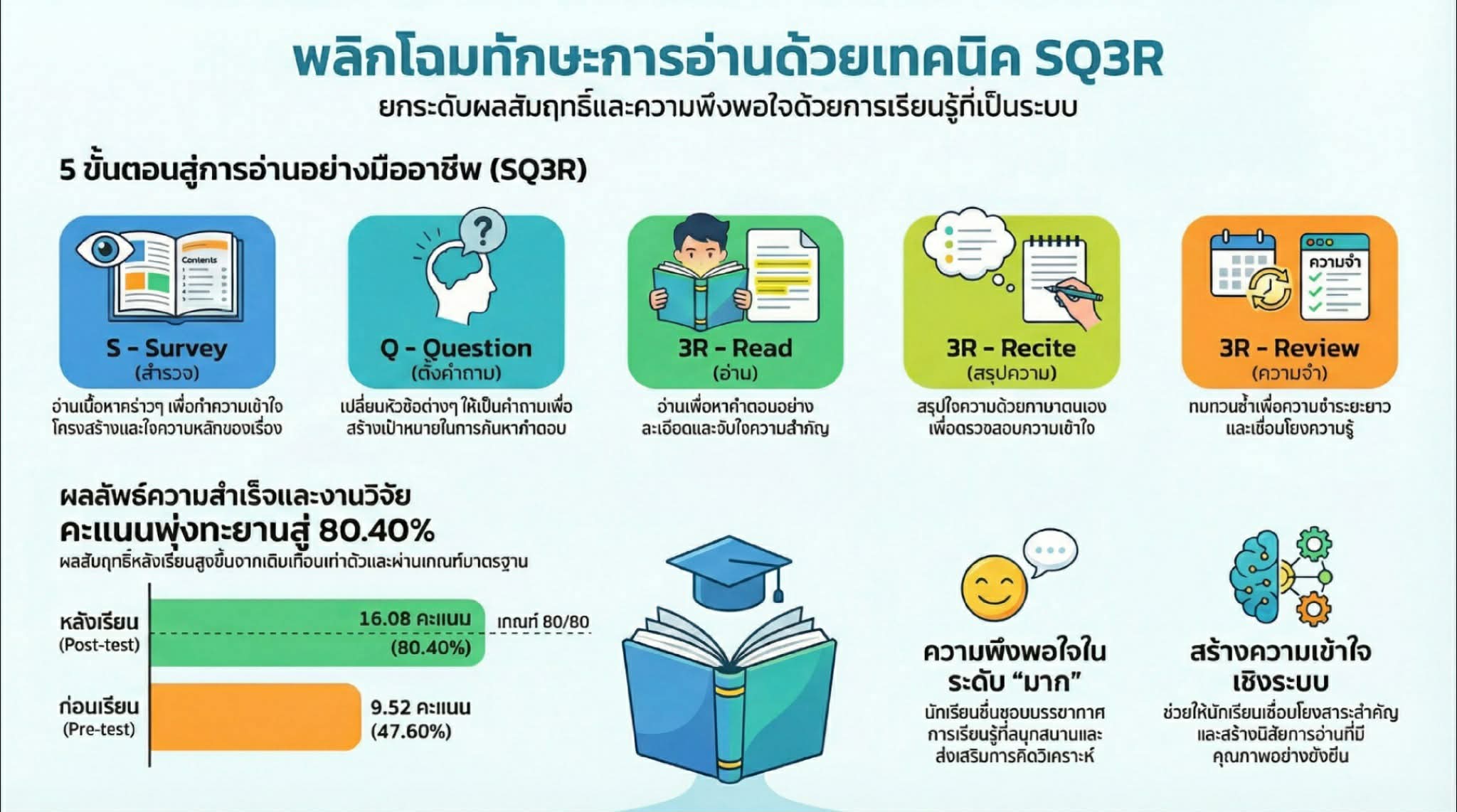
The Development of Reading Skills of Grade 7 Students through SQ3R Learning Method The objectives of this research were: (1) to develop the reading skills of Grade 7 students before and after learning through the SQ3R learning method, (2) to compare the effectiveness of the instructional plan for developing reading skills of Grade 7 students before and after learning through the SQ3R method based on the 80/80 criterion, and (3) to study the students’ satisfaction with the SQ3R learning method. The sample consisted of 25 Grade 7 students from Class 1/1, Semester 1, Academic Year 2025, at Nanang Phatthanasueksa School, Nong Khai Province, selected by simple random sampling. The research instruments were: (1) instructional plans for developing reading skills using the SQ3R method, (2) a satisfaction questionnaire, and (3) a reading skill test. The statistics used for data analysis were mean, standard deviation, and percentage.
The findings revealed that: (1) the students’ reading skills after learning through the SQ3R method exceeded the criterion with an average of 80.40 percent, higher than the 80 percent benchmark, (2) the effectiveness of the instructional plan for developing reading skills using the SQ3R method met the 80/80 criterion, with the index of item-objective congruence (IOC) equal to 1.00, and (3) the students’ satisfaction with the SQ3R learning method was at a high level.
References
ณัฐวรรณ พลเจริญ, และ ศุภฤกษ์ ทานาค. (2562). การพัฒนาทักษะการอ่านวรรณคดีไทยโดยใช้เทคนิค SQ3R ในรายวิชาภาษาไทยพื้นฐาน ของนักเรียนระดับชั้นมัธยมศึกษาปีที่ 5. วารสารศึกษาศาสตร์, 21(3), 77–88.
ปนัดดา หงส์ทอง. (2563). การเปรียบเทียบความสามารถในการอ่านจับใจความของนักเรียนชั้นมัธยมศึกษาปีที่ 3 ระหว่างวิธีสอนแบบ SQ3R กับวิธีสอนแบบปกติ. วารสารวิชาการ คณะศึกษาศาสตร์ มหาวิทยาลัยรามคำแหง, 4(1), 77–88.
ภัทรวดี มาประสพ. (2562). ผลการจัดการเรียนรู้แบบ SQ3R ที่มีต่อความสามารถในการอ่านภาษาอังกฤษเพื่อความเข้าใจของนักเรียนชั้นมัธยมศึกษาปีที่ 2 โรงเรียนในสังกัดสำนักงานเขตประเวศ กรุงเทพมหานคร. การศึกษาค้นคว้าอิสระ ศึกษาศาสตรมหาบัณฑิต, มหาวิทยาลัยสุโขทัยธรรมาธิราช.
Bloom, B. S. (1956). Taxonomy of educational objectives: The classification of educational goals. Handbook I: Cognitive domain. David McKay.
Goodman, K. (1986). What’s whole in whole language. Heinemann.
Kolb, D. (1984). Experiential learning: Experience as the source of learning and development. Prentice Hall.
Piaget, J. (1972). Intellectual evolution from adolescence to adulthood. Human Development, 15(1), 1–12. https://doi.org/10.1159/000271225
Robinson, F. P. (1970). Effective study (4th ed.). Harper & Row.
Vygotsky, L. S. (1978). Mind in society: The development of higher psychological processes. Harvard University Press.
Downloads
Published
Issue
Section
License
Copyright (c) 2026 Journal of Sinsothon

This work is licensed under a Creative Commons Attribution-NonCommercial-NoDerivatives 4.0 International License.
Authors who publish with Journal of TCI agree to the following terms:
- Authors retain copyright and grant the journal right of first publication with the work simultaneously licensed under a Attribution-NonCommercial-NoDerivatives 4.0 International (CC BY-NC-ND 4.0) that allows others to share the work with an acknowledgment of the work's authorship and initial publication in this journal.
- Authors are able to enter into separate, additional contractual arrangements for the non-exclusive distribution of the journal's published version of the work (e.g., post it to an institutional repository or publish it in a book), with an acknowledgment of its initial publication in this journal.
- Authors are permitted and encouraged to post their work online (e.g., in institutional repositories or on their website) prior to and during the submission process, as it can lead to productive exchanges, as well as earlier and greater citation of published work.




