Aphisit Kanphakdi
Keywords:
media ethics, journalistic standards, digital mediaAbstract
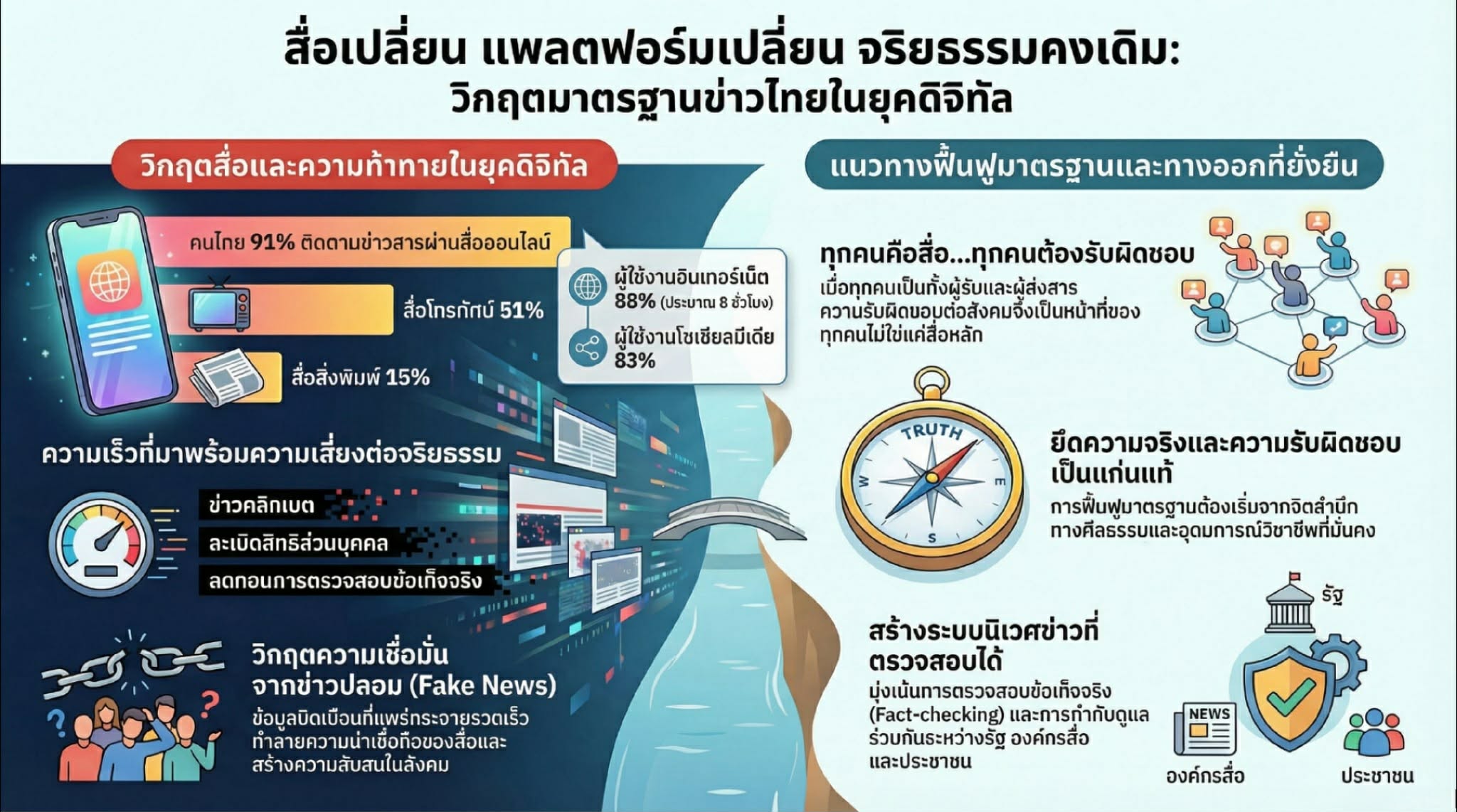
This academic article analyzes the transformation of mass media in the digital age, resulting in rapid changes to the structure, production, and consumption of news. The shift from traditional media to online platforms and social media allows everyone to be both a recipient and a sender of information simultaneously. However, this transition has presented challenges to media ethics and journalistic standards, particularly regarding misinformation, clickbait, the rush to present information, and the weakening of fact-checking processes. Analyzing the crisis of news standards in the Thai social context, under the pressure of digital platforms and evolving consumer demands, the findings indicate that despite changes in media formats and platforms, media ethics remain crucial for maintaining media credibility. Therefore, adaptation by news organizations, journalists, and media consumers should focus on balancing the speed of information delivery with accuracy, accountability, and ethics, in order to support a high-quality and sustainable media ecosystem in Thai society.
References
จักรกริช คำสม. (2568). การพัฒนาสื่อดิจิทัลเพื่อการเรียนรู้และการสื่อสารบนแพลตฟอร์มออนไลน์. วารสารวิชาการการประยุกต์ใช้เทคโนโลยีสารสนเทศ, 11(1), 74-86.
ดร. เผด็จ จงสกุลศิริ. (2568). จริยธรรมในการใช้เทคโนโลยีดิจิทัล: ความท้าทายและแนวทางในการสร้างสังคมดิจิทัลที่ยั่งยืน. วารสารพุทธพัฒนศาสตร์ศึกษา (Online), 31(7), 1-22.
ทองพูล มุขรักษ์, บำรุง ศรีนวลปาน, ชวัลรัตน์ ศรีนวลปาน, และ กรกฎ จำเนียร. (2566). จริยธรรมและจรรยาบรรณของสื่อในสังคมไทยในการนำเสนอข่าวยุคดิจิทัล กรณีศึกษา การกราดยิงหนองบัวลำภู, คดีน้องชมพู่และคดีแตงโม ความท้าทายที่ยังมีปัญหา. วารสารวิชาการบัณฑิตศึกษามหาวิทยาลัยราชภัฏนครศรีธรรมราช, 1(1), 54-67.
ธนกฤตา ปริณดาโชติเดชา, และ ชัชชาญ ปริณดาโชติเดชา.(2566). นวัตกรรมข่าวในยุคดิจิทัล. วารสารมหาวิทยาลัยราชภัฏลำปาง, 12(1), 85-97.
พรรษา รอดอาตม์. (2566). มาตรฐานจริยธรรมที่ควรปฏิบัติสำหรับผู้ที่ต้องการเป็น นักสื่อสารผ่านสื่อสังคมออนไลน์ตามบรรทัดฐานของสังคม. วารสารกองทุนพัฒนาสื่อปลอดภัยและสร้างสรรค์, 2(3), 22-49.
พระครูวิรุฬห์ปัญญาสาร,และพระมหาอานันต์ เจริญศิริพัชร.(2568).นักการเมืองกับการสื่อสารในยุคดิจิทัล ผลกระทบต่อความน่าเชื่อถือและความไว้วางใจของประชาชน. วารสารสิทธิ์ทรรศน์, 3(2), 84-95.
พระคำพล แก้วพิลา, และ กิตติพงศ์ สุวรรณวงศ์. (2568). การวิเคราะห์ปัญหาและแนวทางฟื้นฟูวงการพระพุทธศาสนาไทยตามหลักพุทธธรรมร่วมสมัย.วารสารส่งเสริมและพัฒนาวิชาการสมัยใหม่, 3(6), 1162-1172.
มยุเรศ ตนะวัฒนา. (2568). การศึกษาอุดมการณ์การสื่อข่าวและรายงานข่าวในยุคดิจิทัล. วารสารวิชาการมหาวิทยาลัยราชภัฏภูเก็ต, 21(1), 173-194.
เรียงดาว ทวะชาลี, และ ภูษิต ปุลันรัมย์. (2567). บทบาทของสื่อโซเชียลมีเดียในการสร้างและเปลี่ยนแปลงความคิดเห็นสาธาณะ. วารสารกว๊านพะเยา, 1(6), 28-38.
วริศรา กลมทุกสิ่ง, และ ชวินท์ ธัมมนันท์กุล. (2565). แพลตฟอร์มธุรกิจออนไลน์: อาชีพเกิดใหม่ในยุคดิจิทัล. Journal of Roi Kaensarn Academi, 7(2), 379-387.
Chuenkerdlarp, C., Treesarn, K., และ Pholmat, P. (2567). จริยธรรมการสื่อสารในการนำเสนอสื่อเพื่อการแสดงในยุคดิจิทัล. Journal of Local Management and Development Pibulsongkram Rajabhat University, 4(2), 46-53.
Karuchit, W. (2567). มาตรฐานจริยธรรมในการใช้สื่อออนไลน์ สำหรับหน่วยงานภาครัฐ. Journal of Communication Arts, 42(2), 18-31.
Phoovatis, W. (2565). -สื่อมวลชนไทย:จิตสำนึกเชิงจริยธรรมในการสื่อข่าวยุคหลอมรวมสื่อ. KASEM BUNDIT JOURNAL, 23(1), 28-42.
Roopsuwankun, P. (2567). ความตระหนักถึงจริยธรรมและศีลธรรมในการเป็นผู้สื่อข่าวที่มีความเชี่ยวชาญเฉพาะด้านและมีความน่าเชื่อถือของผู้สื่อข่าวอิเล็กทรอนิกส์. Journal of Digital Communications, 8(1), 87-115.
Sakaew, P. (2567). ปัญหาทางกฎหมายเกี่ยวกับการนำเสนอข่าวอาชญากรรมของสื่อมวลชนที่เป็นการละเมิดสิทธิมนุษยชนในกระบวนการยุติธรรม. Journal of Social Science for Local Development Rajabhat Maha Sarakham University, 8(4), 223-233.
Downloads
Published
Issue
Section
License
Copyright (c) 2026 Journal of Sinsothon

This work is licensed under a Creative Commons Attribution-NonCommercial-NoDerivatives 4.0 International License.
Authors who publish with Journal of TCI agree to the following terms:
- Authors retain copyright and grant the journal right of first publication with the work simultaneously licensed under a Attribution-NonCommercial-NoDerivatives 4.0 International (CC BY-NC-ND 4.0) that allows others to share the work with an acknowledgment of the work's authorship and initial publication in this journal.
- Authors are able to enter into separate, additional contractual arrangements for the non-exclusive distribution of the journal's published version of the work (e.g., post it to an institutional repository or publish it in a book), with an acknowledgment of its initial publication in this journal.
- Authors are permitted and encouraged to post their work online (e.g., in institutional repositories or on their website) prior to and during the submission process, as it can lead to productive exchanges, as well as earlier and greater citation of published work.




