ปัจจัยที่ส่งผลต่อความสำเร็จของการส่งออกข้าวในเวียดนาม
คำสำคัญ:
ความสำเร็จ, การส่งออกข้าว, เวียดนามบทคัดย่อ
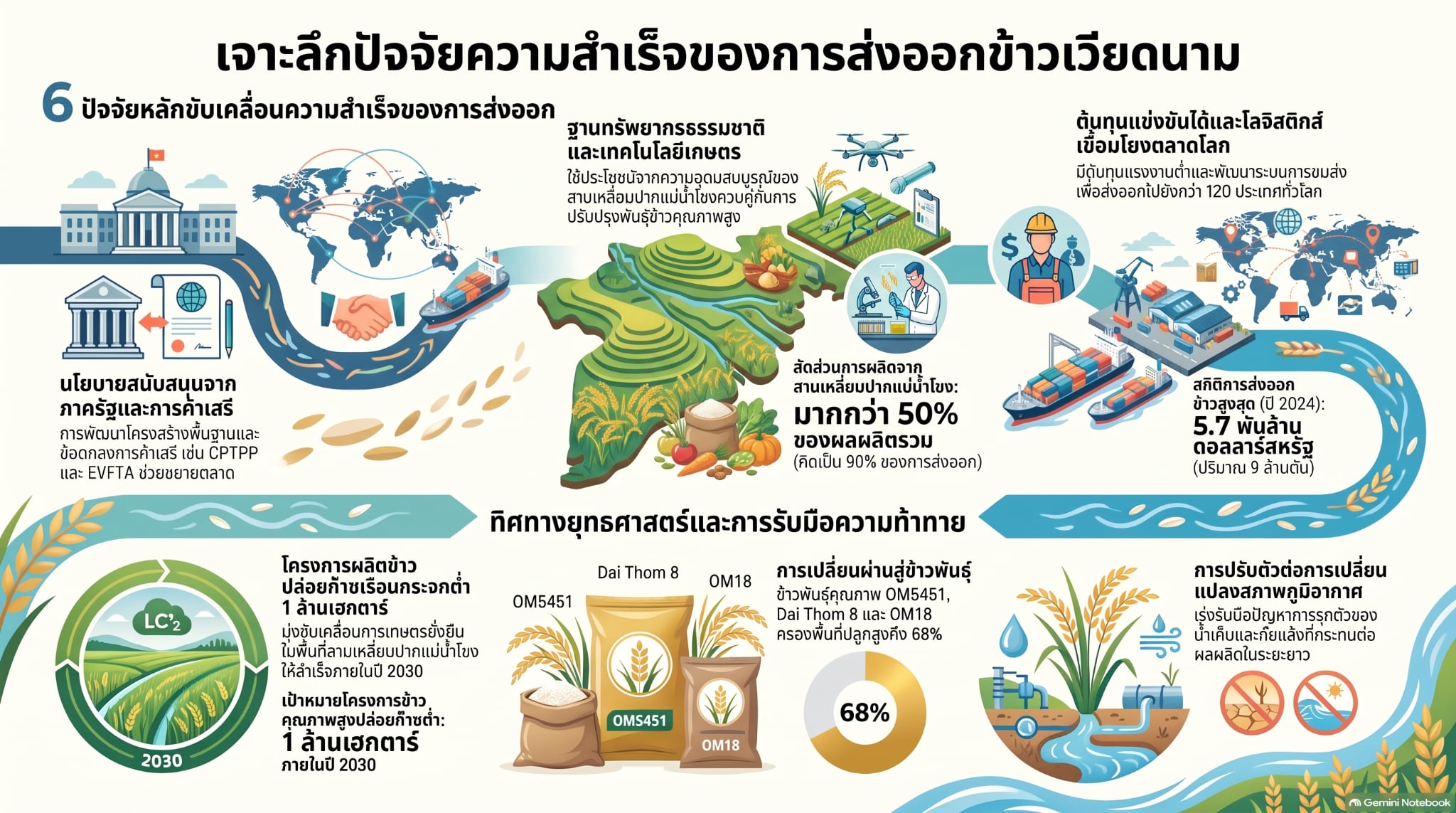
บทความวิชาการนี้มีวัตถุประสงค์เพื่อศึกษาปัจจัยที่ส่งผลต่อความสำเร็จของการส่งออกข้าวในเวียดนาม โดยใช้การวิเคราะห์ข้อมูลจากเอกสารวิชาการ งานวิจัย และรายงานด้านเศรษฐกิจการเกษตร พบว่า ความสำเร็จของการส่งออกข้าวของเวียดนามเกิดจากหลายปัจจัยสำคัญ ได้แก่ การสนับสนุนจากภาครัฐ การพัฒนาเทคโนโลยีการเกษตร ความอุดมสมบูรณ์ของพื้นที่สามเหลี่ยมปากแม่น้ำโขง ต้นทุนการผลิตที่แข่งขันได้ การพัฒนาระบบโลจิสติกส์ และการขยายตลาดการค้าระหว่างประเทศ นอกจากนี้ เวียดนามยังสามารถปรับตัวต่อความเปลี่ยนแปลงของตลาดโลกผ่านนโยบายพัฒนาเกษตรสมัยใหม่และข้อตกลงการค้าเสรี ส่งผลให้เวียดนามกลายเป็นหนึ่งในประเทศผู้ส่งออกข้าวรายสำคัญของโลก อย่างไรก็ตามยังมีปัญหาเกี่ยวกับการเปลี่ยนแปลงสภาพภูมิอากาศ คุณภาพสินค้า และการแข่งขันในตลาดโลกที่ต้องได้รับการพัฒนาอย่างต่อเนื่อง
เอกสารอ้างอิง
กระทรวงพาณิชย์. (2557). การพัฒนาภาคการผลิตข้าวในประเทศเวียดนาม. กรมส่งเสริมการค้าระหว่างประเทศ.
CGIAR System. (2023). Vietnam launches the One million hectares program specializing in high-quality low-emission rice production.
International Rice Research Institute. (2026). Mekong Delta's low-emission rice program surpasses targets, sets new standards for sustainable production.
U.S. Department of Agriculture, Foreign Agricultural Service. (2025). Grain and feed annual: Vietnam (Report No. VM2025-0015).
Viet Nam News. (2025). Cooperatives lead the way in Mekong Delta's humongous sustainable rice project.
Vietnam News Agency. (2025). Vietnam overtakes Thailand to become world's second-largest rice exporter. VietnamPlus.
Vietnam News Agency. (2026). Vietnam exports over 8 million tonnes of rice, earning 4.1 billion USD in 2025. VietnamPlus.
A model of factors affecting export performance of rice and coffee exporters in Vietnam. (2020). Uncertain publication source.
An analysis of factors influencing rice export in Vietnam based on gravity model. (2017). International Journal of Economics and Financial Issues.
Analysis of factors affecting Vietnam's rice export rate. (2023). Journal of Asian Trade and Economic Studies.
Bui, T. H. H., & Chen, Q. (2017). An analysis of factors influencing rice export in Vietnam based on gravity model. Journal of the Knowledge Economy, 8(3), 830–844.
Factors affecting rice export decisions: A case study of Vietnam. (2025). Asian Journal of Agricultural Economics
Food and Agriculture Organization of the United Nations. (2025). The development of a low-emission and high-quality rice sector in the Mekong River Delta. FAO Vietnam
Food and Agriculture Organization of the United Nations. (2026). FAO GIEWS country brief: Viet Nam. FAO GIEWS – Viet Nam
Market structure of rice export in Vietnam from 2010 to 2020. (2022). Vietnam Trade and Industry Review.
Opportunities and challenges for rice export. (2024). Vietnam Trade Promotion Agency.
Vietnamese farmers earn record $5.7 billion from rice exports. (2025). Vietnam Economic News.
Vietnam’s rice exports: Opportunities and challenges. (2021). Vietnam Institute of Industry and Trade Information.
OpenAI. (2026). ChatGPT (ความสำเร็จของการส่งออกข้าวเวียดนาม]. https://chatgpt.com/c/ 6aba774b-0aa4-83ec-a807-169a8325835e
ดาวน์โหลด
เผยแพร่แล้ว
ฉบับ
ประเภทบทความ
สัญญาอนุญาต
ลิขสิทธิ์ (c) 2026 วารสารสินธุ์โสธร

อนุญาตภายใต้เงื่อนไข Creative Commons Attribution-NonCommercial-NoDerivatives 4.0 International License.
Authors who publish with Journal of TCI agree to the following terms:
- Authors retain copyright and grant the journal right of first publication with the work simultaneously licensed under a Attribution-NonCommercial-NoDerivatives 4.0 International (CC BY-NC-ND 4.0) that allows others to share the work with an acknowledgment of the work's authorship and initial publication in this journal.
- Authors are able to enter into separate, additional contractual arrangements for the non-exclusive distribution of the journal's published version of the work (e.g., post it to an institutional repository or publish it in a book), with an acknowledgment of its initial publication in this journal.
- Authors are permitted and encouraged to post their work online (e.g., in institutional repositories or on their website) prior to and during the submission process, as it can lead to productive exchanges, as well as earlier and greater citation of published work.




