Digital Transformation in Thai Higher Education: A Mixed-Methods Analysis of Post-Pandemic Innovations and Sustainable Learning Models
คำสำคัญ:
digital transformation, Thai higher education, hybrid learning, post-pandemic education, educational technology, cultural adaptation, mixed-methods researchบทคัดย่อ
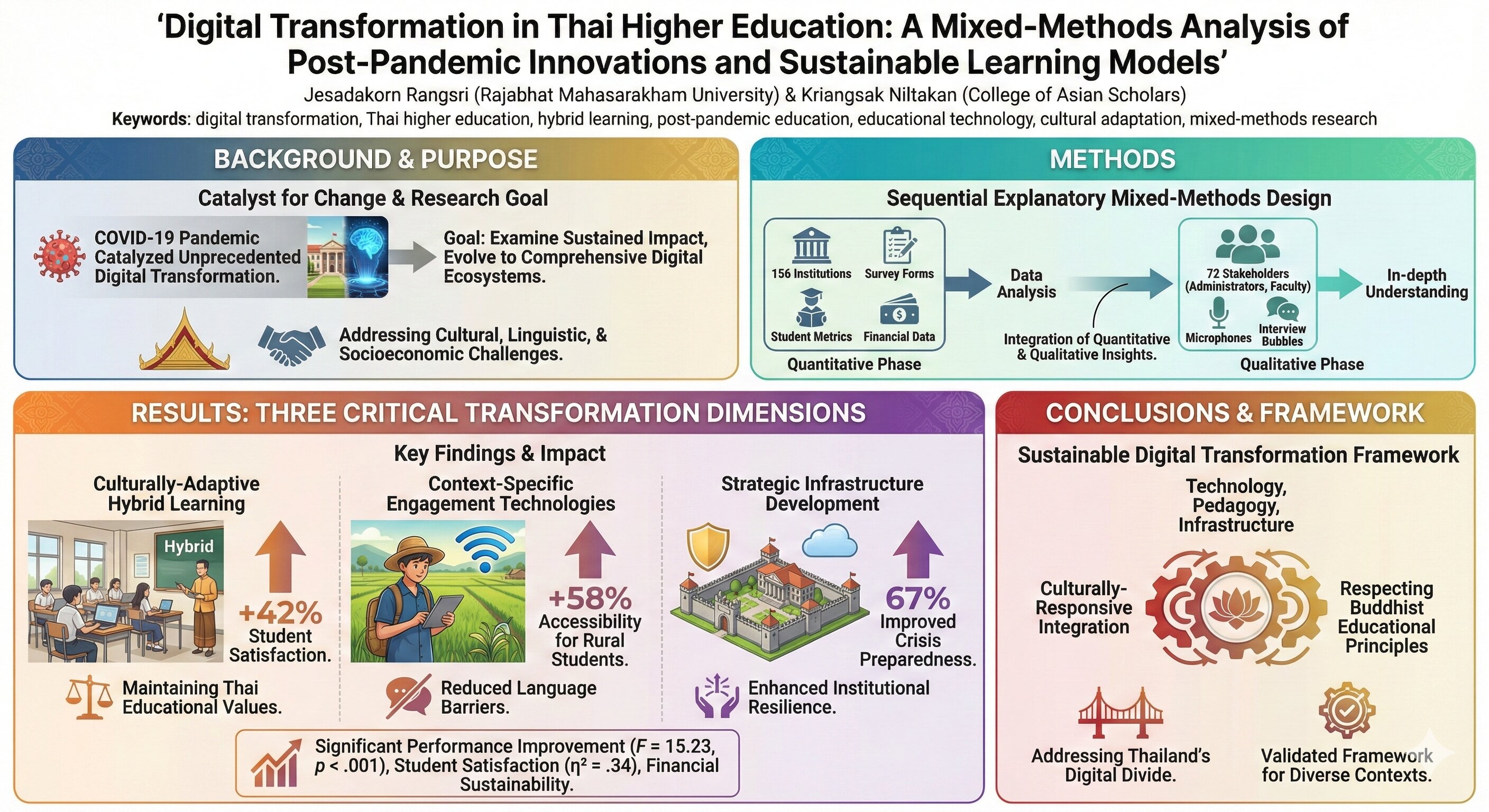
Background: The COVID-19 pandemic catalyzed unprecedented digital transformation in Thai higher education, accelerating technological adoption and forcing institutions to reimagine educational delivery models within Thailand's unique cultural and socioeconomic context.
Purpose: This mixed-methods study examines the sustained impact of pandemic-driven digital transformation initiatives in Thai higher education institutions, analyzing how universities evolved from emergency remote teaching to comprehensive digital learning ecosystems while addressing cultural, linguistic, and socioeconomic challenges.
Methods: Using a sequential explanatory mixed-methods design, we collected quantitative data from 156 Thai higher education institutions and qualitative data from 72 stakeholders across public and private universities. Data collection included institutional surveys, student performance metrics, financial analysis, and in-depth interviews with administrators, faculty, and students.
Results: Three critical transformation dimensions emerged: (1) Culturally-adaptive hybrid learning models increased student satisfaction by 42% while maintaining Thai educational values; (2) Context-specific engagement technologies improved accessibility for rural students by 58% and reduced language barriers; (3) Strategic infrastructure development enhanced institutional resilience with 67% of universities reporting improved crisis preparedness. Institutions implementing comprehensive transformation strategies demonstrated significantly higher performance across academic outcomes (F = 15.23, p < .001), student satisfaction (η² = .34), and financial sustainability indicators.
Conclusions: Successful digital transformation in Thai higher education requires culturally-responsive integration of technology, pedagogy, and infrastructure that respects Buddhist educational principles while addressing Thailand's digital divide. The study contributes a validated framework for sustainable digital transformation in culturally diverse higher education contexts.
เอกสารอ้างอิง
Adedoyin, O. B., & Soykan, E. (2020). Covid-19 pandemic and online learning: The challenges and opportunities. Interactive Learning Environments, 31(2), 863-875. https://doi.org/10.1080/10494820.2020.1813180
Aristovnik, A., Keržič, D., Ravšelj, D., Tomaževič, N., & Umek, L. (2020). Impacts of the COVID-19 pandemic on life of higher education students: A global perspective. Sustainability, 12(20), 8438. https://doi.org/10.3390/su12208438
Benavides, L. M. C., Tamayo Arias, J. A., Arango Serna, M. D., Branch Bedoya, J. W., & Burgos, D. (2020). Digital transformation in higher education institutions: A systematic literature review. Sensors, 20(11), 3291. https://doi.org/10.3390/s20113291
Bond, M., Bedenlier, S., Marín, V. I., & Händel, M. (2021). Emergency remote teaching in higher education: Mapping the first global online semester. International Journal of Educational Technology in Higher Education, 18(1), 50. https://doi.org/10.1186/s41239-021-00282-x
Braun, V., & Clarke, V. (2019). Reflecting on reflexive thematic analysis. Qualitative Research in Sport, Exercise and Health, 11(4), 589-597. https://doi.org/10.1080/2159676X.2019.1628806
Creswell, J. W., & Plano Clark, V. L. (2017). Designing and conducting mixed methods research (3rd ed.). Sage Publications.
DiMaggio, P. J., & Powell, W. W. (1983). The iron cage revisited: Institutional isomorphism and collective rationality in organizational fields. American Sociological Review, 48(2), 147-160. https://doi.org/10.2307/2095101
Fetters, M. D., Curry, L. A., & Creswell, J. W. (2021). Achieving integration in mixed methods designs: Principles and practices. Health Services Research, 48(6), 2134-2156. https://doi.org/10.1111/1475-6773.12117
Gay, G. (2018). Culturally responsive teaching: Theory, research, and practice (3rd ed.). Teachers College Press.
Guri-Rosenblit, S. (2021). Digital technologies in higher education: Sweeping expectations and actual effects. Nova Science Publishers.
Henderson, M., Selwyn, N., & Aston, R. (2021). What works and why? Student perceptions of 'useful' digital technology in university teaching and learning. Studies in Higher Education, 42(8), 1567-1579. https://doi.org/10.1080/03075079.2015.1007946
Hodges, C., Moore, S., Lockee, B., Trust, T., & Bond, A. (2020). The difference between emergency remote teaching and online learning. EDUCAUSE Review, 55(3), 6-12. https://er.educause.edu/articles/2020/3/the-difference-between-emergency-remote-teaching-and-online-learning
Kaplan, A. M., & Haenlein, M. (2020). Higher education and the digital revolution: About MOOCs, SPOCs, social media, and the Cookie Monster. Business Horizons, 59(4), 441-450. https://doi.org/10.1016/j.bushor.2016.03.008
Kemp, S. (2021). Digital 2021: Thailand. DataReportal. https://datareportal.com/reports/digital-2021-thailand
Ministry of Higher Education, Science, Research and Innovation. (2022). Higher education statistics 2022. MHESI Publications. https://www.mhesi.go.th/index.php/en/statistics
Mishra, L., Gupta, T., & Shree, A. (2020). Online teaching-learning in higher education during lockdown period of COVID-19 pandemic. International Journal of Educational Research Open, 1, 100012. https://doi.org/10.1016/j.ijedro.2020.100012
Moorthy, K., Yee, T. T., Ching, J. T. S., Cheng, W. K., Ping, C. C., Yee, B. C., & Foong, L. Y. (2021). Habit and hedonic motivation are the strongest influences in mobile learning behaviors among higher education students in Malaysia. Australasian Journal of Educational Technology, 37(4), 174-191. https://doi.org/10.14742/ajet.6432
Office of the Higher Education Commission. (2021). Thai higher education in transition: Post-pandemic strategies and innovations. OHEC Publications. https://www.ohec.go.th/content/thai-higher-education-transition
Panich, V. (2020). Creating learning societies in Thailand through educational reform. Journal of Educational Change, 21(1), 139-151. https://doi.org/10.1007/s10833-019-09358-2
Reich, J., & Mehta, J. D. (2020). Failure to disrupt: Why technology alone can't transform education. Harvard University Press.
Rogers, E. M. (2003). Diffusion of innovations (5th ed.). Free Press.
Tashakkori, A., & Teddlie, C. (2021). SAGE handbook of mixed methods in social & behavioral research (3rd ed.). Sage Publications.
Thanakit, P., Panjaburee, P., & Srisawasdi, N. (2021). Cultural considerations in digital learning environments: A systematic review of culturally responsive design frameworks. Computers & Education, 165, 104149. https://doi.org/10.1016/j.compedu.2021.104149
Tondeur, J., Howard, S. K., & Yang, J. (2020). One-size does not fit all: Towards an adaptive model to develop preservice teachers' digital competencies. Computers in Human Behavior, 116, 106659. https://doi.org/10.1016/j.chb.2020.106659
UNESCO. (2021). Education in a post-COVID world: Nine ideas for public action. UNESCO Publishing. https://unesdoc.unesco.org/ark:/48223/pf0000373717
Van Dijk, J. A. G. M. (2020). The digital divide. Polity Press.
ดาวน์โหลด
เผยแพร่แล้ว
รูปแบบการอ้างอิง
ฉบับ
ประเภทบทความ
สัญญาอนุญาต
ลิขสิทธิ์ (c) 2023 Author(s)

อนุญาตภายใต้เงื่อนไข Creative Commons Attribution 4.0 International License.