Developing a Cultural Learning Management Model on Ban Chiang World Heritage Site to Promote Local Pride among High School Students in Udon Thani Municipality: A Mixed-Methods Study
Keywords:
Ban Chiang, cultural heritage education, learning management model, local pride, mixed-methods research, Udon Thani, place-based educationAbstract
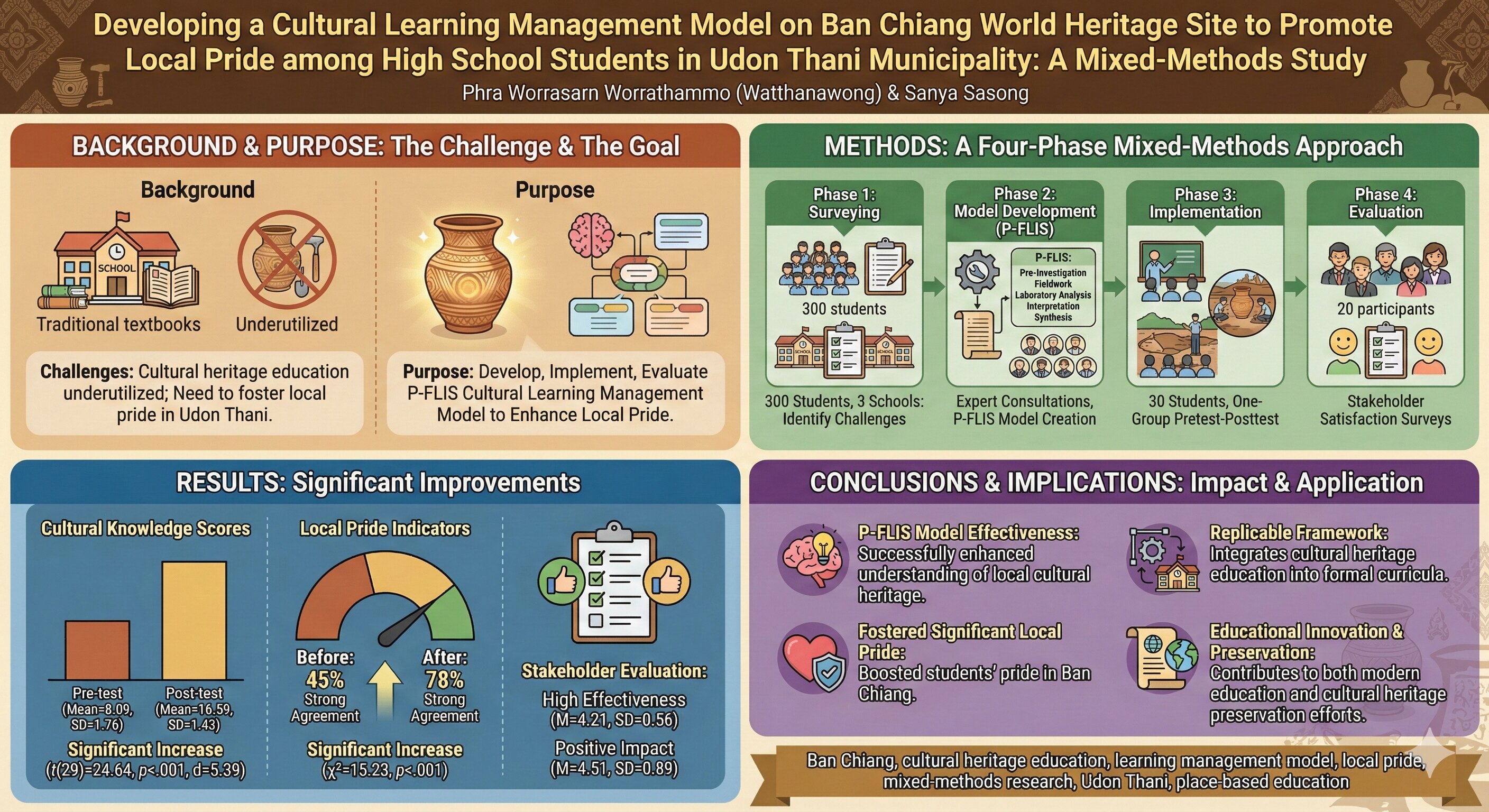
Background: Cultural heritage education plays a crucial role in fostering local identity and community pride, particularly in regions with significant archaeological sites. The Ban Chiang World Heritage Site in Udon Thani Province, Thailand, represents a valuable educational resource that remains underutilized in formal education settings.
Purpose: This study aimed to develop, implement, and evaluate a cultural learning management model centered on the Ban Chiang World Heritage Site to enhance local pride among high school students in Udon Thani Municipality, Thailand.
Methods: A four-phase mixed-methods research design was employed. Phase 1 involved surveying 300 students from three municipal schools to identify current challenges in cultural heritage education. Phase 2 focused on developing the P-FLIS (Pre-Investigation, Fieldwork, Laboratory Analysis, Interpretation, and Synthesis) learning model through expert consultations with seven specialists. Phase 3 tested the model using a one-group pretest-posttest design with 30 Grade 10 students. Phase 4 evaluated stakeholder satisfaction through surveys of 20 participants including administrators, teachers, and parents.
Results: Statistical analysis revealed significant improvements in students' cultural knowledge scores from pretest (M = 8.09, SD = 1.76) to posttest (M = 16.59, SD = 1.43), t(29) = 24.64, p < .001, d = 5.39. Local pride indicators increased significantly, with 78% of students expressing strong agreement with heritage pride statements compared to 45% before intervention (χ² = 15.23, p < .001). Stakeholder evaluation showed high effectiveness ratings (M = 4.21, SD = 0.56) and positive impact on school learning (M = 4.51, SD = 0.89).
Conclusions: The P-FLIS model effectively enhanced students' understanding of local cultural heritage and fostered significant improvements in local pride. The model provides a replicable framework for integrating cultural heritage education into formal curricula, contributing to both educational innovation and cultural preservation efforts.
References
Anderson, L. W., & Krathwohl, D. R. (2001). A taxonomy for learning, teaching, and assessing: A revision of Bloom's taxonomy of educational objectives. Longman.
Apaydin, V. (2020). Critical perspectives on cultural memory and heritage: Construction, transformation and destruction. UCL Press.
Apple, M. W. (2019). Ideology and curriculum (4th ed.). Routledge.
Battiste, M. (2013). Decolonizing education: Nourishing the learning spirit. UBC Press.
Black, P., & Wiliam, D. (1998). Assessment and classroom learning. Assessment in Education, 5(1), 7-74.
Bloom, B. S. (1956). Taxonomy of educational objectives: The classification of educational goals. Longmans.
Braun, V., & Clarke, V. (2006). Using thematic analysis in psychology. Qualitative Research in Psychology, 3(2), 77-101.
Brown, S., & Isaac, J. (2021). Heritage education and community engagement in Europe. International Journal of Heritage Studies, 27(8), 745-762.
Chairat, S., & Chaisawat, M. (2020). Cultural heritage tourism development in Thailand: A case study approach. Journal of Heritage Tourism, 15(6), 612-628.
Champion, E. (2021). Virtual heritage: A guide. Ubiquity Press.
Chilisa, B. (2012). Indigenous research methodologies. SAGE Publications.
Cook, T. D., & Campbell, D. T. (1979). Quasi-experimentation: Design and analysis issues for field settings. Houghton Mifflin.
Creswell, J. W., & Plano Clark, V. L. (2017). Designing and conducting mixed methods research (3rd ed.). SAGE Publications.
Darling-Hammond, L., Hyler, M. E., & Gardner, M. (2020). Effective teacher professional development. Learning Policy Institute.
Davies, M., & Larson, K. (2020). Digital heritage and education: New approaches to cultural learning. Heritage, 3(2), 145-162.
DeVellis, R. F. (2016). Scale development: Theory and applications (4th ed.). SAGE Publications.
Freire, P. (2018). Pedagogy of the oppressed (50th anniversary ed.). Bloomsbury Academic.
Gardner, H. (2011). Frames of mind: The theory of multiple intelligences (3rd ed.). Basic Books.
Gay, G. (2018). Culturally responsive teaching: Theory, research, and practice (3rd ed.). Teachers College Press.
Giroux, H. A. (2020). On critical pedagogy (2nd ed.). Bloomsbury Academic.
Hallinger, P., & Lee, M. (2021). Mapping the landscape of educational leadership and management research in Thailand. Educational Management Administration & Leadership, 49(3), 377-404.
Harrison, R. (2020). Heritage: Critical approaches. Routledge.
Hart, D. (1994). Authentic assessment: A handbook for educators. Addison-Wesley.
hooks, b. (2020). Teaching to transgress: Education as the practice of freedom (25th anniversary ed.). Routledge.
Johnson, D. W., & Johnson, R. T. (2014). Learning together and alone: Cooperative, competitive, and individualistic learning (5th ed.). Allyn & Bacon.
Kolb, D. A. (1984). Experiential learning: Experience as the source of learning and development. Prentice Hall.
Ladson-Billings, G. (2020). Culturally relevant pedagogy: Asking a different question. Teachers College Press.
Lertcharnrit, T., & Niyomsap, N. (2020). Heritage management, education, and community involvement in Thailand: A central Thai community case. Journal of Community Archaeology & Heritage, 7(2), 120-138.
McCarty, T. L., & Lee, T. S. (2014). Critical culturally sustaining/revitalizing pedagogies and indigenous education sovereignty. Harvard Educational Review, 84(1), 101-124.
McLaren, P. (2020). Critical pedagogy: A look at the major concepts. In A. Darder, M. P. Baltodano, & R. D. Torres (Eds.), The critical pedagogy reader (3rd ed., pp. 56-78). Routledge.
Mertens, D. M. (2020). Research and evaluation in education and psychology (5th ed.). SAGE Publications.
Ministry of Education Thailand. (2008). Basic education core curriculum 2008. Office of the Basic Education Commission.
Mortara, M., Catalano, C. E., Bellotti, F., Fiucci, G., Houry-Panchetti, M., & Petridis, P. (2022). Learning cultural heritage by serious games. Journal of Cultural Heritage, 15(3), 318-325.
Moss, P. A. (2003). Reconceptualizing validity for classroom assessment. Educational Measurement: Issues and Practice, 22(4), 13-25.
Mueller, J. (2005). The authentic assessment primer. North Central College.
National Research Council of Thailand. (2019). Research ethics guidelines for human subjects research. NRCT Publications.
Netemeyer, R. G., Bearden, W. O., & Sharma, S. (2003). Scaling procedures: Issues and applications. SAGE Publications.
Nitko, A. J., & Brookhart, S. M. (2019). Educational assessment of students (8th ed.). Pearson.
OECD-UNESCO. (2021). Education in Thailand: An OECD-UNESCO perspective. OECD Publishing.
Paris, D., & Alim, H. S. (2017). Culturally sustaining pedagogies: Teaching and learning for justice in a changing world. Teachers College Press.
Phinney, J. S., & Ong, A. D. (2007). Conceptualization and measurement of ethnic identity: Current status and future directions. Journal of Counseling Psychology, 54(3), 271-281.
Pongsakornrungsilp, S., Pongsakornrungsilp, P., & Kumar, V. (2021). Heritage tourism in Thailand: A stakeholder perspective on sustainable heritage management. Journal of Heritage Tourism, 16(5), 539-555.
Powers, A. L. (2004). An evaluation of four place-based education programs. Journal of Environmental Education, 35(4), 17-32.
Pratomlek, O. (2020). Community-based tourism in Thailand: Impact and recovery from COVID-19. Journal of Tourism and Heritage Research, 3(2), 45-62.
Prensky, M. (2001). Digital natives, digital immigrants. On the Horizon, 9(5), 1-6.
Rispoli, F. (2007). The neolithic of the south China sea. Archaeopress.
Ritchie, J., & Spencer, L. (1994). Qualitative data analysis for applied policy research. In A. Bryman & R. G. Burgess (Eds.), Analyzing qualitative data (pp. 173-194). Routledge.
Rivas-Drake, D., Seaton, E. K., Markstrom, C., Quintana, S., Syed, M., Lee, R. M., Schwartz, S. J., Umaña-Taylor, A. J., French, S., & Yip, T. (2014). Ethnic and racial identity in adolescence: Implications for psychosocial, academic, and health outcomes. Child Development, 85(1), 40-57.
Rogoff, B. (2003). The cultural nature of human development. Oxford University Press.
Schön, D. A. (1983). The reflective practitioner: How professionals think in action. Basic Books.
Schwartz, S. J., Zamboanga, B. L., Luyckx, K., Meca, A., & Ritchie, R. A. (2013). Identity in emerging adulthood: Reviewing the field and looking forward. Emerging Adulthood, 1(2), 96-113.
Shadish, W. R., Cook, T. D., & Campbell, D. T. (2002). Experimental and quasi-experimental designs for generalized causal inference. Houghton Mifflin.
Shepard, L. A. (2000). The role of assessment in a learning culture. Educational Researcher, 29(7), 4-14.
Simon, M., & Forgette-Giroux, R. (2001). A rubric for scoring postsecondary academic skills. Practical Assessment, Research, and Evaluation, 7(18), 1-7.
Siripornphaiboon, T. (2020). Archaeological awareness and cultural identity among Thai youth. Southeast Asian Studies, 8(3), 423-441.
Slavin, R. E. (2011). Educational psychology: Theory and practice (10th ed.). Allyn & Bacon.
Smith, G. A., & Sobel, D. (2020). Place- and community-based education in schools (2nd ed.). Routledge.
Smith, L. (2006). Uses of heritage. Routledge.
Smith, L. (2012). Decolonizing methodologies: Research and indigenous peoples (2nd ed.). Zed Books.
Smith, L., & Waterton, E. (2009). Heritage, communities and archaeology. Duckworth.
Sobel, D. (2021). Place-based education: Connecting classrooms & communities (2nd ed.). Orion Society.
Staley, D. J. (2020). Computers, visualization, and history (2nd ed.). Routledge.
Sternberg, R. J. (2020). The triarchic mind: A new theory of human intelligence (Rev. ed.). Penguin Books.
Thanakit, S., & Rojana, P. (2019). Students' knowledge and attitudes toward archaeological heritage in northeastern Thailand. Journal of Archaeological Education, 5(2), 78-92.
Timothy, D. J. (2021). Cultural heritage and tourism: An introduction (2nd ed.). Channel View Publications.
Tomlinson, C. A. (2001). How to differentiate instruction in mixed-ability classrooms (2nd ed.). ASCD.
Tucker, S., & Shelton, A. (2021). Digital heritage interpretation: Technology-enhanced learning in museums. Museum Management and Curatorship, 36(4), 345-362.
Umaña-Taylor, A. J., Quintana, S. M., Lee, R. M., Cross, W. E., Rivas-Drake, D., Schwartz, S. J., Syed, M., Yip, T., Seaton, E., & Ethnic and Racial Identity in the 21st Century Study Group. (2014). Ethnic and racial identity during adolescence and into young adulthood: An integrated conceptualization. Child Development, 85(1), 21-39.
UNESCO. (2023). Ban Chiang archaeological site. World Heritage Centre. https://whc.unesco.org/en/list/575/
Vygotsky, L. S. (1978). Mind in society: Development of higher psychological processes. Harvard University Press.
Waterton, E., & Watson, S. (2013). Framing theory: Towards a critical imagination in heritage studies. International Journal of Heritage Studies, 19(6), 546-561.
Wertsch, J. V. (1991). Voices of the mind: A sociocultural approach to mediated action. Harvard University Press.
White, J. C. (2022). Ban Chiang discovery and cultural significance (Rev. ed.). University of Pennsylvania Museum.
Wiggins, G., & McTighe, J. (2005). Understanding by design (2nd ed.). ASCD.
Wilson, S. (2008). Research is ceremony: Indigenous research methods. Fernwood Publishing.
Winter, T. (2013). Clarifying the critical in critical heritage studies. International Journal of Heritage Studies, 19(6), 532-545.
Woodhouse, J. L., & Knapp, C. E. (2000). Place-based curriculum and instruction: Outdoor and environmental education approaches. ERIC Digest. ERIC Clearinghouse on Rural Education and Small Schools.
Downloads
Published
How to Cite
Issue
Section
License
Copyright (c) 2024 Author(s)

This work is licensed under a Creative Commons Attribution 4.0 International License.