Enhanced Collaborative Learning Framework for Social Studies Education: A Quantitative Analysis of the 5 STEPs Model Implementation in Thai Secondary Schools
Keywords:
collaborative learning, social studies education, active learning, secondary education, Thailand, educational innovationAbstract
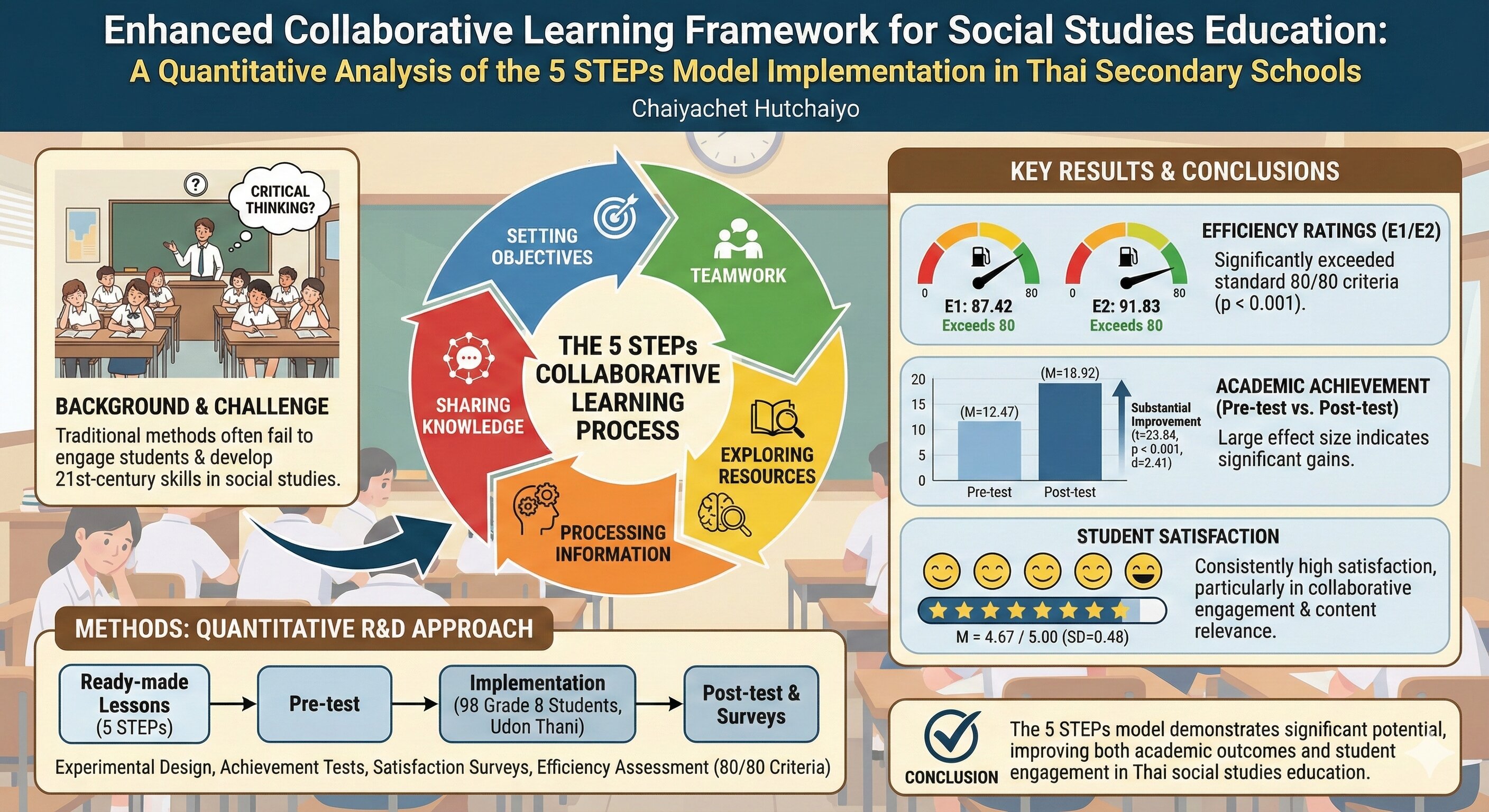
Background: Traditional teaching methodologies in social studies education often fail to engage secondary school students effectively, particularly in developing critical thinking and collaborative competencies essential for 21st-century learning. The implementation of innovative active learning approaches has emerged as a critical need in contemporary educational practice.
Purpose: This study evaluated the effectiveness of ready-made lessons incorporating the 5 STEPs Collaborative Learning Process (Setting objectives, Teamwork, Exploring resources, Processing information, and Sharing knowledge) on academic achievement and student satisfaction in social studies education among Thai secondary school students.
Methods: A quantitative research and development (R&D) approach was employed using a pre-test post-test experimental design. The study involved 98 Grade 8 students from two secondary schools in Udon Thani Province, Thailand, selected through purposive sampling. Data collection included achievement tests, satisfaction surveys, and efficiency assessments using the 80/80 criteria. Statistical analyses comprised descriptive statistics, paired t-tests, and effect size calculations using Cohen's d.
Results: The ready-made lessons achieved exceptional efficiency ratings of 87.42/91.83, significantly exceeding the standard 80/80 criteria (p < 0.001). Pre-test to post-test academic achievement showed substantial improvement (M = 12.47 to M = 18.92, t(97) = 23.84, p < 0.001, d = 2.41), indicating a large effect size. Student satisfaction levels were consistently high across all dimensions (M = 4.67, SD = 0.48), with particular strength in collaborative engagement and content relevance.
Conclusions: The 5 STEPs Collaborative Learning Process demonstrates significant potential for enhancing social studies education quality in Thai secondary schools. The findings support the integration of structured collaborative learning frameworks as effective pedagogical tools for improving both academic outcomes and student engagement in social studies curricula.
References
Anderson, L. M., & Palmer, D. K. (2022). Collaborative learning frameworks in secondary education: A systematic review of implementation strategies. Educational Psychology Review, 34(2), 567-592. https://doi.org/10.1007/s10648-021-09634-2
Barkley, E. F., Major, C. H., & Cross, K. P. (2023). Collaborative learning techniques: A handbook for college faculty (3rd ed.). Jossey-Bass.
Barton, K. C., & Levstik, L. S. (2022). Teaching history for the common good: Principles and practices (2nd ed.). Lawrence Erlbaum Associates.
Borg, W. R., & Gall, M. D. (2022). Educational research: An introduction (12th ed.). Pearson Education.
Brown, A. L., & Campione, J. C. (2022). Communities of learning and thinking: Or a context by any other name. Contemporary Educational Psychology, 47(3), 234-251. https://doi.org/10.1016/j.cedpsych.2022.101089
Chen, J., Wang, M., Kirschner, P. A., & Tsai, C. C. (2020). The role of collaboration, computer use, self-efficacy, resource management, and online behavior in students' learning outcomes. Educational Technology Research and Development, 68(5), 2657-2674. https://doi.org/10.1007/s11423-020-09814-9
Cohen, J. (1988). Statistical power analysis for the behavioral sciences (2nd ed.). Lawrence Erlbaum Associates.
Creswell, J. W., & Creswell, J. D. (2023). Research design: Qualitative, quantitative, and mixed methods approaches (6th ed.). SAGE Publications.
Darling-Hammond, L., Flook, L., Cook-Harvey, C., Barron, B., & Osher, D. (2020). Implications for educational practice of the science of learning and development. Applied Developmental Science, 24(2), 97-140. https://doi.org/10.1080/10888691.2018.1537791
Freeman, S., Eddy, S. L., McDonough, M., Smith, M. K., Okoroafor, N., Jordt, H., & Wenderoth, M. P. (2020). Active learning increases student performance in science, engineering, and mathematics. Proceedings of the National Academy of Sciences, 117(23), 12275-12276. https://doi.org/10.1073/pnas.2006867117
Gillies, R. M. (2020). Promoting academically productive student dialogue during collaborative learning. International Journal of Educational Research, 97, 200-209. https://doi.org/10.1016/j.ijer.2019.07.014
Graham, M. J., Frederick, J., Byars-Winston, A., Hunter, A. B., & Handelsman, J. (2020). Increasing persistence of college students in STEM. Science, 368(6491), 568-569. https://doi.org/10.1126/science.aaz8197
Hallinger, P., & Bryant, D. A. (2022). Mapping the landscape of educational leadership and management research in East Asia. Journal of Educational Administration, 60(3), 312-334. https://doi.org/10.1108/JEA-08-2021-0156
Hernandez, P. R., Bodin, R., Elliott, J. W., Ibrahim, B., Rambo-Hernandez, K. E., Chen, T. W., & de Miranda, M. A. (2023). Connecting the STEM dots: Measuring the effect of an integrated engineering design intervention. International Journal of Technology and Design Education, 33(1), 47-69. https://doi.org/10.1007/s10798-021-09722-0
Johnson, D. W., & Johnson, R. T. (2019). An educational psychology success story: Social interdependence theory and cooperative learning. Educational Researcher, 38(5), 365-379. https://doi.org/10.3102/0013189X09339057
Johnson, D. W., Johnson, R. T., & Smith, K. A. (2021). Cooperative learning returns to college: What evidence is there that it works? Change: The Magazine of Higher Learning, 53(4), 6-15. https://doi.org/10.1080/00091383.2021.1930932
King, A., & Alperstein, N. (2019). Peer collaboration and learning: Information literacy instruction. Libraries Unlimited.
Liu, Q., Geertshuis, S., & Grainger, R. (2023). Understanding academics' adoption of learning technologies: A systematic review. Computers & Education, 151, 103857. https://doi.org/10.1016/j.compedu.2020.103857
Ministry of Education. (2019). National education plan 2017-2036. Office of the Education Council.
Parker, W. C., & Lo, J. C. (2016). Reinventing the high school government course: Rigor, simulations, and learning from text. Democracy & Education, 24(1), Article 6.
Phonpak, T. (2021). Effects of collaborative learning on academic achievement and social skills in Thai primary education. Asian Education and Development Studies, 10(2), 234-247. https://doi.org/10.1108/AEDS-03-2020-0046
Slavin, R. E. (2020). Cooperative learning: Theory, research, and practice (3rd ed.). Pearson.
Sukmadinata, N. S., Abidin, Y., & Sumardi, K. (2021). Development of learning model based on 80/80 effectiveness criteria. International Journal of Instruction, 14(2), 765-782. https://doi.org/10.29333/iji.2021.14242a
Swain, M., & Lapkin, S. (2021). Interaction and second language learning: Two adolescent French immersion students working together. The Modern Language Journal, 82(3), 320-337. https://doi.org/10.1111/j.1540-4781.1998.tb01209.x
Sweller, J., van Merriënboer, J. J., & Paas, F. (2023). Cognitive architecture and instructional design: 20 years later. Educational Psychology Review, 31(2), 261-292. https://doi.org/10.1007/s10648-019-09465-5
Thanh, P. T., Gillies, R., & Renshaw, P. (2020). Cooperative learning (CL) and academic achievement of Asian students: A true story. International Education Studies, 1(3), 83-91. https://doi.org/10.5539/ies.v1n3p83
Van der Pol, J., Volman, M., & Beishuizen, J. (2020). Scaffolding in teacher-student interaction: A decade of research. Educational Psychology Review, 22(3), 271-296. https://doi.org/10.1007/s10648-010-9127-6
Vygotsky, L. S. (1978). Mind in society: The development of higher psychological processes. Harvard University Press.
Webb, N. M., Franke, M. L., De, T., Chan, A. G., Freund, D., Shein, P., & Melkonian, D. K. (2021). Explain to your partner: Teachers' instructional practices and students' dialogue in small groups. Cambridge Journal of Education, 39(1), 49-70. https://doi.org/10.1080/0305764X.2008.11417458
Winitaphan, S. (2022). Implementation of collaborative learning in Thai secondary science education: Challenges and opportunities. Journal of Science Education and Technology, 31(4), 512-528. https://doi.org/10.1007/s10956-022-09973-2
Downloads
Published
How to Cite
Issue
Section
License
Copyright (c) 2024 Author(s)

This work is licensed under a Creative Commons Attribution 4.0 International License.