Bridging Skills Gaps: An Analysis of Adult Vocational Education Programs in Thailand’s Labor Market
คำสำคัญ:
Vocational education, skills gap, labor market, Thailand, adult learning, workforce development, industry partnerships, curriculum development, educational policy, ASEAN Economic Communityบทคัดย่อ
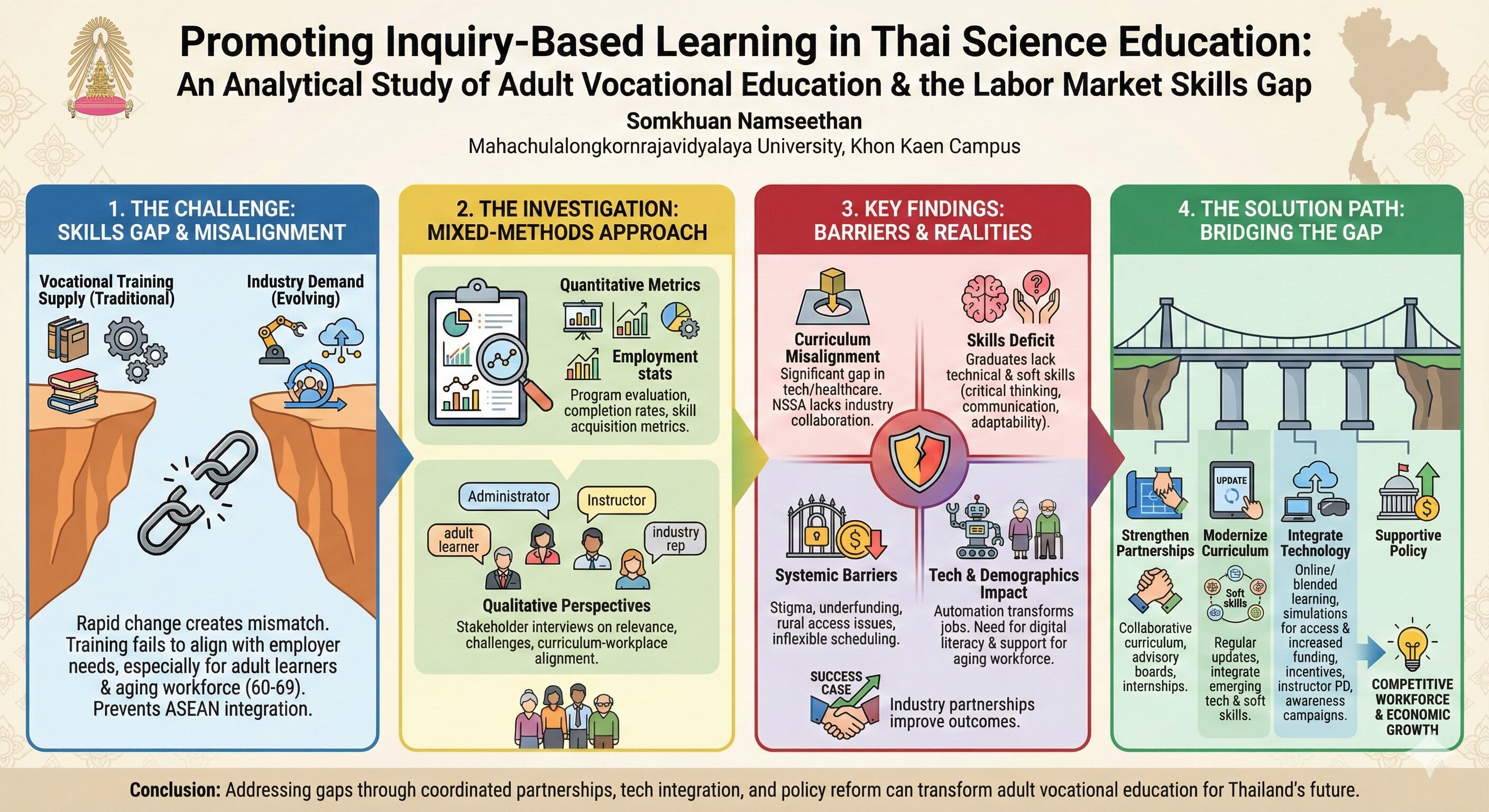
Background: Rapid technological change and economic transformation have intensified demand for adaptable, specialized skills in Thailand’s labor market. A persistent mismatch exists between competencies provided by vocational education programs and those required by employers, particularly within the context of ASEAN Economic Community integration. Adult vocational education plays a critical role in enhancing employability, supporting economic growth, and reducing unemployment. However, traditional training models often lack responsiveness to evolving industry demands, necessitating systematic evaluation of program relevance and effectiveness.
Purpose: This study examined adult vocational education programs in Thailand to assess their effectiveness in bridging skills gaps. It evaluated curriculum alignment with employer needs across sectors, analyzed factors influencing program efficacy—including policy frameworks, private sector engagement, and accessibility barriers—and proposed recommendations to strengthen industry collaboration, curriculum modernization, and technology integration.
Methods: A mixed-methods analytical approach combined quantitative evaluation with qualitative stakeholder perspectives. Data included reviews of program structures, curricula, and outcomes across multiple provinces and sectors, alongside policy analysis. Quantitative indicators measured enrollment, completion, employment outcomes, and skill acquisition relative to industry standards. Semi-structured interviews with administrators, instructors, industry representatives, and adult learners explored implementation challenges and curriculum relevance. Demographic analysis examined accessibility variations across age, socioeconomic background, and geographic location, including the significant proportion of workforce-active adults aged 60–69.
Results: Findings revealed substantial curriculum-industry misalignment, particularly in metal fabrication, engineering, information technology, and healthcare. Limited collaboration between regulatory authorities and industry stakeholders contributed to outdated competency standards. Graduates frequently lacked both advanced technical skills and essential soft skills such as communication and critical thinking. Barriers included social stigmatization of vocational pathways, inadequate funding, urban concentration of quality programs, and inflexible scheduling. Successful industry-partnership models demonstrated improved employment outcomes, practical skill acquisition, and expanded access through digital learning platforms. Technological advancement and workforce aging further underscored the need for adaptable, lifelong learning frameworks.
Conclusions: Adult vocational education in Thailand holds strong potential to reduce skills gaps but requires systemic reform. Strengthening industry partnerships, updating curricula, expanding digital delivery models, increasing government investment, and promoting positive perceptions of vocational education are essential to enhancing workforce readiness and sustaining economic competitiveness.
เอกสารอ้างอิง
Adhi Kusumastuti, Samsudin Anis, Achmad Nizar Hidayanto, Sita Nurmasitah, Atika Atika, Delta Apriyani, Taofan Ali Achmadi, Sudiyono Sudiyono (2023). Proceedings of the 4th Vocational Education International Conference (VEIC 2022). Springer Nature. https://play.google.com/store/books/details?id=83eiEAAAQBAJ&source=gbs_api
Asian Development Bank (2021). Technical and Vocational Education and Training in the Philippines in the Age of Industry 4.0. Asian Development Bank. https://play.google.com/store/books/details?id=pSg5EAAAQBAJ&source=gbs_api
Birger Fredriksen, Jee-Peng Tan (2008). An African Exploration of the East Asian Education Experience. World Bank Publications. http://books.google.com/books?id=IIZ4O4CBm9gC&dq=Adult+vocational+education+programs+in+Thailand+and+their+impact+on+bridging+skills+gaps+in+the+labor+market&hl=&source=gbs_api
Collectif (2018-07-03). Education, Economy and Identity. Institut de recherche sur l’Asie du Sud-Est contemporaine. http://books.google.com/books?id=KztjDwAAQBAJ&dq=Overview+of+adult+vocational+education+programs+in+Thailands+labor+market&hl=&source=gbs_api
DVV International, Department of Lifelong Education, Chulalongkorn University (2020). The Role of Adult Learning and Education in Cambodia, Lao PDR, Vietnam and Thailand - Country Studies. DVV International. https://www.dvv-international.la/fileadmin/files/south-and-southeast-asia/documents/Final_Version_ALE_within_LLL_Southeast_Asia.pdf
Emanuela Di Gropello, Aurelien Kruse, Prateek Tandon (2011). Skills for the Labor Market in Indonesia. World Bank Publications. http://books.google.com/books?id=tdr3iNb7zrQC&dq=implications+for+stakeholders+in+Thailands+labor+market+regarding+adult+vocational+education+programs+and+skills+gaps&hl=&source=gbs_api
Guangpei Wei, Ampapan Tuntinakhongul (2024). Developing Adult Vocational Training Strategies for Chinese Higher Education Institutes under the Background of Industrial Revolution 4.0. Pakistan Journal of Life and Social Sciences, 22(2). pp. 2968-2979. https://doi.org/10.57239/PJLSS-2024-22.2.00218
Joan DeJaeghere, Erin Murphy-Graham (2021). Life Skills Education for Youth. Springer Nature.
Johann Heilmann, Nazaret Nazaretyan (2020). Reaching the Marginalized - Good Practices in Adult Learning and Education in the Middle East, Southeast and South Asia. DVV International. https://www.dvv-international.de/fileadmin/files/Inhalte_Bilder_und_Dokumente/News/2020/25_Publication_ALE_Poverty.pdf
Karen Evans, Annette Ostendorf, Chompoonuh K. Permpoonwiwat (2023).Resilience of Vocational Education and Training in Phases of External Shock – Experiences from the Corona Pandemic in Asian and European Skill Eco Systems. Innsbruck University Press. https://library.oapen.org/bitstream/handle/20.500.12657/85307/10.15203-99106-116-8.pdf?sequence=1#page=108
Kritsada Wattanasaovaluk (2021). The Economic Significance of Work Experience for Elderly Employment in Thailand. Volume 29. pp. 82-99. http://doi.org/10.25133/JPSSv292021.006
Kyaw Zin (2022). The Role of National Skills Standards Authority for the Development of National Occupational Competency Standard in Engineering Sector (Case Study in Yangon Region). Yangon University of Economics. https://meral.edu.mm/record/8527/file_preview/Kyaw%20Zin%2C%20EMDevS-14%2C%2017th%20Batch.pdf?allow_aggs=True
Le Thai Phong, Nguyen Thu Thuy, Nguyen Thi Hanh, Dau Bao Ngoc (2021). Does Demographics Matter in Lifelong Learning? A Research Context of Vietnam. Innovare Academic Sciences Pvt Ltd, Vol 9, Issue 5. pp. 27-31. http://dx.doi.org/10.22159/ijss.2021v9i5.42880
Manoon Toyama, Vasu Suvanvihok (2020). The Opportunities for Open and Distance Education in the Enhancement of Migrant Labour Skills and Competencies in ASEAN: The Case of Thailand. Vol. 12, No. 2. pp. 42-45. https://ajodl.oum.edu.my/document/Previous/Volume12.N0.2_2020/04.%20The%20Opportunities%20ODL.pdf
Marope, P.T.M., Chakroun, B., Holmes, K.P. (2015-05-26). Unleashing the potential. UNESCO Publishing. http://books.google.com/books?id=XLL9CQAAQBAJ&dq=Enhancing+vocational+education+in+Thailands+labor+market+through+adult+education+programs+and+skill+gap+analysis&hl=&source=gbs_api
Matthias Pilz (2016-12-20). Vocational Education and Training in Times of Economic Crisis. Springer. https://play.google.com/store/books/details?id=utHDDQAAQBAJ&source=gbs_api
Nattadech Choomplang, Dararatt Anantanasuwong (2023). The Employment Perspectives of Care Providers for Older Persons in Thailand. Human Resource and Organization Development Journal, Vol. 15 No. 2/2023. pp. 51-54. https://researchmap.jp/nattadech0221/published_papers/46146968/attachment_file.pdf
OECD (2010). OECD Reviews of Vocational Education and Training Learning for Jobs. OECD Publishing. https://play.google.com/store/books/details?id=4QdStvpfhN8C&source=gbs_api
Shubha Jayaram, Wambui Munge, Bob Adamson, David Sorrell, Nitika Jain (2017). Bridging the Skills Gap. Springer. https://play.google.com/store/books/details?id=VBjjDQAAQBAJ&source=gbs_api
Suwithida Charungkaittikul, Sok Soth (2020). The Role of Adult Learning and Education in Cambodia, Lao PDR, Vietnam and Thailand - Country Studies. DVV International and Department of Lifelong Education, Faculty of Education, Chulalongkorn University. https://www.dvv-international.la/fileadmin/files/south-and-southeast-asia/documents/Final_Version_ALE_within_LLL_Southeast_Asia.pdf
Warn N. Lekfuangfu, Voraprapa Nakavachara (2020). Reshaping Thailand’s Labor Market Structure: The Unified Forces of Technology and Trade. Puey Ungphakorn Institute for Economic Research. https://content.botlc.or.th/mm-info/PIER/DP/dp123.pdf
WIJAYANTI Febry (2023). THE LABOR MARKET DEVELOPMENT OF THE LARGEST CITIES IN DEMOGRAPHIC TRANSITION CIRCUMSTANCE. Federal State Autonomous Educational Institution of Higher Education “Ural Federal University named after the First President of Russia B.N. Yeltsin”. https://elar.urfu.ru/bitstream/10995/130144/1/urfu2620_d.pdf
ดาวน์โหลด
เผยแพร่แล้ว
รูปแบบการอ้างอิง
ฉบับ
ประเภทบทความ
สัญญาอนุญาต
ลิขสิทธิ์ (c) 2025 Author(s)

อนุญาตภายใต้เงื่อนไข Creative Commons Attribution 4.0 International License.