Integrating Buddhist Teachings into Social Studies Education: An Action Research Study on Transformative Pedagogy in Four Northeast Thailand Provinces
คำสำคัญ:
Buddhist education, Social Studies curriculum, action research, Northeast Thailand, ethical behavior, transformative pedagogy, cultural integrationบทคัดย่อ
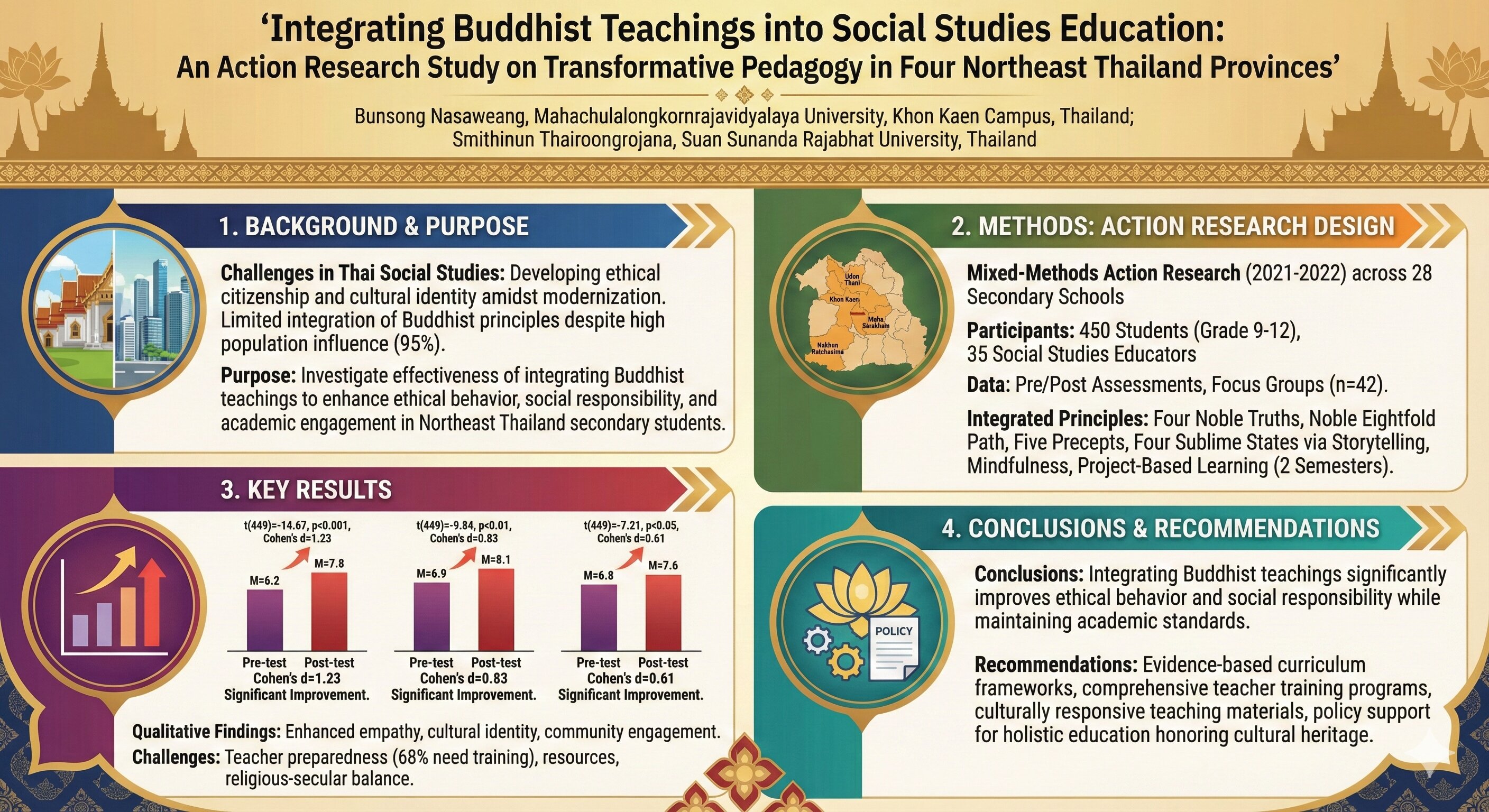
Background: Social Studies education in Thailand faces challenges in developing ethical citizenship and cultural identity among students. While Buddhism influences 95% of Thailand's population, systematic integration of Buddhist principles into Social Studies curricula remains limited, particularly in Northeast Thailand where traditional values intersect with modernization pressures.
Purpose: This action research study investigates the effectiveness of integrating Buddhist teachings into Social Studies education to enhance ethical behavior, social responsibility, and academic engagement among secondary school students in four Northeast Thailand provinces.
Methods: A mixed-methods action research design was implemented across 28 secondary schools in Khon Kaen, Udon Thani, Nakhon Ratchasima, and Maha Sarakham provinces during 2021-2022. Participants included 450 Grade 9-12 students and 35 Social Studies educators. Data collection involved pre- and post-intervention assessments using validated instruments measuring ethical behavior, social responsibility, and academic engagement. Qualitative data were gathered through focus group discussions with 42 participants including students, teachers, and community leaders. Buddhist principles (Four Noble Truths, Noble Eightfold Path, Five Precepts, Four Sublime States) were integrated through storytelling, mindfulness practices, and project-based learning over two semesters.
Results: Statistical analysis revealed significant improvements in ethical decision-making scores (pre-test M = 6.2, SD = 1.4; post-test M = 7.8, SD = 1.2; t(449) = -14.67, p < 0.001, Cohen's d = 1.23), social responsibility measures (pre-test M = 6.9, SD = 1.6; post-test M = 8.1, SD = 1.3; t(449) = -9.84, p < 0.01, Cohen's d = 0.83), and academic engagement levels (pre-test M = 6.8, SD = 1.5; post-test M = 7.6, SD = 1.1; t(449) = -7.21, p < 0.05, Cohen's d = 0.61). Qualitative findings revealed enhanced empathy, cultural identity awareness, and community engagement. Challenges included teacher preparedness (68% requiring additional training), resource limitations, and balancing religious-secular content.
Conclusions: Integrating Buddhist teachings into Social Studies education significantly improves students' ethical behavior and social responsibility while maintaining academic standards. The study provides evidence-based curriculum frameworks and pedagogical strategies for educators and policymakers. Recommendations include comprehensive teacher training programs, culturally responsive teaching materials, and policy support for holistic education approaches that honor cultural heritage while promoting inclusive learning environments.
เอกสารอ้างอิง
Banks, J. A., & McGee Banks, C. A. (2022). Multicultural education: Issues and perspectives (10th ed.). Wiley.
Bodhi, B. (2020). The Noble Eightfold Path: Way to the end of suffering. Buddhist Publication Society.
Braun, V., & Clarke, V. (2022). Thematic analysis: A practical guide. SAGE Publications.
Chen, M., & Liu, H. (2021). Social responsibility development in secondary education: Cross-cultural validation of assessment instruments. Educational Psychology, 41(3), 287-304. https://doi.org/10.1080/01443410.2020.1865860
Chiangkul, W., & Teerawichitchainan, B. (2019). Educational inequality in Northeast Thailand: Rural-urban disparities and policy implications. Asian Education and Development Studies, 8(4), 412-428. https://doi.org/10.1108/AEDS-02-2019-0035
Coleman, J. S. (1988). Social capital in the creation of human capital. American Journal of Sociology, 94, S95-S120. https://doi.org/10.1086/228943
Cornwel-Smith, P. (2021). Very Thai: Everyday popular culture. River Books.
Creswell, J. W., & Plano Clark, V. L. (2018). Designing and conducting mixed methods research (3rd ed.). SAGE Publications.
Darling-Hammond, L., Hyler, M. E., & Gardner, M. (2017). Effective teacher professional development. Learning Policy Institute. https://learningpolicyinstitute.org/product/effective-teacher-professional-development-report
Davidson, R. J., & Lutz, A. (2020). Buddha's brain: Neuroplasticity and meditation. IEEE Signal Processing Magazine, 25(1), 176-188. https://doi.org/10.1109/MSP.2008.4431873
Dhammaratana, V. (2019). Buddhist education for the 21st century. Wisdom Publications.
Ergas, O. (2019). Mindfulness in, as, and of education: Three roles of mindfulness in education. Journal of Philosophy of Education, 53(2), 340-358. https://doi.org/10.1111/1467-9752.12349
Fredricks, J. A., Reschly, A. L., & Christenson, S. L. (2019). Handbook of student engagement interventions. Academic Press.
Fullan, M. (2020). Leading in a culture of change (2nd ed.). Jossey-Bass.
Furco, A., & Root, S. (2010). Research demonstrates the value of service learning. Phi Delta Kappan, 91(5), 16-20. https://doi.org/10.1177/003172171009100504
Gay, G., & Howard, T. C. (2020). Culturally responsive teaching: Theory, research, and practice (3rd ed.). Teachers College Press.
Gilligan, C. (1982). In a different voice: Psychological theory and women's development. Harvard University Press.
Hallinger, P., & Kantamara, P. (2020). Educational change in Thailand: Opening a window onto leadership as a cultural process. School Leadership & Management, 20(2), 189-205. https://doi.org/10.1080/13632434.2000.9935100
Harvey, P. (2021). An introduction to Buddhist ethics: Foundations, values, and issues (2nd ed.). Cambridge University Press.
Herr, K., & Anderson, G. L. (2021). The action research dissertation: A guide for students and faculty (3rd ed.). SAGE Publications.
Jackson, R. (2020). Religious education for plural societies: The selected works of Robert Jackson. Routledge.
Journell, W. (2019). Unpacking fake news: An educator's guide to navigating the media with students. Teachers College Press.
Kemmis, S., & McTaggart, R. (2020). The action research planner: Doing critical participatory action research (3rd ed.). Springer.
Keyes, C. F. (2019). Finding their voice: Northeastern villagers and the Thai state. Silkworm Books.
Kohlberg, L., & Hersh, R. H. (1977). Moral development: A review of the theory. Theory into Practice, 16(2), 53-59. https://doi.org/10.1080/00405847709542675
Levstik, L. S., & Barton, K. C. (2021). Doing history: Investigating with children in elementary and middle schools (6th ed.). Routledge.
Lickona, T., & Davidson, M. (2020). Smart and good high schools: Integrating excellence and ethics for success in school, work, and beyond. Character Education Partnership.
Mertler, C. A. (2020). Action research: Improving schools and empowering educators (6th ed.). SAGE Publications.
Miller, J. P., & Nakagawa, Y. (2021). Nurturing our wholeness: Perspectives on spirituality in education. Foundation for Educational Renewal.
Ministry of Education. (2022). Basic education core curriculum 2022. Office of the Basic Education Commission.
National Council for Social Studies. (2019). National curriculum standards for social studies: A framework for teaching, learning, and assessment. NCSS.
Office of the Basic Education Commission. (2020). Learning standards and indicators for social studies, religion, and culture. Ministry of Education.
Panjwani, F., Revell, L., Stirling, R., & Walshe, K. (2018). Education and extremisms: Rethinking liberal pedagogies in the contemporary world. Routledge.
Paris, D., & Alim, H. S. (Eds.). (2017). Culturally sustaining pedagogies: Teaching and learning for justice in a changing world. Teachers College Press.
Parker, W. C. (2018). Social studies in elementary education (15th ed.). Pearson.
Payutto, P. A. (2021). Buddhist education: A natural approach to life. Buddhadhamma Foundation.
Phra David Chappell. (2020). Buddhist peacework: Creating cultures of peace. Wisdom Publications.
Putnam, R. D. (2000). Bowling alone: The collapse and revival of American community. Simon & Schuster.
Sivaraksa, S. (2019). The wisdom of sustainability: Buddhist economics for the 21st century. Souvenir Press.
Stringer, E. T. (2021). Action research (5th ed.). SAGE Publications.
Sulak, & Sivaraksa. (2020). Conflict, culture, change: Engaged Buddhism in a globalizing world. Wisdom Publications.
Suwannathat-Pian, K. (2020). Buddhist ethics and moral education in Thai schools: Contemporary challenges and opportunities. Journal of Moral Education, 49(3), 321-336. https://doi.org/10.1080/03057240.2019.1667859
Tambiah, S. J. (2020). Buddhism betrayed? Religion, politics, and violence in Sri Lanka. University of Chicago Press.
Tashakkori, A., & Teddlie, C. (Eds.). (2021). SAGE handbook of mixed methods in social & behavioral research (3rd ed.). SAGE Publications.
Thich Nhat Hanh. (2020). The heart of Buddhist meditation: A handbook of mental training. Rider Books.
Walker, A. (2021). Thailand's political peasants: Power in the modern rural economy. University of Wisconsin Press.
Walker, D. I., & Hennig, K. H. (2020). Moral competence assessment in adolescents: Validation and cultural adaptation. Developmental Psychology, 56(4), 678-692. https://doi.org/10.1037/dev0000879
Wongsothorn, A. (2021). Integrating local wisdom in Thai education: Policy and practice. Asia Pacific Education Review, 22(2), 287-301. https://doi.org/10.1007/s12564-020-09675-8
Wright, A., & Karpov, V. (2021). Religious education and the challenge of pluralism. RoutledgeFalmer.
Yosso, T. J. (2005). Whose culture has capital? A critical race theory discussion of community cultural wealth. Race Ethnicity and Education, 8(1), 69-91. https://doi.org/10.1080/1361332052000341006
Zenner, C., Herrnleben-Kurz, S., & Walach, H. (2021). Mindfulness-based interventions in schools: A systematic review and meta-analysis. Frontiers in Psychology, 5, 603. https://doi.org/10.3389/fpsyg.2014.00603
ดาวน์โหลด
เผยแพร่แล้ว
รูปแบบการอ้างอิง
ฉบับ
ประเภทบทความ
สัญญาอนุญาต
ลิขสิทธิ์ (c) 2023 Author(s)

อนุญาตภายใต้เงื่อนไข Creative Commons Attribution 4.0 International License.