Assessment and Evaluation in Thai Classrooms: A Comparative Study of Traditional and Competency-Based Approaches
คำสำคัญ:
Assessment, Traditional Education, Competency-Based Assessment, Thai Classrooms, Educational Reformบทคัดย่อ
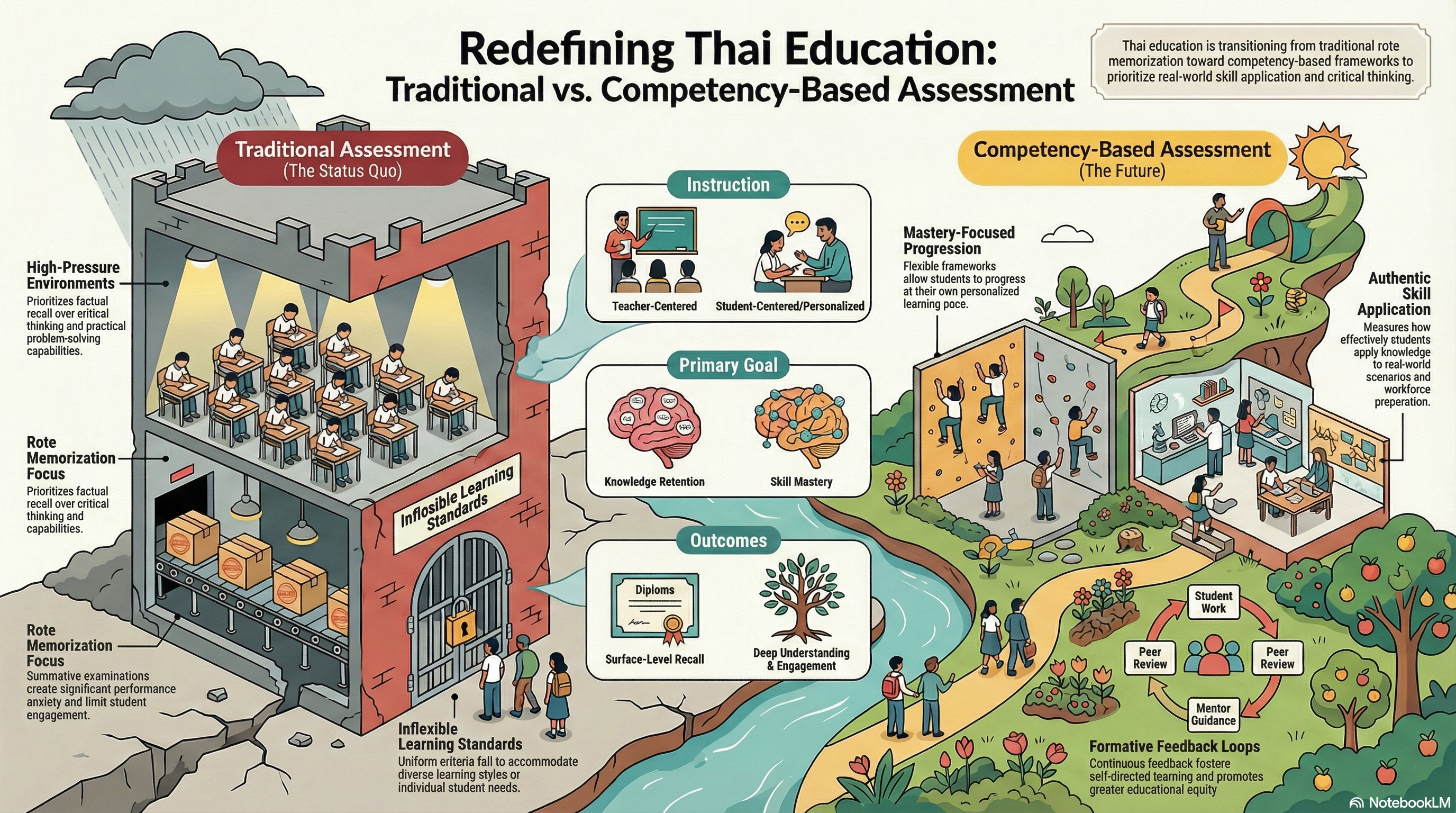
Background: Thai education has historically emphasized traditional assessment methodologies prioritizing rote memorization and standardized testing, pedagogical approaches that inadequately develop critical thinking, problem-solving capabilities, and real-world skill application essential for 21st-century success. These conventional evaluation practices, characterized by teacher-centered instruction and summative examinations measuring factual recall, create high-pressure environments where learning outcomes focus on knowledge retention rather than competency mastery, limiting student engagement and failing to accommodate diverse learning styles.
Purpose: This comparative study examined traditional and competency-based assessment approaches in Thai classrooms, analyzing their differential impacts on student engagement, learning outcomes, and educational equity, evaluated strengths and limitations of standardized testing versus skill mastery evaluation methodologies, and developed comprehensive recommendations for educational reforms integrating competency-based assessments while addressing implementation challenges including teacher preparedness deficiencies and resource constraints.
Methods: The research employed mixed-methods comparative analysis integrating quantitative performance metrics with qualitative stakeholder perspectives. Data collection encompassed systematic examination of student achievement outcomes, analysis of engagement indicators, teacher interviews exploring implementation experiences and professional development needs, policy document review assessing current Thai educational regulations, and international comparative analysis examining successful competency-based models.
Results: Traditional assessment demonstrated significant limitations: standardized testing emphasized surface-level recall inhibiting deep understanding, high-stakes environments generated performance anxiety, and uniform criteria inadequately accommodated diverse learners. Competency-based implementations revealed substantial advantages: mastery-focused progression allowed personalized learning paces, authentic assessment measured real-world skill application, formative feedback fostered self-directed learning, and flexible frameworks promoted educational equity. Teacher perspectives identified implementation challenges: inadequate professional development, increased workload demands, cultural resistance, and unclear competency definitions. Student outcome comparisons demonstrated competency-based participants exhibited enhanced critical thinking, superior knowledge retention, greater engagement, and improved workforce preparation.
Conclusions: Transforming Thai assessment practices requires systematic reforms embracing competency-based frameworks while strategically integrating traditional assessment strengths through comprehensive teacher professional development, hybrid assessment models, technology integration, policy reforms establishing clear competency standards, and phased transition strategies supporting sustained pedagogical innovation.
เอกสารอ้างอิง
Adarsh, K., Krishnamurthi, R., Bhatia, S., Kaushik, K., Ahuja, N. J., Nayyar, A., & Masud, M. (2021). Blended learning tools and practices: A comprehensive analysis. IEEE Access, 9, 85151–85197. https://doi.org/10.1109/access.2021.3085844
Bülent, Ç. (2024). Editorial. Science Education International. https://www.semanticscholar.org/paper/b5b0547cb320010088447f043ebfffe61d56ea97
Buntha, A., Yasri, P., & Duangpummet, P. (2024). Enhancing science education in Thailand: Implementing the CER framework to improve PISA performance and student argumentation. 2024 9th International STEM Education Conference (iSTEM-Ed). https://www.semanticscholar.org/paper/a01e72e195d71ad7279b495e151d942b2f589166
Chan, L., Moo, N. T., Paw, N. N. Y., & Sasaki, et al. (2021). Deep change in low-resource classrooms: Data-driven teacher professional development for educators from Burma using a choice-based approach. Retrieved from https://core.ac.uk/download/490688853.pdf
Galloway, N., & Numajiri, T. (2019). Global Englishes language teaching: Bottom-up curriculum implementation. TESOL Quarterly, 54(1), 118–145. https://doi.org/10.1002/tesq.547
Jameson, J., Rumyantseva, N. L., Cai, M., Markowski, M., Essex, R., & McNay, I. (2022). A systematic review and framework for digital leadership research maturity in higher education. Computers and Education Open, 3, 100115. https://doi.org/10.1016/j.caeo.2022.100115
Kolb, A. Y., & Kolb, D. (2022). Experiential learning theory as a guide for experiential educators in higher education. Experiential Learning and Teaching in Higher Education, 1, 38–38. https://doi.org/10.46787/elthe.v1i1.3362
Longhurst, G. J., Stone, D., Dulohery, K., Scully, D., Campbell, T., & Smith, C. F. (2020). Strength, weakness, opportunity, threat (SWOT) analysis of the adaptations to anatomical education in the United Kingdom and Republic of Ireland in response to the COVID‐19 pandemic. Anatomical Sciences Education, 13(3), 301–311. https://doi.org/10.1002/ase.1967
Niwae, Y. (2023). Analysis of Islamic religious education learning management and its impact on teaching methods in Ban Bangpu Yaring Pattani elementary school, Thailand. Proceeding of The Postgraduate School Universitas Muhammadiyah Jakarta. https://www.semanticscholar.org/paper/88a045b21aa9784bbf98858f35e44fef072ff581
Nusche, D., Braun, H., Halász, G., & Santiago, P. (2014). OECD reviews of evaluation and assessment in education: Netherlands 2014. OECD Publishing. https://play.google.com/store/books/details?id=Gz4BBAAAQBAJ
Pennycook, A. (2020). Translingual entanglements of English. World Englishes, 39(2), 222–235. https://doi.org/10.1111/weng.12456
Pholying, T. (2025). Embracing global Englishes in Thailand: Linguistic diversity and cultural integration. Asian Journal of Arts and Culture, 5(1), 112–130. https://www.semanticscholar.org/paper/7243a756888c9fab936e235783566f8628e4543c
Rahman, S. (2022). Transition from traditional curriculum to modular curriculum: Possible challenges. Journal of Gandhara Medical and Dental Science. https://www.semanticscholar.org/paper/62e9689fc9ddc81d1e246285dd4c30acb65ac595
Rose, H., & Montakantiwong, A. (2018). A tale of two teachers: A duoethnography of the realistic and idealistic successes and failures of teaching English as an international language. RELC Journal, 49(1), 88–101. https://doi.org/10.1177/0033688217746206
Smirnova, Y. K. (2023). Application of eye-tracking technology dual eye tracking (DUET) in the study of cooperation between children with atypical development and adults in the learning process. Forum, 1, 98–99. https://doi.org/10.61365/forum.2023.078
Supriatnadi, N., Hasibuan, A., & Arfianty, R. (2023). Speech act devices in Nivea cosmetics advertisements on Japanese television. European Journal of Humanities and Social Sciences, 2023(6), 3–8. https://doi.org/10.29013/EJHSS-23-6-3-8
Thunstrom, S. R. (2024). Experiences of classroom teachers in a mastery-based, personalized learning environment: A phenomenological study. Retrieved from https://core.ac.uk/download/614444348.pdf
Tyrosvoutis, G. (2016). Taking the sage off the stage: Identifying obstacles to student-centered instruction on the Thai-Myanmar border. Retrieved from https://core.ac.uk/download/229430477.pdf
Wagemaker, H. (2020). Reliability and validity of international large-scale assessment. IEA Research for Education. https://doi.org/10.1007/978-3-030-53081-5
Winfield, L. (2016). The Thai-Lao mother tongue: Teacher needs, competencies, and conditions for effective instruction (Doctoral dissertation). University of London.
Zhang, X., & Liu, Y. (2024). Perceptions towards English as an international language: A study of international students at a Thai university. Suranaree Journal of Social Science. https://www.semanticscholar.org/paper/7243a756888c9fab936e235783566f8628e4543c
ดาวน์โหลด
เผยแพร่แล้ว
รูปแบบการอ้างอิง
ฉบับ
ประเภทบทความ
สัญญาอนุญาต
ลิขสิทธิ์ (c) 2025 Insights into Modern Education (i-ME)

อนุญาตภายใต้เงื่อนไข Creative Commons Attribution-NonCommercial-NoDerivatives 4.0 International License.