Reforming Social Studies Education in Thailand: Strategies for the Integration of Local Wisdom and Global Citizenship
คำสำคัญ:
Local wisdom, global citizenship, social studies education, Thailand, curriculum reformบทคัดย่อ
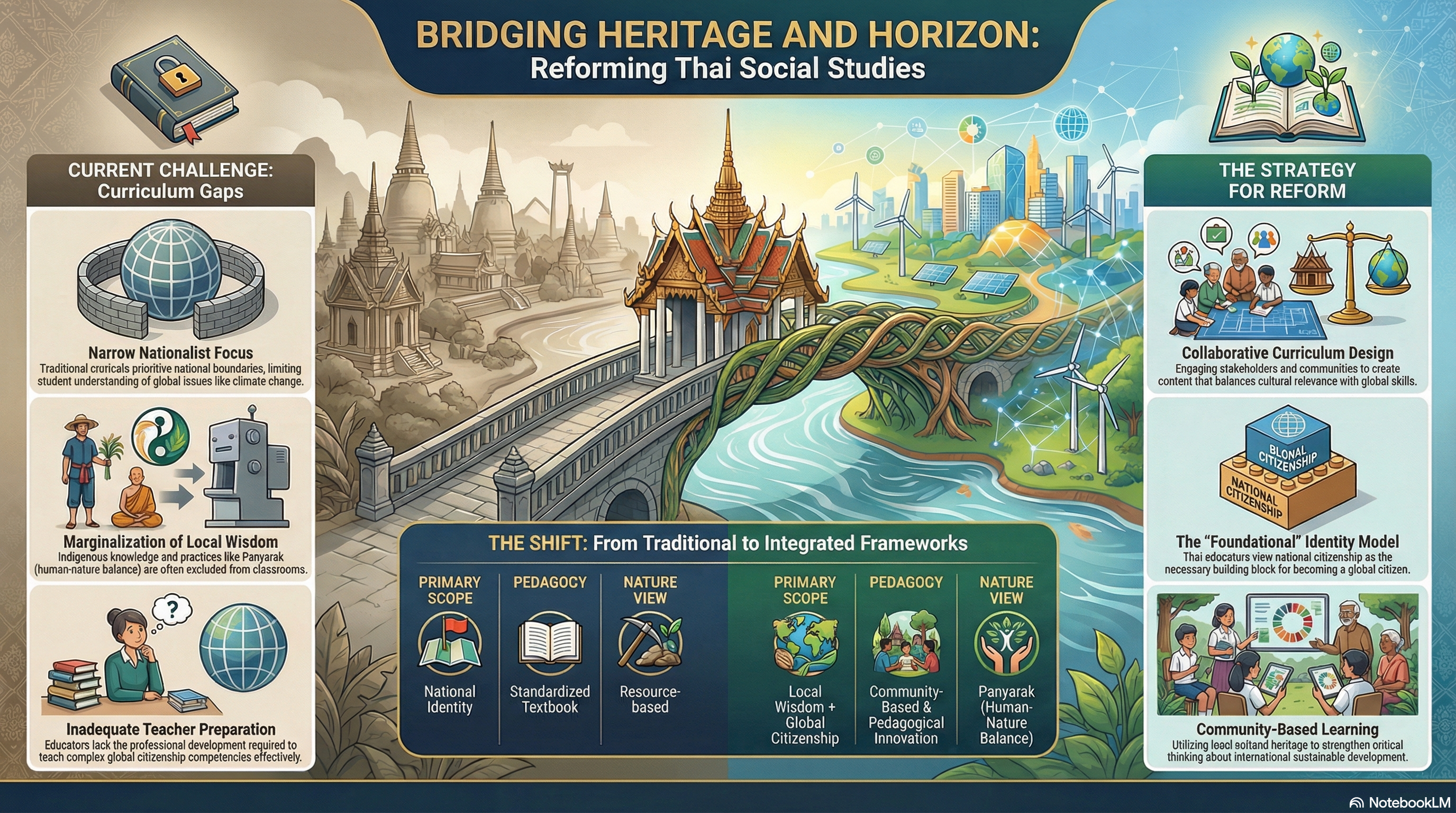
Background: Thai social studies education has historically emphasized nationalist curricula prioritizing civic responsibility within national boundaries, pedagogical approaches that inadequately prepare students for navigating interconnected global challenges including climate change, migration, and cultural diversity. Traditional curricula often marginalize Thailand's rich cultural heritage—including indigenous knowledge systems, Buddhist teachings, and sustainable living practices—while simultaneously failing to cultivate global citizenship competencies essential for 21st-century participation in an interconnected world.
Purpose: This research examined social studies education reform in Thailand through integration of local wisdom and global citizenship education, analyzed the role of Thai cultural practices and Buddhist principles in shaping student identity and sustainable development understanding, evaluated current curriculum limitations in addressing both cultural preservation and global engagement needs, and developed comprehensive strategies for curriculum reform incorporating collaborative design processes, teacher professional development, community engagement mechanisms, and culturally responsive assessment practices balancing local cultural relevance with global citizenship competencies.
Methods: The study employed qualitative analytical methodology integrating policy document analysis of Thai social studies curricula, literature review examining alternative education movements incorporating Buddhist values, stakeholder interviews with university administrators and students exploring global citizenship perceptions, comparative examination of successful community-based projects demonstrating local wisdom application to global issues, and case study evaluation of innovative pedagogical approaches including hand puppet media utilizing local wisdom for citizenship skill development.
Results: Analysis revealed significant curriculum gaps: nationalist emphasis limited students' understanding of global interconnectedness, insufficient integration of traditional practices like Panyarak (human-nature balance) and Wai (respect customs) marginalized cultural knowledge, students demonstrated superficial global citizenship understanding, and inadequate teacher preparation constrained effective instruction. Stakeholder perspectives indicated Thai educators perceive national citizenship as foundational to global citizenship—a culturally distinct viewpoint requiring curriculum reforms honoring this context. Successful implementations demonstrated community-based learning connecting cultural heritage with global issues enhanced engagement, collaborative curriculum development created culturally relevant content, and local wisdom integration strengthened critical thinking about sustainable development.
Conclusions: Transforming Thai social studies education requires balanced curriculum frameworks integrating local wisdom with global citizenship through comprehensive teacher professional development, collaborative stakeholder engagement, community partnership cultivation, and assessment practices emphasizing both cultural preservation and global competency development.
เอกสารอ้างอิง
Charungkaittikul, S., & Henschke, J. A. (2011). The scenario of a learning society model toward promoting a positive paradigm shift for communities. Retrieved from https://core.ac.uk/download/268762376.pdf
El Islami, R. A. Z., & Nuangchalerm, P. (2020). Comparative study of scientific literacy: Indonesian and Thai pre-service science teachers report. Retrieved from https://core.ac.uk/download/587989943.pdf
Laochankham, S. (2018). The antecedents of local government service delivery under crisis conditions: The case of Khon Kaen Province, Thailand. Retrieved from https://core.ac.uk/download/212627841.pdf
Meyer, O. C. (2021). Countering ‘plastic addicted subjects’: Power, essentialized identities, and expertise in Thailand. Retrieved from https://core.ac.uk/download/475632259.pdf
Sovacool, B. K., Hess, D. J., Amir, S., Geels, F. W., Hirsh, R. F., Rodríguez Medina, L., Miller, C. A., et al. (2020). Sociotechnical agendas: Reviewing future directions for energy and climate research. Energy Research & Social Science, 70, 101617. https://doi.org/10.1016/j.erss.2020.101617
Suadi, S., Saifuddin, S., & Fadli, F. (2018). Incorporating peace education into Aqidah Akhlak subject in East Aceh. Emerald Reach Proceedings Series. Retrieved from https://doi.org/10.1108/978-1-78756-793-1-00013
Henpiya, A., Sa-U, S., & Wae-u-seng, N. (2019). Islamic educational administration and management program, Prince of Songkla University (PSU): Contributions and challenges for Malay Muslim community in Thailand. Retrieved from https://core.ac.uk/download/234030116.pdf
Assanarkutty, S. J., Mohd Sabri, W. N. A., Mustafa, Z., & Nurhasanah. (2023). Retrospective analysis and anticipation of curriculum design for future Southeast Asia. Retrieved from https://core.ac.uk/download/578168643.pdf
Jones, M. E. (2008). The social movement of spiritually engaged alternative education in Thailand against the background of reform and globalization. Retrieved from https://core.ac.uk/download/213816370.pdf
Thanosawan, P. (2012). Global citizenship in Thai higher education: Case studies of a university and its affiliated international college. Retrieved from https://core.ac.uk/download/41236644.pdf
Murdiono, M., Saputra, B. D., & Tohani, E. (2023). Nationalism education in elementary school: A systematic literature review. Retrieved from https://core.ac.uk/download/587989704.pdf
Gillies, V., & Ribbens McCarthy, J. (2017). Troubling children's families: Who's troubled and why? Approaches to inter-cultural dialogue. Retrieved from https://core.ac.uk/download/143477181.pdf
Chotimah, U., Farida, F., & Jaenudin, R. (2020). Concept of social studies curricula in junior high schools in Indonesia and Thailand. Retrieved from https://core.ac.uk/download/357190599.pdf
Baharudin, B., Laila, A., Pitoyo, A., Sukasih, et al. (2023). The effectiveness of hand muppet learning media based on local wisdom to improve cultural literacy and citizenship ability. Retrieved from https://core.ac.uk/download/555442169.pdf
Praningrum, P., Widodo, S., & Mujiharjo, S. (2014). Strategy behavior in the economies of coffee farmers using protected forests: Case study in protected forest Bukit Pedinding Hill and Serdang Hill in Sub District Lebong. Retrieved from https://core.ac.uk/download/35335601.pdf
ดาวน์โหลด
เผยแพร่แล้ว
รูปแบบการอ้างอิง
ฉบับ
ประเภทบทความ
สัญญาอนุญาต
ลิขสิทธิ์ (c) 2025 Insights into Modern Education (i-ME)

อนุญาตภายใต้เงื่อนไข Creative Commons Attribution 4.0 International License.