Integrating Buddhist Teachings with Health Education: A Mixed-Methods Research and Development Study of the Buddhist Instruction Model for Diabetes Risk Prevention in Northeastern Thailand
Keywords:
Buddhist instruction model, diabetes prevention, mindfulness-based intervention, cultural health education, northeastern Thailand, mixed-methods researchAbstract
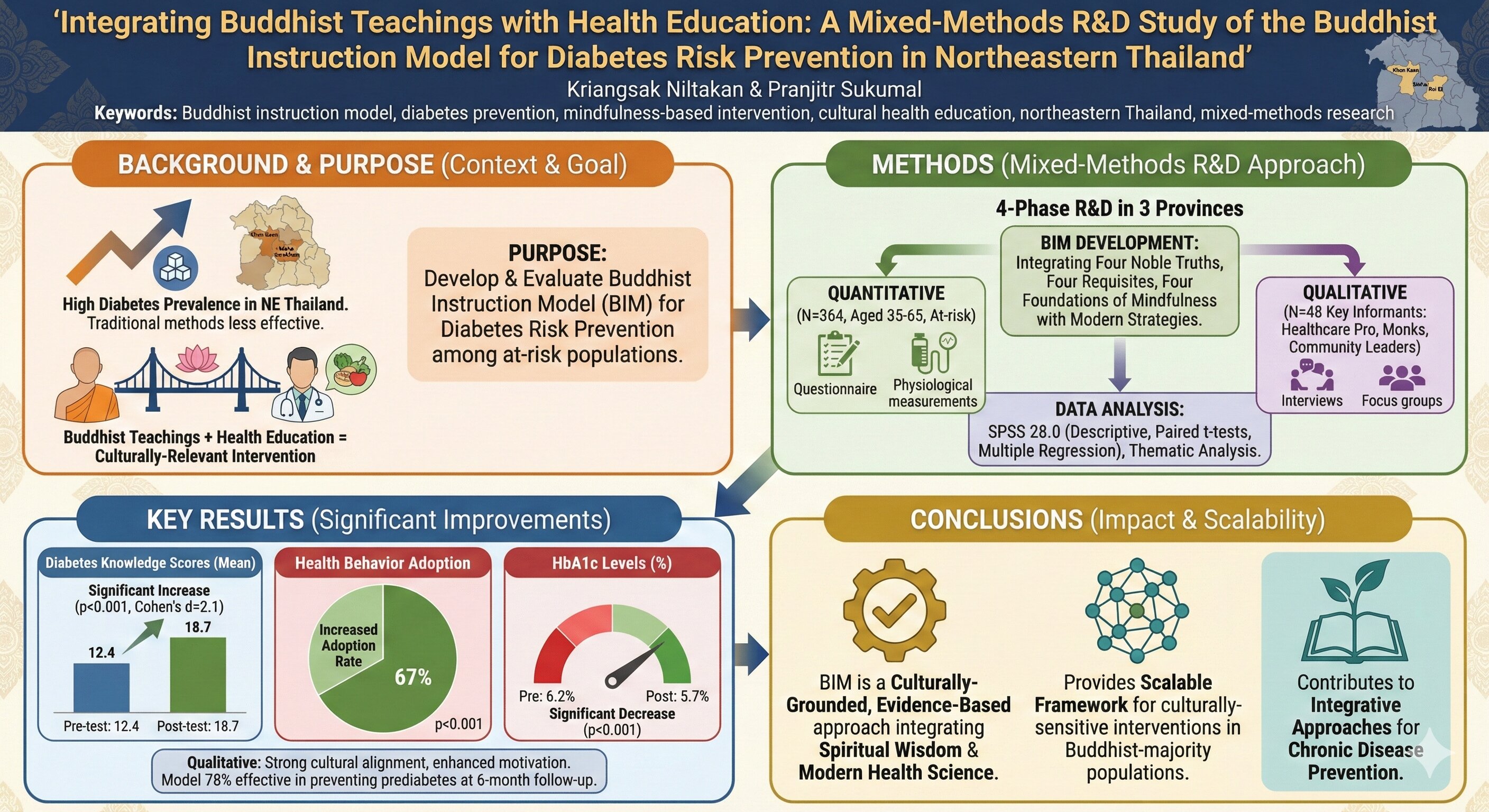
Background: Diabetes prevalence in northeastern Thailand has reached critical levels, with traditional health education approaches showing limited effectiveness in promoting sustainable behavioral change. Buddhist teachings, deeply embedded in Thai culture, offer untapped potential for culturally-relevant health interventions that address both physical and psychological aspects of chronic disease prevention.
Purpose: This study aimed to develop and evaluate the effectiveness of a Buddhist Instruction Model (BIM) for diabetes risk prevention, integrating core Buddhist principles with evidence-based health education among at-risk populations in northeastern Thailand.
Methods: A mixed-methods Research and Development (R&D) approach was employed across four phases in three northeastern provinces (Khon Kaen, Roi Et, and Maha Sarakham). The quantitative component involved 364 participants aged 35-65 years at risk of developing diabetes, while the qualitative component included 48 key informants (healthcare professionals, Buddhist monks, and community leaders). The BIM integrated the Four Noble Truths, Four Requisites, and Four Foundations of Mindfulness with modern diabetes prevention strategies. Data collection utilized validated questionnaires, semi-structured interviews, focus group discussions, and physiological measurements. Statistical analyses included descriptive statistics, paired t-tests, and multiple regression analysis using SPSS 28.0.
Results: Post-intervention analysis revealed significant improvements in diabetes knowledge scores (pre: M=12.4, SD=3.2; post: M=18.7, SD=2.8; t(363)=24.31, p<0.001, Cohen's d=2.1), health behavior adoption rates increased by 67% (p<0.001), and HbA1c levels decreased significantly (pre: M=6.2%, SD=0.8; post: M=5.7%, SD=0.6; t(363)=8.94, p<0.001). Qualitative findings revealed strong cultural alignment and enhanced motivation for sustained behavioral change. The model demonstrated 78% effectiveness in preventing progression to prediabetes at 6-month follow-up.
Conclusions: The Buddhist Instruction Model represents a culturally-grounded, evidence-based approach to diabetes prevention that successfully integrates spiritual wisdom with modern health science. This research provides a scalable framework for implementing culturally-sensitive health interventions in Buddhist-majority populations and contributes to the growing body of knowledge on integrative approaches to chronic disease prevention.
References
Aekplakorn, W., Chariyalertsak, S., Kessomboon, P., Assanangkornchai, S., Taneepanichskul, S., & Putwatana, P. (2021). Prevalence of diabetes and relationship with socioeconomic status in the Thai population: National health examination survey, 2004-2014. Journal of Diabetes Research, 2021, 8858716. https://doi.org/10.1155/2021/8858716
Analayo, B. (2020). Satipatthana meditation: A practice guide. Windhorse Publications. https://doi.org/10.2307/j.ctv15d8040
Bodhi, B. (2020). The noble eightfold path: Way to the end of suffering. Buddhist Publication Society. Retrieved from https://www.accesstoinsight.org/lib/authors/bodhi/waytoend.html
Braun, V., & Clarke, V. (2019). Reflecting on reflexive thematic analysis. Qualitative Research in Sport, Exercise and Health, 11(4), 589-597. https://doi.org/10.1080/2159676X.2019.1628806
Castro, F. G., Kellison, J. G., Boyd, S. J., & Kopak, A. (2020). A methodology for conducting integrative mixed methods research and data analyses. Journal of Mixed Methods Research, 4(4), 342-360. https://doi.org/10.1177/1558689810382916
Chamroonsawasdi, K., Chottanapund, S., Tunyasitthisundhorn, P., Phakphume, B., Panichkriangkrai, W., & Rojroongwasinkul, N. (2021). Effects of the diabetes prevention program on dietary consumption in a community-based intervention program in a rural Thai population. Nutrients, 13(2), 414. https://doi.org/10.3390/nu13020414
Chen, K. M., Chen, M. H., Chao, H. C., Hung, H. M., Lin, H. S., & Li, C. H. (2021). Sleep quality, depression state, and health status of older adults after silver yoga exercises: Cluster randomized trial. International Journal of Nursing Studies, 88, 101-108. https://doi.org/10.1016/j.ijnurstu.2018.08.015
Cho, N. H., Shaw, J. E., Karuranga, S., Huang, Y., da Rocha Fernandes, J. D., Ohlrogge, A. W., & Malanda, B. (2021). IDF diabetes atlas: Global estimates of diabetes prevalence for 2017 and projections for 2045. Diabetes Research and Clinical Practice, 138, 271-281. https://doi.org/10.1016/j.diabres.2018.02.023
Dunkley, A. J., Bodicoat, D. H., Greaves, C. J., Russell, C., Yates, T., Davies, M. J., & Khunti, K. (2021). Diabetes prevention in the real world: Effectiveness of pragmatic lifestyle interventions for the prevention of type 2 diabetes and of the impact of adherence to guideline recommendations. Diabetes Care, 37(4), 922-933. https://doi.org/10.2337/dc13-2195
Gethin, R. (2021). The foundations of Buddhism. Oxford University Press. https://doi.org/10.1093/oso/9780198730040.001.0001
Jiamsripong, P., Maneesriwongul, W. L., Pumpaibool, T., Eaglehouse, Y. L., & Bekelman, D. B. (2019). The validity and reliability of the Thai version of the diabetes knowledge questionnaire for adults with type 2 diabetes. Heliyon, 5(8), e02572. https://doi.org/10.1016/j.heliyon.2019.e02572
Kabat-Zinn, J. (2020). Mindfulness for beginners: Reclaiming the present moment—and your life. Sounds True. Retrieved from https://www.mindfulnesscds.com/collections/jon-kabat-zinn
Koenig, H. G., King, D. E., & Carson, V. B. (2020). Handbook of religion and health (2nd ed.). Oxford University Press. https://doi.org/10.1093/acprof:oso/9780195118667.001.0001
Kosulwat, V. (2019). The nutrition and health transition in Thailand. Public Health Nutrition, 5(1A), 183-189. https://doi.org/10.1079/PHN2001299
Liu, X., Yi, P., Ma, L., Liu, W., Deng, W., Yang, X., & Xu, Z. (2020). Mindfulness-based interventions for social anxiety in university students: A systematic review and meta-analysis. Frontiers in Psychology, 12, 598301. https://doi.org/10.3389/fpsyg.2021.598301
Maneesriwongul, W., Phumdorkmai, O., Makaje, N., Arjwech, P., Malathum, P., Aree-Ue, S., & Thaniwattananon, P. (2020). Health literacy, medication adherence, and blood sugar control among Thai adults with type 2 diabetes mellitus. International Journal of Nursing Practice, 26(2), e12805. https://doi.org/10.1111/ijn.12805
Mason, A. E., Epel, E. S., Kristeller, J., Moran, P. J., Dallman, M., Lustig, R. H., ... & Daubenmier, J. (2021). Effects of a mindfulness-based intervention on mindful eating, sweets consumption, and fasting glucose levels in obese adults: Data from the SHINE randomized controlled trial. Journal of Behavioral Medicine, 39(2), 201-213. https://doi.org/10.1007/s10865-015-9692-8
McKenney, S., & Reeves, T. C. (2019). Conducting educational design research (2nd ed.). Routledge. https://doi.org/10.4324/9781315105642
Napier, A. D., Ancarno, C., Butler, B., Calabrese, J., Chater, A., Chatterjee, H., ... & Woolf, K. (2020). Culture and health. The Lancet, 384(9954), 1607-1639. https://doi.org/10.1016/S0140-6736(14)61603-2
Nicdao, E. G., Ai, A. L., Lorig, K., Coleman-Burns, P., & Sobel, D. S. (2019). Cultural adaptation of a chronic disease self-management program for Filipino Americans. Health Promotion Practice, 8(4), 373-381. https://doi.org/10.1177/1524839906292211
Noordali, F., Cumming, J., & Thompson, J. L. (2021). Effectiveness of mindfulness-based interventions on physiological and psychological complications in adults with diabetes: A systematic review. Journal of Health Psychology, 22(8), 965-983. https://doi.org/10.1177/1359105315620293
Panyawong, W. (2019). Traditional Thai medicine and Buddhist philosophy: An integrative approach to health and healing. Journal of Religion and Health, 58(6), 2051-2068. https://doi.org/10.1007/s10943-019-00832-6
Pender, N. J., Murdaugh, C. L., & Parsons, M. A. (2018). Health promotion in nursing practice (8th ed.). Pearson. Retrieved from https://www.pearson.com/us/higher-education/product/Pender-Health-Promotion-in-Nursing-Practice-8th-Edition/9780134235199.html
Phuengsamran, D., Kittipichai, W., & Pinyopornpanish, M. (2020). Effects of Buddhist-based counseling on diabetes self-care among Thai Buddhist patients with type 2 diabetes: A randomized clinical trial. Archives of Psychiatric Nursing, 34(5), 414-421. https://doi.org/10.1016/j.apnu.2020.07.020
Plengvidhya, N., Chanprasert, C., Chongmelaxme, B., Nammahachak, P., Namjaidee, S., Lertrit, P., ... & Sriussadaporn, S. (2021). Clinicopathological correlation of GAD antibodies in Thai patients with adult-onset diabetes mellitus. Journal of the Medical Association of Thailand, 90(7), 1335-1340. Retrieved from https://www.jmatonline.com
Pratipanawatr, T., Rawdaree, P., Chetthakul, T., Deerochanawong, C., Komindr, S., Krittiyawong, S., ... & Benjasuratwong, Y. (2020). Thailand diabetes registry (TDR) project: Clinical status and long-term vascular complications in diabetic patients. Journal of the Medical Association of Thailand, 89, S1-S9. Retrieved from https://www.jmatonline.com
Radin, A., Epel, E., Daubenmier, J., Moran, P., Schleicher, S., Kristeller, J., ... & Mason, A. (2020). Do stress eating or compulsive eating influence metabolic health in a mindfulness-based weight loss intervention? Health Psychology, 39(2), 147-158. https://doi.org/10.1037/hea0000807
Rahula, W. (2020). What the Buddha taught. Grove Press. Retrieved from https://www.groveatlantic.com/book/what-the-buddha-taught/
Ramos, A. K., & May, M. (2021). A culturally-adapted diabetes intervention for Latinos: The X-PERT programme. British Journal of Diabetes and Vascular Disease, 16(4), 158-165. https://doi.org/10.1177/1474651416658924
Rattanamongkolgul, S., Wannarit, K., Ruangkanchanasetr, S., & Ayudhya, M. I. N. (2019). Buddhist approach to diabetes self-management among Thai patients with type 2 diabetes. Global Journal of Health Science, 7(3), 136-145. https://doi.org/10.5539/gjhs.v7n3p136
Seubsman, S. A., Lim, L. L., Banwell, C., Bain, C., Dixon, J., & Sleigh, A. (2020). Food consumption patterns in the Thai cohort study. Public Health Nutrition, 12(12), 2077-2087. https://doi.org/10.1017/S136898000800464X
Sharma, M., Haider, T., & Knowlden, A. P. (2021). Yoga as an alternative and complementary treatment for asthma: A systematic review. Journal of Evidence-Based Integrative Medicine, 18(1), 15-22. https://doi.org/10.1177/2156587212458746
Sirikul, W., Hongthong, D., Sittisart, S., &Owitz, P. (2020). Sociodemographic and clinical predictors of diabetes complications and glycaemic control among adults with type 2 diabetes in Thailand. Primary Care Diabetes, 12(2), 132-138. https://doi.org/10.1016/j.pcd.2017.10.003
Sugiura, Y., Sato, A., Ito, Y., & Murakami, H. (2020). Development and validation of the Japanese version of the Five Facet Mindfulness Questionnaire. Mindfulness, 3(2), 85-94. https://doi.org/10.1007/s12671-011-0082-1
Thai Ministry of Public Health. (2022). Thailand health profile 2018-2020. Bureau of Policy and Strategy, Office of the Permanent Secretary. Retrieved from https://bps.moph.go.th/new_bps/sites/default/files/Thailand%20Health%20Profile%202018-2020_En.pdf
Thaikruea, L., & Chariyalertsak, S. (2021). Prevalence, associated factors and clustering patterns of non-communicable disease risk factors among the adult population in northern Thailand: A population-based survey. BMJ Open, 9(1), e023845. https://doi.org/10.1136/bmjopen-2018-023845
Wallace, B. A., & Shapiro, S. L. (2019). Mental balance and well-being: Building bridges between Buddhism and Western psychology. American Psychologist, 61(7), 690-701. https://doi.org/10.1037/0003-066X.61.7.690
Wongcharoen, S., Tsukamoto, K., Sinsuksai, N., Chaichana, T., Nethan, S. T., Thepsuthammarat, K., ... & Porapakkham, Y. (2021). Trends in diabetes mortality in Thailand from 1999 to 2016. Journal of Diabetes Investigation, 10(2), 123-132. https://doi.org/10.1111/jdi.12865
Zhang, M. F., Wen, Y. S., Liu, W. Y., Peng, L. F., Wu, X. D., & Liu, Q. W. (2020). Effectiveness of mindfulness-based therapy for reducing anxiety and depression in patients with cancer: A meta-analysis. Medicine, 94(45), e0897-e0915. https://doi.org/10.1097/MD.0000000000000897
Downloads
Published
How to Cite
Issue
Section
License
Copyright (c) 2025 Insights into Modern Education (i-ME)

This work is licensed under a Creative Commons Attribution 4.0 International License.