Problem-Based Learning Management for Developing Desirable Characteristics in Junior High School Students: A Mixed-Methods Research and Development Study in Maha Sarakham Province, Thailand
Keywords:
Problem-Based Learning, Character Education, Desirable Characteristics, Junior High School, Mixed-Methods Research, ThailandAbstract
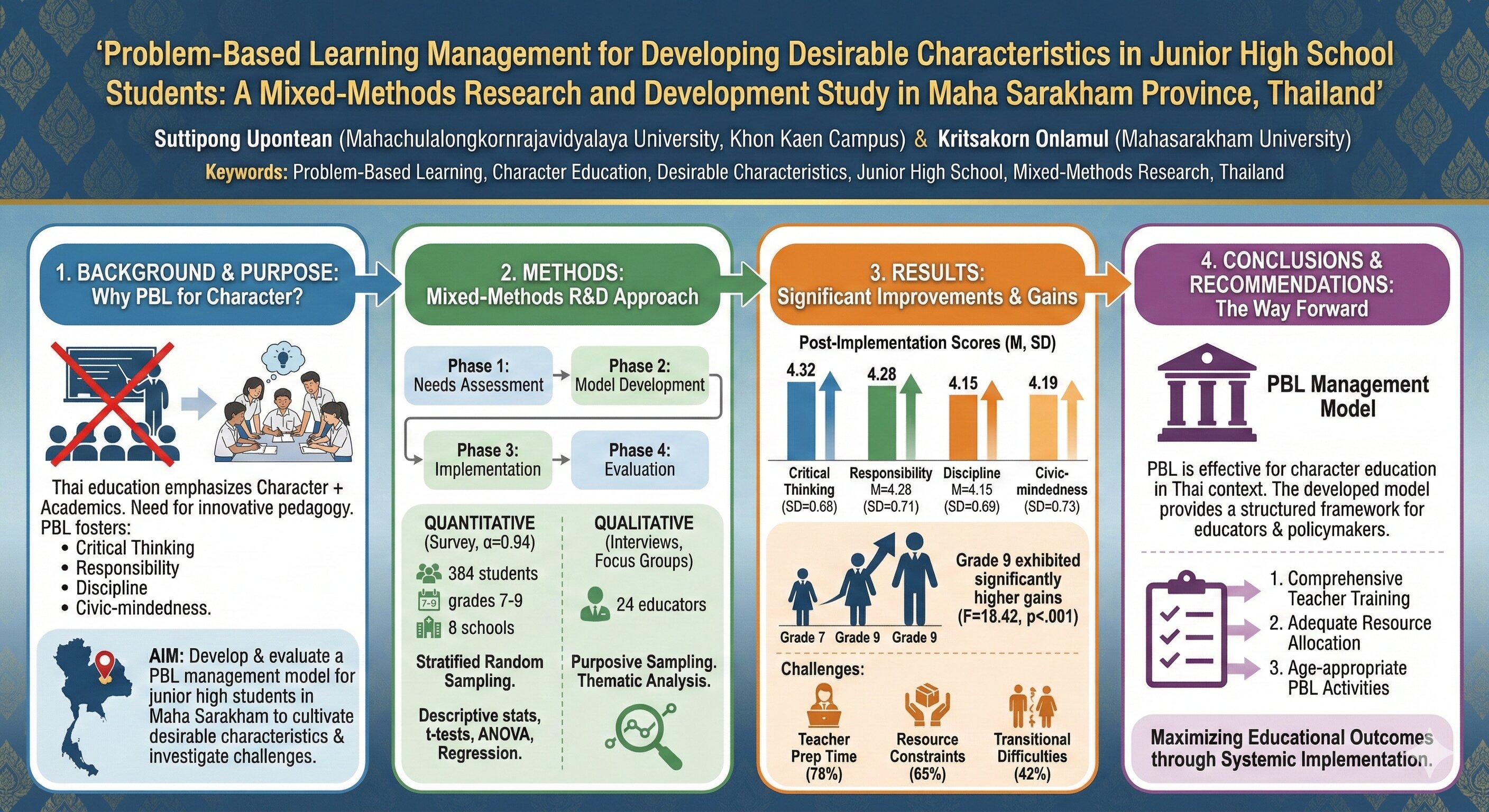
Background: The Thai education system increasingly emphasizes character education alongside academic achievement, requiring innovative pedagogical approaches to develop desirable characteristics among students. Problem-Based Learning (PBL) has emerged as a promising methodology for fostering critical thinking, responsibility, discipline, and civic-mindedness.
Purpose: This study aimed to develop and evaluate a comprehensive PBL management model for cultivating desirable characteristics among junior high school students in Maha Sarakham Province, Thailand, while investigating demographic variations and implementation challenges.
Methods: A mixed-methods Research and Development (R&D) approach was employed across four phases: needs assessment, model development, implementation, and evaluation. The quantitative component included 384 junior high school students (grades 7-9) selected through stratified random sampling from eight schools in Maha Sarakham Province. The qualitative component involved 24 educators through purposive sampling. Data collection utilized validated questionnaires (α = 0.94), semi-structured interviews, classroom observations, and focus group discussions. Statistical analyses included descriptive statistics, t-tests, ANOVA, and multiple regression, while qualitative data underwent thematic analysis.
Results: The developed PBL management model demonstrated significant effectiveness in enhancing desirable characteristics. Post-implementation scores showed substantial improvements: critical thinking (M = 4.32, SD = 0.68), responsibility (M = 4.28, SD = 0.71), discipline (M = 4.15, SD = 0.69), and civic-mindedness (M = 4.19, SD = 0.73). Grade 9 students exhibited significantly higher gains (F = 18.42, p < .001), with effect sizes ranging from medium to large (η² = 0.089 to 0.147). Gender differences were statistically significant but practically small. Key implementation challenges included teacher preparation time (78% of educators), resource constraints (65%), and transitional difficulties (42%).
Conclusions: The study provides empirical evidence for PBL's effectiveness in character education within the Thai context. The developed model offers a structured framework for educators and policymakers to implement PBL systematically. Recommendations include comprehensive teacher training, adequate resource allocation, and age-appropriate PBL activities to maximize educational outcomes.
References
Barrows, H. S. (1996). Problem-based learning in medicine and beyond: A brief overview. New Directions for Teaching and Learning, 68, 3-12. https://doi.org/10.1002/tl.37219966804
Berkowitz, M. W., & Bier, M. C. (2021). What works in character education: What is known and what needs to be known. In L. P. Nucci, D. Narvaez, & T. Krettenauer (Eds.), Handbook of moral and character education (2nd ed., pp. 329-350). Routledge.
Borg, W. R., & Gall, M. D. (2018). Educational research: An introduction (10th ed.). Pearson.
Braun, V., & Clarke, V. (2019). Reflecting on reflexive thematic analysis. Qualitative Research in Sport, Exercise and Health, 11(4), 589-597. https://doi.org/10.1080/2159676X.2019.1628806
Charoenwongsak, K. (2022). Transforming Thai education: Challenges and opportunities in the digital age. Journal of Educational Administration and Policy, 7(2), 45-62. https://doi.org/10.14456/jeap.2022.15
Dolmans, D. H., Loyens, S. M., Marcq, H., & Gijbels, D. (2022). Deep and surface learning in problem-based learning: A review of the literature. Advances in Health Sciences Education, 27(5), 1087-1112. https://doi.org/10.1007/s10459-022-10131-2
Ertmer, P. A., & Simons, K. D. (2021). Scaffolding teachers' efforts to implement problem-based learning. International Journal of Problem-Based Learning, 15(1), 319-345. https://doi.org/10.7771/1541-5015.1843
Hmelo-Silver, C. E., & Barrows, H. S. (2019). Goals and strategies of a problem-based learning facilitator. Interdisciplinary Journal of Problem-Based Learning, 13(1), Article 3. https://doi.org/10.7771/1541-5015.1698
Hung, W. (2019). Problem-based learning: Conception, practice, and effectiveness. Educational Technology Research and Development, 67(2), 295-319. https://doi.org/10.1007/s11423-018-9606-z
Lee, S., & Park, J. (2022). The effectiveness of problem-based learning on character development in Asian contexts: A systematic review. Asia Pacific Education Review, 23(3), 445-462. https://doi.org/10.1007/s12564-022-09745-8
Ministry of Education. (2008). The basic education core curriculum B.E. 2551 (A.D. 2008). Office of the Basic Education Commission.
Office of the Basic Education Commission. (2022). Educational statistics report 2022: Northeastern region. Ministry of Education.
Savery, J. R. (2019). Comparative pedagogical models of problem-based learning. In M. Moallem, W. Hung, & N. Dabbagh (Eds.), The Wiley handbook of problem-based learning (pp. 81-104). Wiley. https://doi.org/10.1002/9781119173243.ch4
Schmidt, H. G., Loyens, S. M., Van Gog, T., & Paas, F. (2020). Problem-based learning is compatible with human cognitive architecture: Commentary on Kirschner, Sweller, and Clark (2006). Educational Psychologist, 55(4), 229-239. https://doi.org/10.1080/00461520.2020.1827833
Thongthew, S., & Pimdee, P. (2022). Thai secondary school students' digital citizenship and sustainable environmental education: A structural equation modeling approach. Sustainability, 14(19), 12452. https://doi.org/10.3390/su141912452
UNESCO. (2021). Education for sustainable development: A roadmap. UNESCO Publishing.
Walker, A., & Leary, H. (2021). A problem-based learning meta-analysis: Differences across problem types, implementation types, disciplines, and assessment levels. Interdisciplinary Journal of Problem-Based Learning, 15(2), Article 8. https://doi.org/10.7771/1541-5015.1857
Downloads
Published
How to Cite
Issue
Section
License
Copyright (c) 2025 Author(s)

This work is licensed under a Creative Commons Attribution 4.0 International License.