Critical Thinking Integration in Thai Secondary Schools: A Mixed-Methods Analysis of Pedagogical Transformation in Northeast Thailand's Educational Landscape
Keywords:
critical thinking, educational transformation, Thai education, mixed-methods research, pedagogical innovation, northeast ThailandAbstract
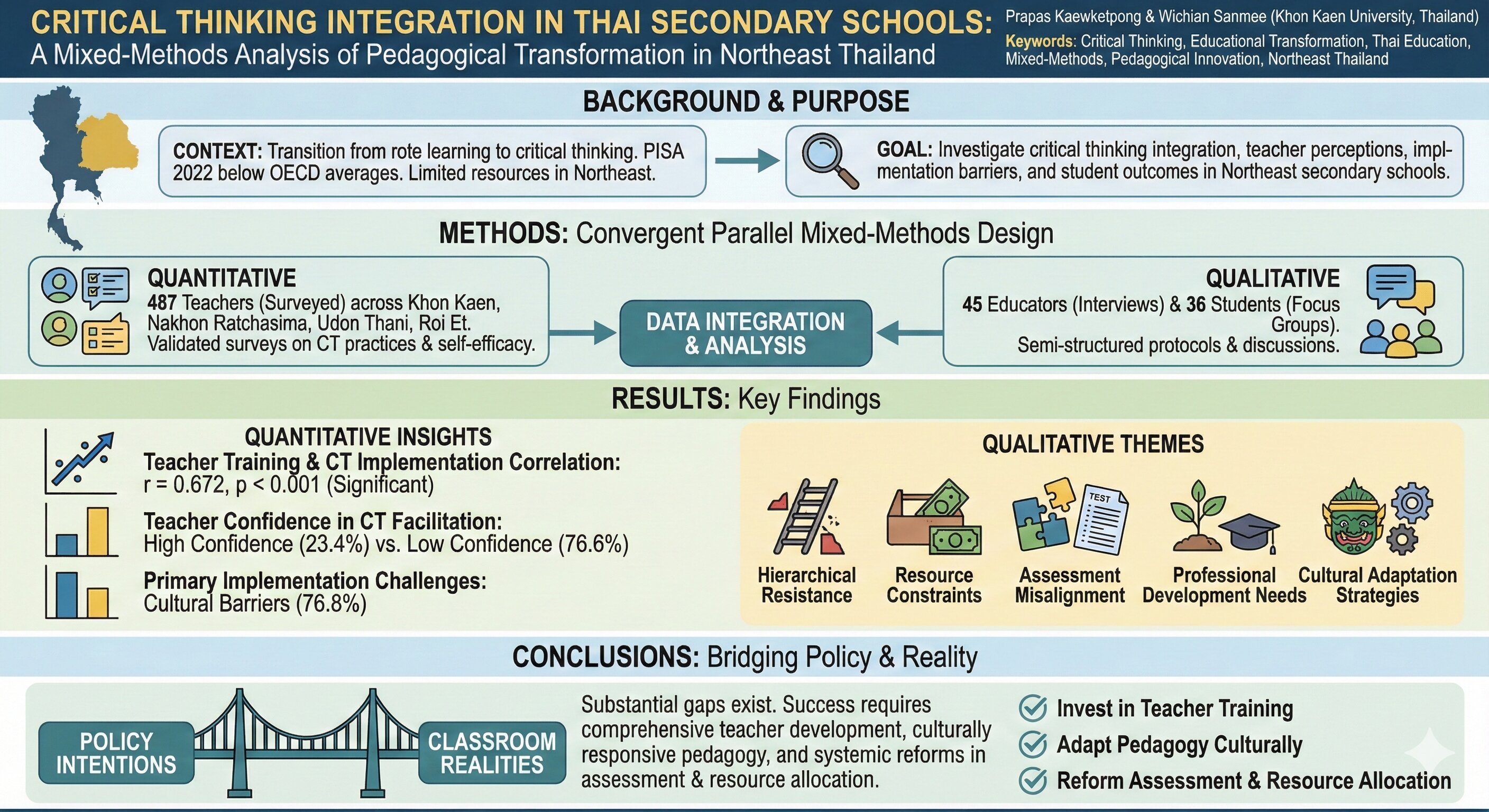
Background: Thailand's educational system faces mounting pressure to transition from traditional rote learning methodologies to critical thinking-centered approaches. Recent PISA 2022 results revealed Thai students scoring significantly below OECD averages, with particular concerns in northeastern provinces where educational resources remain limited.
Purpose: This mixed-methods study investigates the current state of critical thinking integration in secondary schools across northeast Thailand, examining teacher perceptions, implementation barriers, and student outcomes in the context of 21st-century educational transformation.
Methods: A convergent parallel mixed-methods design was employed across four northeastern provinces (Khon Kaen, Nakhon Ratchasima, Udon Thani, and Roi Et). Quantitative data were collected from 487 secondary school teachers through validated surveys measuring critical thinking teaching practices and self-efficacy. Qualitative insights were gathered through semi-structured interviews with 45 purposively selected educators and focus group discussions with 36 students.
Results: Statistical analysis revealed significant correlations between teacher training exposure and critical thinking implementation (r = 0.672, p < 0.001). Only 23.4% of teachers demonstrated high confidence in facilitating critical thinking activities, while 76.8% identified cultural barriers as primary implementation challenges. Thematic analysis uncovered five key implementation themes: hierarchical resistance, resource constraints, assessment misalignment, professional development needs, and cultural adaptation strategies.
Conclusions: The study reveals substantial gaps between policy intentions and classroom realities in critical thinking integration. Success requires comprehensive teacher development programs, culturally responsive pedagogical approaches, and systemic reforms addressing assessment practices and resource allocation.
References
Abrami, P. C., Bernard, R. M., Borokhovski, E., Waddington, D. I., Wade, C. A., & Persson, T. (2015). Strategies for teaching students to think critically: A meta-analysis. Review of Educational Research, 85(2), 275-314. https://doi.org/10.3102/0034654314551063
Aksornkool, N., & Konawarathna, S. (2021). Educational transformation in ASEAN: Challenges and opportunities for critical thinking development. Asia Pacific Journal of Education, 41(3), 428-445. https://doi.org/10.1080/02188791.2020.1793738
Anderson, L. W., & Krathwohl, D. R. (Eds.). (2001). A taxonomy for learning, teaching, and assessing: A revision of Bloom's taxonomy of educational objectives. Longman.
Bandura, A. (2006). Self-efficacy beliefs of adolescents. Information Age Publishing.
Braun, V., & Clarke, V. (2019). Reflecting on reflexive thematic analysis. Qualitative Research in Sport, Exercise and Health, 11(4), 589-597. https://doi.org/10.1080/2159676X.2019.1628806
Changwong, K., Sukkamart, A., & Sisan, B. (2018). Critical thinking skill development: Analysis of a new learning management model for Thai high schools. Journal of International Studies, 11(2), 37-48. https://doi.org/10.14254/2071-8330.2018/11-2/3
Chantarasombat, C. (2020). Buddhist principles and critical thinking integration in Thai higher education. International Journal of Buddhist Thought and Culture, 30(2), 67-89. https://doi.org/10.16893/IJBTC.2020.09.30.2.67
Creswell, J. W., & Plano Clark, V. L. (2018). Designing and conducting mixed methods research (3rd ed.). Sage Publications.
Facione, P. A. (2020). Critical thinking: What it is and why it counts. Insight Assessment. https://www.insightassessment.com/wp-content/uploads/ia/pdf/whatwhy.pdf
Facione, P. A., Facione, N. C., & Giancarlo, C. A. F. (2019). The disposition toward critical thinking: Its character, measurement, and relationship to critical thinking skill. Informal Logic, 20(1), 61-84. https://doi.org/10.22329/il.v20i1.2254
Ku, K. Y. L., & Ho, I. T. (2020). Metacognitive strategies that enhance critical thinking. Metacognition and Learning, 5(3), 251-267. https://doi.org/10.1007/s11409-010-9060-6
Lau, K. C., & Chan, D. W. (2019). Critical thinking in Asian contexts: Challenges and opportunities. Educational Psychology Review, 31(4), 851-876. https://doi.org/10.1007/s10648-019-09500-x
OECD. (2022). PISA 2022 results (Volume I and II): Country notes - Thailand. OECD Publishing. https://www.oecd.org/en/publications/pisa-2022-results-volume-i-and-ii-country-notes_ed6fbcc5-en/thailand_6138f4af-en.html
Panya, N., & Thongsin, S. (2020). Regional educational disparities in northeastern Thailand: A comprehensive analysis. Asian Education and Development Studies, 9(4), 487-502. https://doi.org/10.1108/AEDS-03-2019-0048
Sirisookslip, S., Ariratana, W., & Ngang, T. K. (2020). The development of leadership of student council for Thailand 4.0. International Journal of Instruction, 13(2), 445-456. https://doi.org/10.29333/iji.2020.13231a
Suwannoi, P., & Pasiphol, S. (2021). Cultural adaptation of critical thinking instruction in Thai secondary schools. Contemporary Educational Psychology, 67, 101995. https://doi.org/10.1016/j.cedpsych.2021.101995
Thongsin, S., Boonyanuwat, N., & Laonongwa, A. (2021). Impact of COVID-19 on educational practices in northeast Thailand: Teacher adaptation and student learning outcomes. Education Sciences, 11(8), 423. https://doi.org/10.3390/educsci11080423
Vygotsky, L. S. (1978). Mind in society: The development of higher psychological processes. Harvard University Press.
Downloads
Published
How to Cite
Issue
Section
License
Copyright (c) 2025 Author(s)

This work is licensed under a Creative Commons Attribution 4.0 International License.