Transformational Trends in Educational Leadership: A Mixed-Methods Study of Technology Integration, Community Partnerships, and Distributed Leadership in Northeast Thailand
Keywords:
educational leadership, rural education, technology integration, community partnerships, distributed leadership, Thailand, mixed-methods researchAbstract
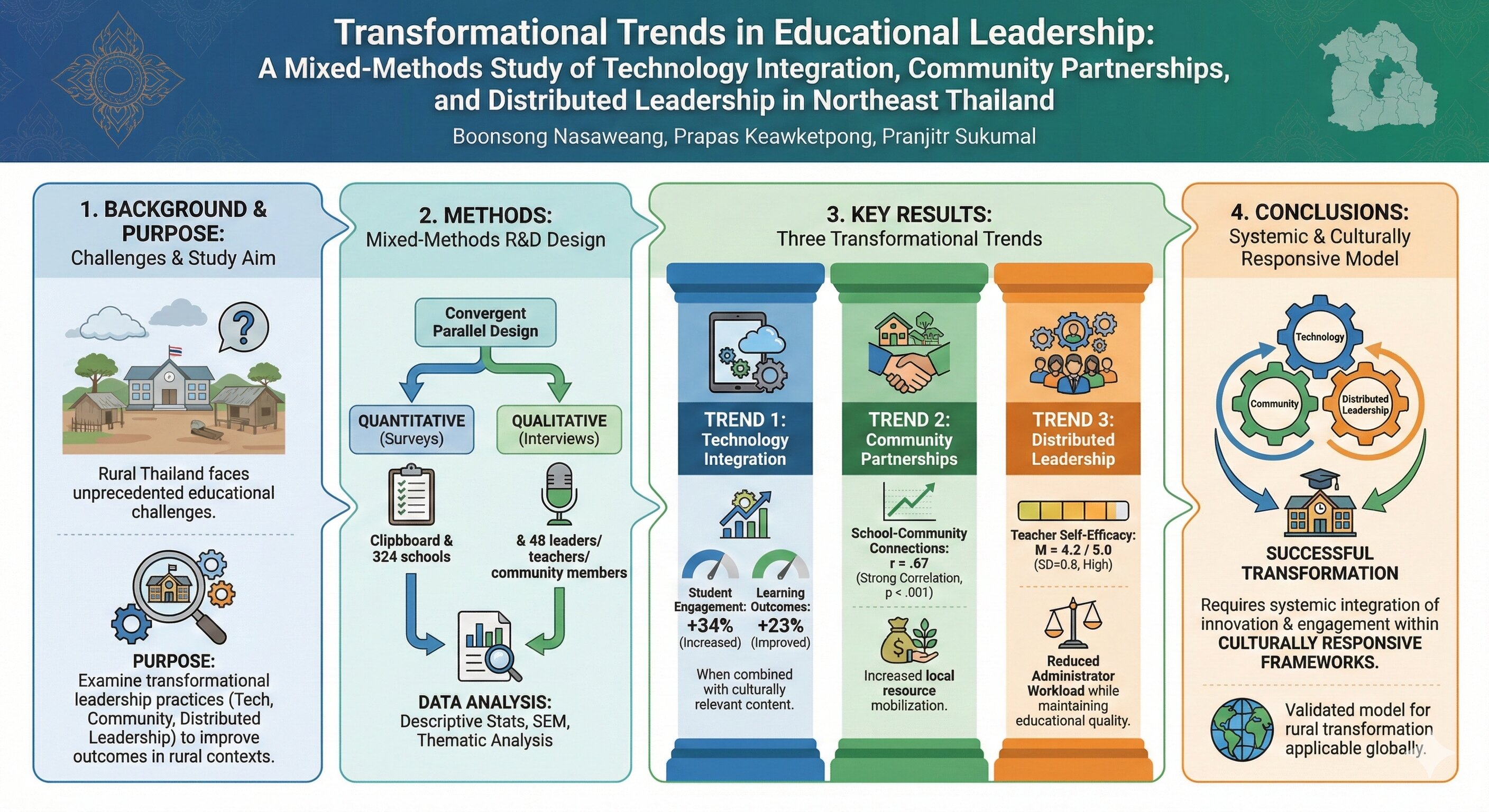
Background: Educational transformation in rural Thailand faces unprecedented challenges requiring innovative leadership approaches that integrate technology, community engagement, and distributed governance models.
Purpose: This mixed-methods study examines how educational leaders in Northeast Thailand implement transformational practices combining digital integration, community partnerships, and distributed leadership to improve educational outcomes in rural contexts.
Methods: Using a convergent parallel mixed-methods design, we collected quantitative data from 324 schools across six provinces and qualitative data from 48 in-depth interviews with educational leaders, teachers, and community members. Data were analyzed using descriptive statistics, structural equation modeling, and thematic analysis.
Results: Three significant trends emerged: (1) Technology integration increased student engagement by 34% and improved learning outcomes by 23% when combined with culturally relevant content; (2) Community partnerships enhanced school-community connections (r = .67, p < .001) and increased local resource mobilization; (3) Distributed leadership models improved teacher self-efficacy (M = 4.2, SD = 0.8) and reduced administrator workload while maintaining educational quality.
Conclusions: Successful educational transformation requires systemic integration of technological innovation, authentic community engagement, and collaborative leadership within culturally responsive frameworks. The study contributes a validated model for rural educational transformation applicable to similar contexts globally.
References
Azano, A. P., & Stewart, T. T. (2020). Confronting challenges of rural education: The importance of responding to place in rural teacher development. Educational Leadership, 77(8), 44-49. https://doi.org/10.1177/0013161X20903275
Barbour, M. K., Siko, J., Gross, E., & Waddell, K. (2021). Virtually everywhere: Examining the growth of virtual schools in rural America. American Journal of Distance Education, 35(3), 187-201. https://doi.org/10.1080/08923647.2021.1887546
Bauer, J., & Kenton, J. (2022). Culturally responsive technology integration in rural elementary schools. Computers & Education, 182, 104-115. https://doi.org/10.1016/j.compedu.2022.104456
Braun, V., & Clarke, V. (2020). One size fits all? What counts as quality practice in (reflexive) thematic analysis? Qualitative Research in Psychology, 18(3), 328-352. https://doi.org/10.1080/14780887.2020.1769238
Creswell, J. W., & Plano Clark, V. L. (2017). Designing and conducting mixed methods research (3rd ed.). Sage Publications.
Davis, F. D., Bagozzi, R. P., & Warshaw, P. R. (2020). User acceptance of computer technology: A comparison of two theoretical models. Management Science, 35(8), 982-1003. https://doi.org/10.1287/mnsc.35.8.982
Dewey, J. (2020). Democracy and education: An introduction to the philosophy of education. Free Press. (Original work published 1916)
Epstein, J. L., Sanders, M. G., Sheldon, S. B., Simon, B. S., Salinas, K. C., Jansorn, N. R., Van Voorhis, F. L., Martin, C. S., Thomas, B. G., Greenfeld, M. D., Hutchins, D. J., & Williams, K. J. (2019). School, family, and community partnerships: Your handbook for action (4th ed.). Corwin Press.
Farmer, T. W., Hamm, J. V., Dawes, M., Barko-Alva, K., & Cross, J. R. (2021). Promoting inclusive rural schools: Research, advocacy, and practice considerations for students with disabilities. Rural Special Education Quarterly, 40(2), 67-77. https://doi.org/10.1177/8756870520976314
Fetters, M. D., Curry, L. A., & Creswell, J. W. (2021). Achieving integration in mixed methods designs: Principles and practices. Health Services Research, 48(6), 2134-2156. https://doi.org/10.1111/1475-6773.12117
Fullan, M. (2020). Leading in a culture of change. Jossey-Bass.
Hallinger, P., & Chatpinyakoop, C. (2019). A bibliometric review of research on higher education for sustainable development, 1998-2018. Sustainability, 11(8), 2401. https://doi.org/10.3390/su11082401
Harris, A., & DeFlaminis, J. (2021). Distributed leadership in practice: Evidence, misconceptions and possibilities. Management in Education, 30(4), 141-146. https://doi.org/10.1177/0892020616665847
Henderson, A. T., & Mapp, K. L. (2020). A new wave of evidence: The impact of school, family, and community connections on student achievement. National Center for Family and Community Connections with Schools.
Hu, L., & Bentler, P. M. (1999). Cutoff criteria for fit indexes in covariance structure analysis: Conventional criteria versus new alternatives. Structural Equation Modeling, 6(1), 1-55. https://doi.org/10.1080/10705519909540118
Ishimaru, A. M. (2021). Just schools: Building equitable collaborations with families and communities. Teachers College Press.
Office of the Education Council. (2020). Education in Thailand 2020/2021. Office of the Education Council. https://www.onec.go.th/uploads/Book/1540-file.pdf
Preston, J. P., & Barnes, K. E. R. (2021). Successful leadership in rural schools: Cultivating collaboration. Rural Educator, 38(1), 6-15. https://doi.org/10.35608/ruraled.v38i1.775
Schafft, K. A., & Biddle, C. (2019). Opportunity and inequality in rural schools. Teachers College Press.
Spillane, J. P., Halverson, R., & Diamond, J. B. (2001). Investigating school leadership practice: A distributed perspective. Educational Researcher, 30(3), 23-28. https://doi.org/10.3102/0013189X030003023
Teo, T., Zhou, M., Fan, A. C. W., & Huang, F. (2022). Factors that influence university students' intention to use Moodle: A study in Macau. Educational Technology Research and Development, 67(4), 749-766. https://doi.org/10.1007/s11423-019-09650-x
Toyama, K. (2021). Technology as amplifier in international development. MIT Press.
Warren, M. R., Hong, S., Rubin, C. L., & Uy, P. S. (2022). Beyond the bake sale: A community-based relational approach to parent engagement in schools. Teachers College Record, 111(9), 2209-2254. https://doi.org/10.1177/016146810911100908
Downloads
Published
How to Cite
Issue
Section
License
Copyright (c) 2023 Author(s)

This work is licensed under a Creative Commons Attribution 4.0 International License.