
Buddhism and the Cultivation of Psychological Resilience in a Rapidly Changing Society
Article Sidebar
Main Article Content
Abstract
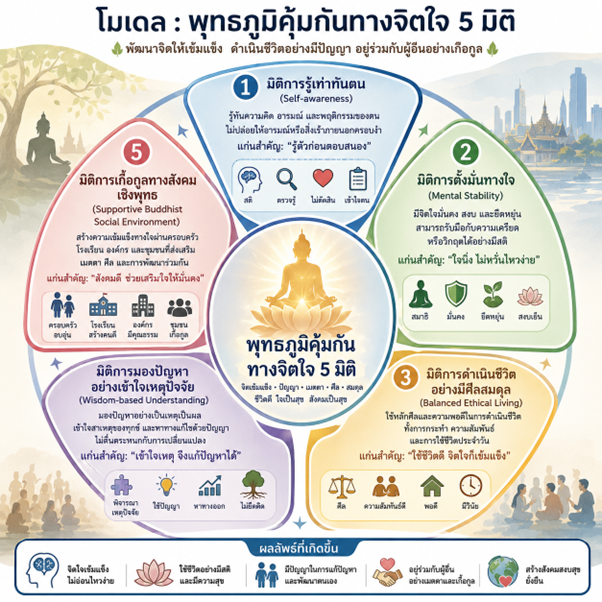
This academic article examines the role of Buddhism in strengthening psychological immunity in a rapidly changing society, analyzes the components of mental resilience within an integrated Buddhist framework, and synthesizes academic implications for contemporary Thai society. The study employs qualitative documentary research based on 12 Thai-language journal articles published in TCI-indexed journals. The selected works cover mindfulness, psychological resilience, holistic well-being, Bhavana 4, Buddhist psychological strength, stress reduction, and mental development among youth, university students, working-age adults, and older persons. The findings show that Buddhism does not understand psychological immunity merely as protection from mental illness. Rather, it sees it as a holistic process of human development. Key components include mindfulness, emotional awareness, wise coping, balanced self-reliance, hope, psychological flexibility, and socially grounded moral living through ethics and compassion. The reviewed literature consistently indicates that mindfulness, Bhavana 4, Bala 5, the Four Noble Truths, and Buddhist psychology can be used as practical frameworks for cultivating inner strength, reducing stress, promoting mental well-being, and enhancing the capacity to cope with uncertainty. This article proposes a new conceptual framework called the “Five Dimensions of Buddhist Psychological Immunity”: self-awareness, mental stability, ethical and balanced living, causal understanding of suffering, and Buddhist-oriented social support. It argues that strengthening psychological immunity in Thai society should not be limited to clinical services or crisis intervention. Instead, it should be developed as a cultural and educational foundation for self-care, mental stability, and collective well-being in families, schools, workplaces, and communities.
Article Details

This work is licensed under a Creative Commons Attribution-NonCommercial-NoDerivatives 4.0 International License.
References
จิรชฎา เชียงกูล และเมธาวี อุดมธรรมานุภาพ. (2567). การพัฒนาสุขภาวะองค์รวมอย่างมีความสุขตามแนวพุทธจิตวิทยา. วารสารจิตวิทยาพุทธศาสตร์ประยุกต์เพื่อสังคม, 10(1), 277–290.
ชำนาญ เกิดช่อ และ คณะ. (2568). แนวทางการเสริมสร้างสุขภาวะแนวพุทธในสังคมผู้สูงวัย. วารสารวิจยวิชาการ, 8(1), 369–380.
ณญาน นลินขวัญ วิชชุดา ฐิติโชติรัตนา และเมธาวี อุดมธรรมานุภาพ. (2568). คุณค่าของการเจริญสติ. วารสารพุทธจิตวิทยา, 10(1), 22–30.
ณญาน นลินขวัญ เมธาวี อุดมธรรมานุภาพ และสิริวัฒน์ ศรีเครือดง. (2567). การพัฒนาสุขภาวะองค์รวมด้วยหลักภาวนา 4. วารสารพุทธจิตวิทยา, 9(4), 700–710.
ปรีญาณี กองบุญมา, กมลาศ ภูวชนาธิพงศ์, และ วิชชุดา ฐิติโชติรัตนา. (2568). พุทธจิตวิทยา: แนวทางสู่สุขภาวะสำหรับคนวัยทำงาน กลุ่มแซนด์วิชเจเนอเรชั่นในประเทศไทย. วารสารจิตวิทยาพุทธศาสตร์ประยุกต์เพื่อสังคม, 11(1), 391–403.
ประสาร ศรีพงษ์เพลิด. (2568). การวิเคราะห์องค์ประกอบเชิงยืนยันของภูมิคุ้มกันทางจิตในยุคชีวิตวิถีใหม่ของนิสิตนักศึกษาระดับปริญญาตรี สังกัดสถาบันอุดมศึกษา. วารสารพุทธจิตวิทยา, 10(1), 103–114.
พรทิพย์ เกศตระกูล, สิริวัฒน์ ศรีเครือดง, และ กมลาศ ภูวชนาธิพงศ์. (2565). พุทธจิตวิทยาเพื่อพลังใจวัยรุ่น. วารสารพุทธจิตวิทยา, 7(2), 79–88.
พุทธชาติ แผนสมบุญ และคณะ (2567). การพัฒนาตัวบ่งชี้ภูมิคุ้มกันทางใจเพื่อเสริมสร้างทักษะชีวิตวิถีใหม่ตามแนวพุทธจิตวิทยาสำหรับเยาวชนในสังคมไทย. วารสารจิตวิทยาพุทธศาสตร์ประยุกต์เพื่อสังคม, 10(1), 43–55.
พระพรหมบัณฑิต (ประยูร ธมฺมจิตฺโต). (2556). พุทธบูรณาการ เพื่อการพัฒนาจิตใจและสังคม. วารสาร มจร สังคมศาสตร์ปริทรรศน์, 3(3), 1–24.
พระสมุห์วัลลภ วลฺลโภ (เจสระ). (2559). การพัฒนาจิตเพื่อลดความยึดติดในมิติทางพระพุทธศาสนา. วารสารพุทธจิตวิทยา, 1(2), 15–29.
วรัญญา สิริโพธิธนากุล. (2568). ปัจจัยที่เสริมสร้างพลังใจตามแนวพุทธจิตวิทยา เพื่อส่งเสริมสุขภาวะทางจิตของผู้สูงอายุในสังคมไทย. วารสารบัณฑิตศึกษาปริทรรศน์, 21(1), 193–211.
วุฒิชัย อุทธาพงษ์, สิริวัฒน์ ศรีเครือดง, และ กมลาศ ภูวชนาธิพงศ์. (2566). การฝึกสติเพื่อการพัฒนาความยืดหยุ่นทางจิตใจในผู้สูงอายุ. วารสารจิตวิทยาพุทธศาสตร์ประยุกต์เพื่อสังคม, 9(2), 376–393.
