
Buddhist Innovation and Human Development in Contemporary Society
Article Sidebar
Main Article Content
Abstract
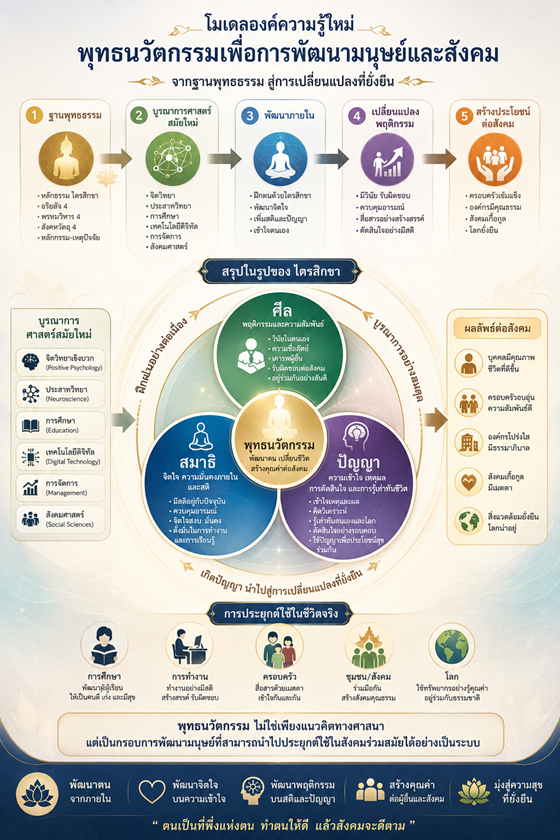
This academic article aims to examine Buddhist innovation and human development in contemporary society. It focuses on the meaning, components, and application of Buddhist principles for human development amid rapid changes in technology, economy, competition, consumer culture, stress, and psychological vulnerability in modern life. This article employs a documentary study by reviewing Buddhist concepts, human development theories, innovation concepts, and relevant academic literature. The collected data are analyzed and synthesized into an integrative Buddhist framework.The study finds that Buddhist innovation does not merely refer to the creation of new material objects or technologies. Rather, it refers to the creative application of Buddhist teachings in new contexts in order to generate meaningful value for individuals, organizations, communities, and society. The Threefold Training serves as a key foundation for holistic human development. Morality develops behavior, responsibility, and relationships. Concentration develops mental stability, mindfulness, and emotional regulation. Wisdom develops understanding, reasoning, decision-making, and awareness of life. The new body of knowledge proposed in this article is the “Buddhist Innovation Model for Contemporary Human Development,” consisting of five components: Buddhist principles, interdisciplinary integration, inner development, behavioral transformation, and social responsibility. The article argues that Buddhist innovation can serve as an important approach for cultivating capable, ethical, mindful, wise, and balanced human beings in contemporary society.
Article Details

This work is licensed under a Creative Commons Attribution-NonCommercial-NoDerivatives 4.0 International License.
References
ธนัท ติระพรชัย. (2567). พุทธนวัตกรรมกับการพัฒนาทุนมนุษย์. วารสารสหวิทยาการนวัตกรรมปริทรรศน์, 7(1), 310–319.
ธีรทัศน์ ปิติภาคย์พงษ์, อำพร เจริญพร้อม, และวิลาวัลย์ บุญเพ็ง. (2568). ไตรสิกขากับการพัฒนามนุษย์ในศตวรรษที่ 21. วารสารครุพัฒนาปริทรรศน์, 2(2), 1–11.
ปาริชาติ เปรมวิชัย. (2566). หลักไตรสิกขาเพื่อการพัฒนาทรัพยากรมนุษย์. วารสารสหวิทยาการนวัตกรรมปริทรรศน์, 6(1), A34–A41.
พระครูใบฏีกาแสงเฮือง นรินฺโท และคณะ. (2569). พุทธนวัตกรรมและการยกระดับคุณภาพชีวิตพฤติกรรมการใช้ความรุนแรงของเด็กและเยาวชนเพื่อขับเคลื่อนยกระดับชุมชนสู่สันติสุขในจังหวัดบึงกาฬ. วารสาร มจร พุทธศาสตร์ปริทรรศน์, 10(1), 97–110.
พระครูพิศาลพัฒนานุกิจ (สุจินต์ นันตมาศ). (2568). พุทธการบริหารทุนมนุษย์ในศตวรรษที่ 21. วารสารพุทธนวัตกรรมและการจัดการ, 8(1), 194–208.
พระครูสมุห์พูลสวัสดิ์ ฐิตสีโล. (2567). การพัฒนาทุนมนุษย์ตามแนวพระพุทธศาสนา. วารสารพุทธนวัตกรรมและการจัดการ, 7(3), 207–218.
พระมหาจิณณวัตร สุจิณฺโณ กันยาประสิทธิ์, และพระมหาธีระชัย สุจิตฺโต ภักมี. (2567). ไตรสิกขากับการพัฒนาคุณภาพชีวิต. วารสาร มจร อุบลปริทรรศน์, 9(2),2604-2612.
พระมหาบรรณ ปญฺญาธโร. (2565). การพัฒนาคุณภาพชีวิตตามลักษณะทางพระพุทธศาสนา. วารสารพุทธนวัตกรรมและการจัดการ, 5(2), 183–191.
พระฤทธิรงค์ ขนฺติธมฺโม (บุญแสน), พระครูประยุตสารธรรม, อาทิตย์ ผ่านพูล, และณฐอร เจือจันทร์. (2569). ยุทธศาสตร์การพัฒนาพุทธนวัตกรรมเพื่อความยั่งยืนของสังคมไทยในศตวรรษที่ 21. วารสารสินธุ์โสธร, 2(1),47-59.
โยตะ ชัยวรมันกุล, สุพัฒน์ ชัยวรรณ์, พระมหาวีรธิษณ์ วรินฺโท, ผจญ คำชูสงข์, และธวัช หอมทวนลม. (2565). พุทธนวัตกรรมในการพัฒนาการเรียนรู้ของเด็กและเยาวชน. วารสาร มจร พุทธปัญญาปริทรรศน์, 7(2), 91–103.
วีนัส ธรรมสาโรรัชต์. (2567). การบูรณาการตามหลักไตรสิกขาเพื่อการพัฒนาทรัพยากรมนุษย์ของสำนักงานพื้นที่การศึกษาจังหวัดราชบุรี. วารสาร มจร สังคมศาสตร์ปริทรรศน์, 13(2), 476–483.
อรรถพล เสือคำรณ. (2566). การพัฒนาทุนมนุษย์ตามแนวพระพุทธศาสนา เพื่อการพัฒนาองค์กรอย่างยั่งยืน. วารสารสหวิทยาการนวัตกรรมปริทรรศน์, 6(2), A217–A228.
