The New Meaning of Religion in Thailand's Online Society
Article Sidebar
Main Article Content
Abstract
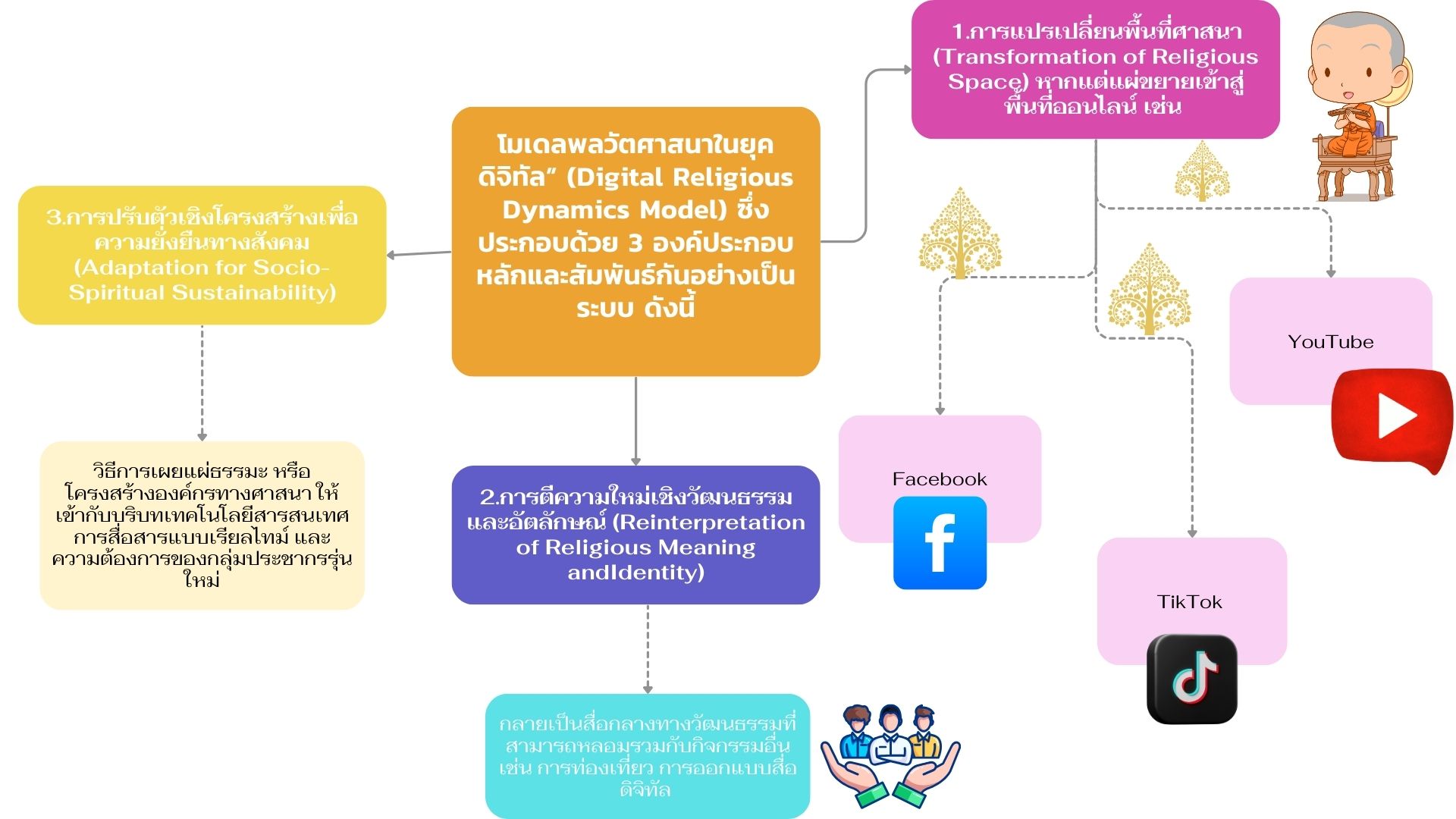
This article presents a new body of knowledge concerning the "New Meaning of Religion in the Thai Online Society Era," synthesized through the analysis of social, cultural, and technological transformations that directly influence the roles, forms, and spatial expressions of religion in contemporary Thai society. The study proposes the Digital Religious Dynamics Model, which consists of three interconnected components reflecting structural, interpretive, and communicative shifts within religion. The first component, Transformation of Religious Space, highlights the expansion of religious expression beyond traditional sacred spaces such as temples into digital platforms like Facebook, YouTube, and TikTok, creating new forms of spiritual engagement unconstrained by physical boundaries. The second component, Reinterpretation of Religious Meaning and Identity, illustrates how religion integrates with contemporary cultural practices—such as tourism, digital art, and online media—thus recontextualizing sacredness in ways that align with modern tastes and worldviews. The third component, Adaptation for Socio-Spiritual Sustainability, refers to the structural adaptation of religious institutions, clergy roles, and dissemination methods in response to real-time digital communication and generational shifts, while preserving ethical and spiritual values essential for societal cohesion. This new theoretical framework asserts that religion in the Thai online era is not a passive remnant of tradition, but rather an active, dynamic, and adaptive force. It retains its moral and spiritual essence while embracing openness, cultural hybridity, and digital innovation. Religion, in this sense, evolves into a flexible socio-cultural mechanism, capable of coexisting meaningfully with rapid technological changes and modern lifestyles.
Article Details

This work is licensed under a Creative Commons Attribution-NonCommercial-NoDerivatives 4.0 International License.
References
ชัยวัฒน์ จิวพานิชย์ และพัลลภ พิริยะสุรวงศ์. (2558). การศึกษาไทยกับยุคของสังคมออนไลน์. วารสารวิจัยและพัฒนา มหาวิทยาลัยราชภัฏสวนสุนันทา, 7(3), 118–201.
ฉัตรวรัญช์ องคสิงห์, & อรนี บุญมีนิมิตร. (2566). การสร้างความหมายใหม่ของวัดไทยในสังคมร่วมสมัย: กรณีศึกษาวัดภูเก็ต จังหวัดน่าน. วารสารธรรมเพื่อชีวิต, 29(4), 20–33.
ธรรศ ศรีรัตนบัลล์. (2559). ตำแหน่งทางศาสนา: การสร้างความหมายใหม่ในสังคมไทใหญ่ อำเภอเมือง จังหวัดแม่ฮ่องสอน. วารสารธรรมศาสตร, 35(3), 20–42.
พรชัย ฉันต์วิเศษลักษณ์. (2561). นวัตกรรมสื่อใหม่ในยุคสื่อสังคมออนไลน์เฟื่องฟูกับการปรับตัวของสื่อโทรทัศน์. วารสารศาสตร์, 11(1), 223–225.
พระชลญาณมุนี. (2565). การปรับตัวของพระสงฆ์รุ่นใหม่ในยุคของสังคมออนไลน์. วารสารวิทยาลัยสงฆ์นครลำปาง, 11(1), 195–213.
พระณัฏฐพน ศุทธภาพิสุทธิคุณ. (2567). วัฒนธรรมการทำบุญออนไลน์: การเปลี่ยนแปลงของพิธีกรรมทางพุทธศาสนาในยุคดิจิทัล. วารสารภาษาและวัฒนธรรมศึกษา, 3(2), 40–48.
พิเชฐ ทั่งโต. (2563). เทคโนโลยีสารสนเทศกับยุทธศาสตร์เพื่อการเผยแผ่พระพุทธศาสนาในยุคออนไลน์. วารสารสหวิทยาการนวัตกรรมปริทรรศน์, 3(1), 62–75.
เมธี เชษฐวิสุต. (2562). สื่อสังคมออนไลน์กับการเผยแผ่พระพุทธศาสนา. วารสารพุทธศาสตร์ศึกษา, 10(2), 521–531.
แม่ชีกฤษณา รักษาโฉม, มาร์ติน เซเกอร์, & กรรณิการ์ ขาวเงิน. (2566). ความสำคัญของชุมชนทางศาสนาของสตรี: ความเป็นตัวตนและศักยภาพด้านการส่งเสริมการรู้พระพุทธศาสนาและการขับเคลื่อนการทำงานทางศาสนาของชุมชนสตรีในสังคมไทย. วารสารสันติศึกษาปริทรรศน์ มจร, 11(6), 2480–2496.
สมสัก เพ็ดสะไหม. (2565). การสื่อความหมายของพุทธศิลป์ร่วมสมัย: การตีความพุทธธรรมผ่านงานศิลปะดิจิทัล. วารสารภาษาและวัฒนธรรมศึกษา, 1(1), 17–22.
สุเมธ ตั้งประเสริฐ. (2565). กลยุทธ์และวิธีการสื่อสารของพรรคการเมืองไทยผ่านสื่อสังคมออนไลน์ในการเลือกตั้งทั่วไป พ.ศ. 2562. วารสารรัฐศาสตร์ มหาวิทยาลัยราชภัฏสวนสุนันทา, 5(1), 26–38.
วชิราภรณ์ คลังธนบูรณ์. (2559). ห้องสมุดยุคใหม่: สังคมอาเซียน สังคมออนไลน์. วารสารวิชาการหอสมุดแห่งชาติ, 4(1), 1–5.
