Digital Divide and Educational Inequality in Northeast Thailand: A Mixed-Methods Research and Development Study in Four Provinces
คำสำคัญ:
digital divide, educational inequality, Northeast Thailand, rural education, mixed-methods research, R&D methodologyบทคัดย่อ
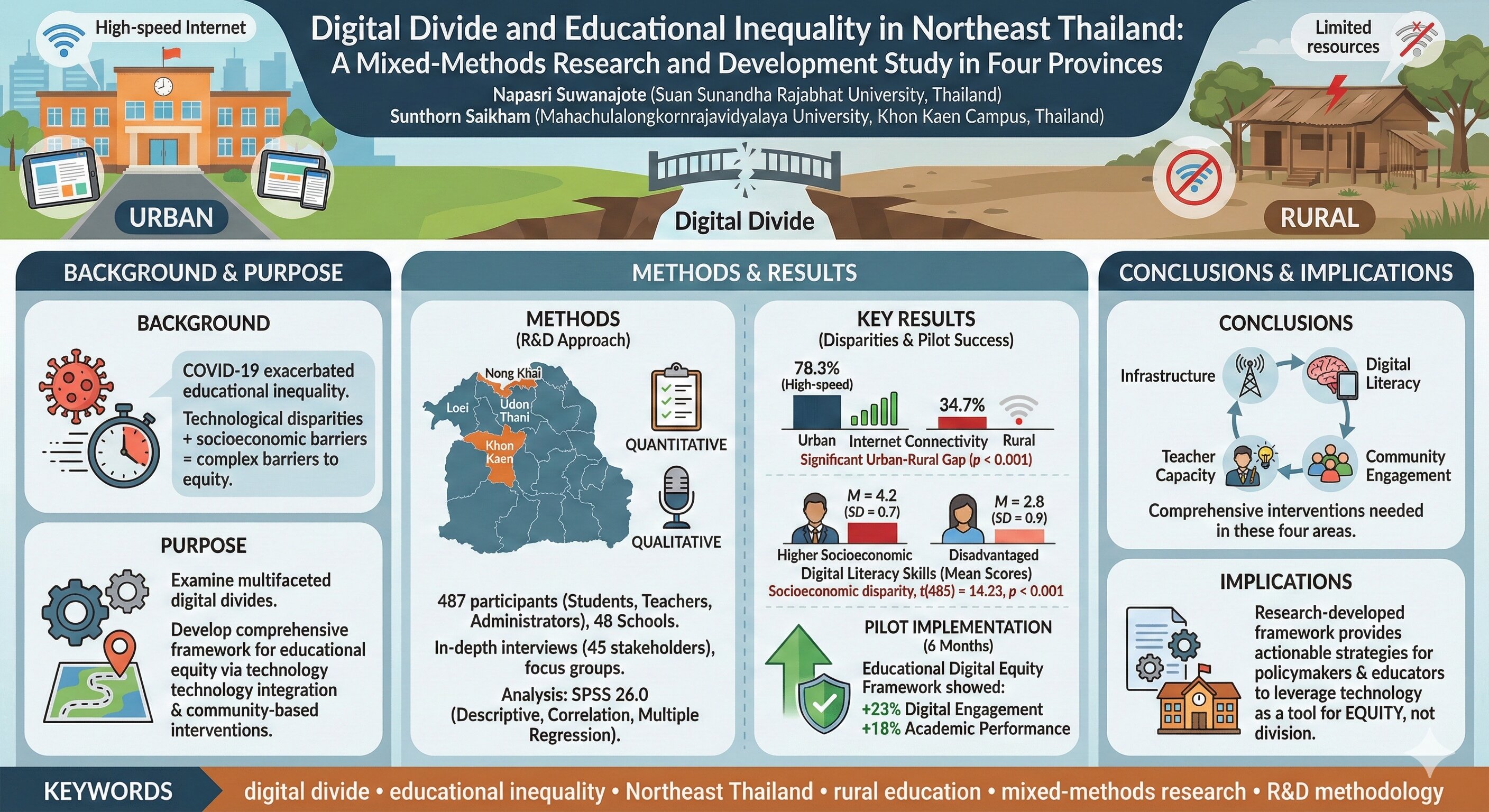
Background: Educational inequality in Thailand's Northeast region has been exacerbated by the digital divide, particularly following COVID-19's acceleration of digital learning adoption. The intersection of technological disparities with existing socioeconomic inequalities creates complex barriers to educational equity in rural communities.
Purpose: This study examines the multifaceted nature of educational digital divides in Northeast Thailand and develops a comprehensive framework for addressing educational inequality through technology integration and community-based interventions.
Methods: A mixed-methods Research and Development (R&D) approach was employed across four provinces in Northeast Thailand (Khon Kaen, Udon Thani, Nong Khai, and Loei). Quantitative data were collected from 487 participants including students, teachers, and administrators across 48 schools. Qualitative data involved in-depth interviews with 45 stakeholders and focus group discussions. Statistical analyses included descriptive statistics, correlation analysis, and multiple regression analysis using SPSS 26.0.
Results: Significant disparities were found in digital access: urban schools averaged 78.3% high-speed internet connectivity compared to 34.7% in rural areas (p < 0.001). Students from higher socioeconomic backgrounds demonstrated superior digital literacy skills (M = 4.2, SD = 0.7) compared to their disadvantaged peers (M = 2.8, SD = 0.9), t(485) = 14.23, p < 0.001. The developed Educational Digital Equity Framework showed promising results in pilot implementation, with participant schools demonstrating 23% improvement in digital engagement and 18% increase in academic performance over six months.
Conclusions: Educational inequality in Northeast Thailand requires comprehensive interventions addressing infrastructure, digital literacy, teacher capacity, and community engagement. The research-developed framework provides actionable strategies for policymakers and educators to leverage technology as a tool for educational equity rather than division.
เอกสารอ้างอิง
Azano, A. P., & Stewart, T. T. (2015). Exploring place and practicing justice: Preparing pre-service teachers for success in rural schools. Journal of Research in Rural Education, 30(9), 1-12. http://jrre.psu.edu/articles/30-9.pdf
Barbour, M. K., & LaBonte, R. (2017). State of rural education: Understanding the issues facing rural schools and communities. Rural Educator, 38(3), 1-9. https://doi.org/10.35608/ruraled.v38i3.231
Beaunoyer, E., Dupéré, S., & Guitton, M. J. (2020). COVID-19 and digital inequalities: Reciprocal impacts and mitigation strategies. Computers in Human Behavior, 111, 106424. https://doi.org/10.1016/j.chb.2020.106424
Bjork, C. (2019). Indonesian education: Teachers, schools, and central bureaucracy. Routledge.
Borg, W. R., & Gall, M. D. (2007). Educational research: An introduction (8th ed.). Pearson.
Braun, V., & Clarke, V. (2019). Reflecting on reflexive thematic analysis. Qualitative Research in Sport, Exercise and Health, 11(4), 589-597. https://doi.org/10.1080/2159676X.2019.1628806
Chudgar, A., Chandra, M., & Rajan, A. (2019). Gender gaps in learning in South Asia: Examining the role of access, grade-for-age, and learning environment. International Journal of Educational Development, 67, 11-23. https://doi.org/10.1016/j.ijedudev.2019.02.007
Creswell, J. W., & Creswell, J. D. (2018). Research design: Qualitative, quantitative, and mixed methods approaches (5th ed.). SAGE Publications.
Fetters, M. D., Curry, L. A., & Creswell, J. W. (2013). Achieving integration in mixed methods designs—principles and practices. Health Services Research, 48(6pt2), 2134-2156. https://doi.org/10.1111/1475-6773.12117
Hargittai, E., & Micheli, M. (2019). Internet skills and why they matter. In M. Graham & W. H. Dutton (Eds.), Society and the internet: How networks of information and communication are changing our lives (pp. 109-124). Oxford University Press.
Hatlevik, O. E., Throndsen, I., Loi, M., & Gudmundsdottir, G. B. (2018). Students' ICT self-efficacy and computer and information literacy: Determinants and relationships. Computers & Education, 118, 107-119. https://doi.org/10.1016/j.compedu.2017.11.011
Hennessy, S., Haßler, B., & Hofmann, R. (2020). Challenges and opportunities for teacher professional development in interactive use of technology in African schools. Technology, Pedagogy and Education, 29(5), 557-577. https://doi.org/10.1080/1475939X.2020.1815087
Intarakumnerd, P., & Chaminade, C. (2021). Innovation policies in Thailand 4.0: Challenges and ways forward. In P. Intarakumnerd & T. Schiller (Eds.), Science, technology and innovation policy for the future of Thailand (pp. 15-38). Springer.
Koehler, M. J., Mishra, P., Kereluik, K., Shin, T. S., & Graham, C. R. (2017). The technological pedagogical content knowledge framework. In M. J. Bishop, E. Boling, J. Elen, & V. Svihla (Eds.), Handbook of research on educational communications and technology (pp. 101-111). Springer.
König, J., Jäger-Biela, D. J., & Glutsch, N. (2020). Adapting to online teaching during COVID-19 school closure: Teacher education and teacher competence effects among early career teachers in Germany. European Journal of Teacher Education, 43(4), 608-622. https://doi.org/10.1080/02619768.2020.1809650
Kretzmann, J., & McKnight, J. (2019). Building communities from the inside out: A path toward finding and mobilizing a community's assets. Asset-Based Community Development Institute.
National Statistical Office. (2021). Household survey on the use of information and communication technology 2021. National Statistical Office of Thailand.
Office of the Education Council. (2020). National education plan 2017-2036. Office of the Education Council, Ministry of Education.
Paris, D., & Alim, H. S. (2017). Culturally sustaining pedagogies: Teaching and learning for justice in a changing world. Teachers College Press.
Pholphirul, P., & Rugchatjaroen, A. (2021). Digital divide and educational inequality during COVID-19: Evidence from Thailand. World Development Perspectives, 23, 100354. https://doi.org/10.1016/j.wdp.2021.100354
Reich, J., & Mehta, J. (2020). Systematic educational equity requires systemic school reform: Lessons for and from the pandemic. Educational Researcher, 49(6), 384-388. https://doi.org/10.3102/0013189X20938899
Van Deursen, A. J., & Helsper, E. J. (2015). The third-level digital divide: Who benefits most from being online? Communication and Information Technologies Annual, 10, 29-52. https://doi.org/10.1108/S2050-206020150000010002
Van Dijk, J. A. (2020). The digital divide. Polity Press.
Warren, M. R., Hong, S., Rubin, C. L., & Uy, P. S. (2020). Beyond the bake sale: A community-based relational approach to parent engagement in schools. Teachers College Record, 111(9), 2209-2254. https://www.tcrecord.org/Content.asp?ContentId=15975
ดาวน์โหลด
เผยแพร่แล้ว
รูปแบบการอ้างอิง
ฉบับ
ประเภทบทความ
สัญญาอนุญาต
ลิขสิทธิ์ (c) 2023 Author(s)

อนุญาตภายใต้เงื่อนไข Creative Commons Attribution 4.0 International License.