The Implementation of Buddhist Ethical Teachings through Active Learning Models in Phrapariyattidhamma Schools
Keywords:
Active learning, Buddhist education, Phrapariyattidhamma schools, ethical teachings, MIAP model, monastic education, religious education reform, ThailandAbstract
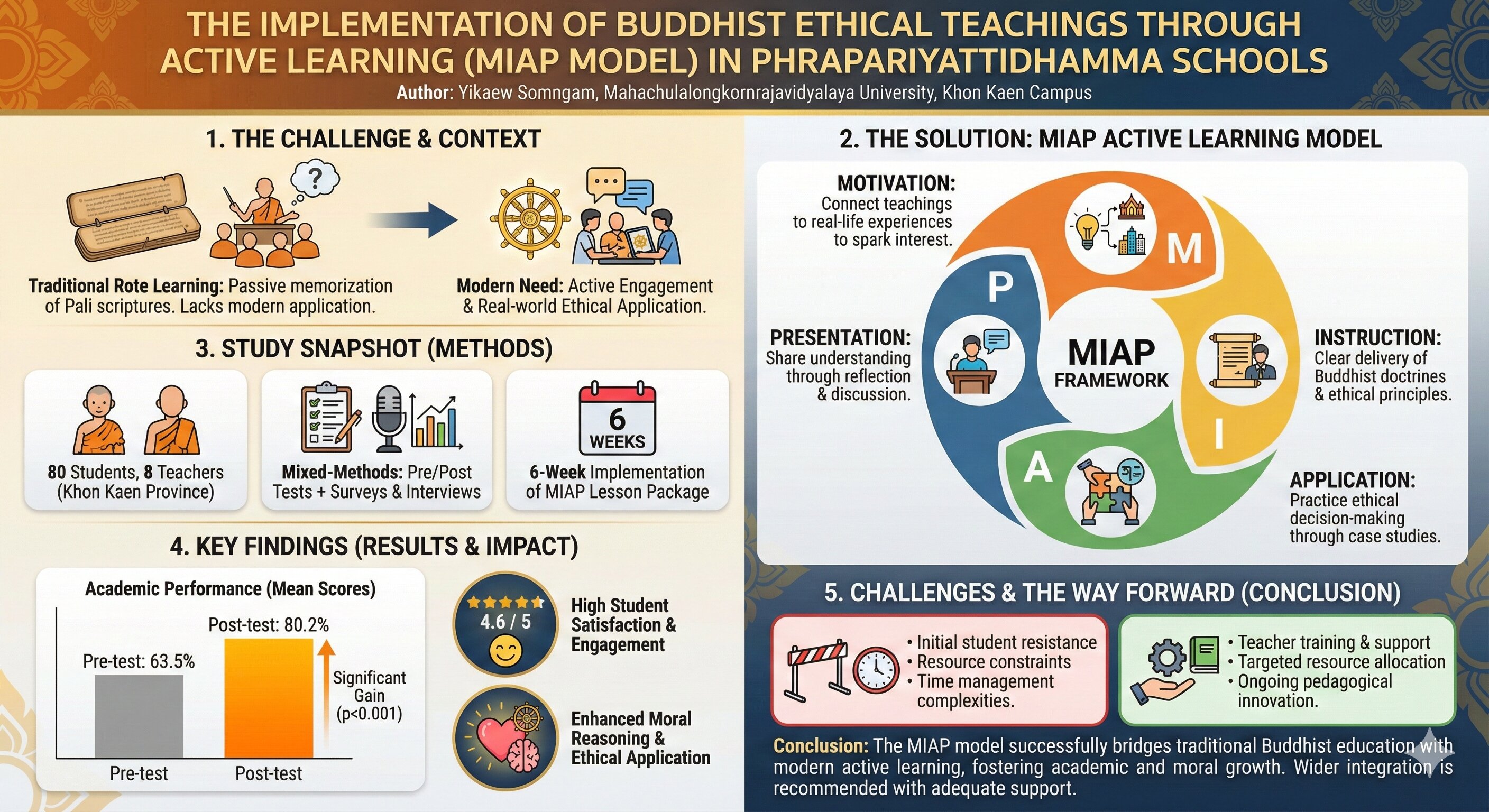
Background: Traditional Buddhist monastic education in Phrapariyattidhamma schools has historically emphasized lecture-based teaching and rote memorization of Pali scriptures and doctrines, methods that may inadequately prepare students for applying ethical teachings in contemporary contexts. The growing recognition of active learning's potential to enhance student engagement, critical thinking, and practical application of knowledge presents opportunities for educational reform in religious institutions. Buddhist ethical teachings, foundational to the moral and spiritual development of monks and novices, require pedagogical approaches that facilitate internalization and real-world application beyond mere memorization.
Purpose: This mixed-methods research aimed to evaluate the effectiveness of the MIAP (Motivation, Instruction, Application, and Presentation) Active Learning model in teaching Buddhist ethical teachings at Phrapariyattidhamma schools in Khon Kaen Province, assess its impact on student academic performance and engagement, identify implementation challenges encountered by teachers and students, and explore the model's contribution to students' moral and spiritual development in a monastic educational context.
Methods: The study employed a mixed-methods design combining quantitative pre-test/post-test assessments with qualitative data collection through student satisfaction surveys and teacher interviews. Using purposive sampling, 80 secondary students and 8 teachers from three Phrapariyattidhamma schools in Khon Kaen Province participated in the six-week implementation of the MIAP-based lesson package on Buddhist ethical teachings. The lesson package structured learning through four phases: motivating students by connecting teachings to real-life experiences, delivering clear instruction on Buddhist doctrines and ethical principles, facilitating practical application through case studies and ethical decision-making exercises, and providing opportunities for students to present their understanding through reflections and discussions. Quantitative data were analyzed using paired t-tests to compare pre-test and post-test performance, with descriptive statistics summarizing engagement and satisfaction scores. Qualitative data from semi-structured teacher interviews underwent thematic analysis to identify recurring patterns related to implementation challenges, pedagogical effectiveness, and observed student development.
Results: Pre-test and post-test analysis revealed statistically significant improvement in academic performance, with mean scores increasing from 63.5% to 80.2% (t(79) = 9.27, p < 0.001), demonstrating substantial gains in comprehension and application of Buddhist ethical concepts. Students showed marked improvement in moral reasoning sections, successfully applying Buddhist principles to hypothetical ethical dilemmas. Student engagement and satisfaction surveys yielded an overall satisfaction score of 4.6 out of 5, with students reporting enhanced engagement during application phases involving real-life scenarios, increased interest through motivational elements connecting traditional teachings to contemporary issues, and heightened perception of relevance to daily life and spiritual development. Teacher observations confirmed increased student motivation and ownership of learning, particularly during application and presentation phases. However, teachers identified implementation challenges including initial student resistance to unfamiliar interactive methods (which diminished over time), resource constraints limiting availability of teaching aids and materials, and time management complexities requiring careful balancing of MIAP phases. Qualitative findings revealed the model's significant contribution to moral and spiritual development, with students demonstrating deeper ethical understanding, greater confidence in discussing Buddhist principles, and enhanced reflective capacity regarding personal moral choices.
Conclusions: The MIAP Active Learning model effectively enhances academic performance, student engagement, and ethical understanding in Phrapariyattidhamma schools, successfully bridging traditional Buddhist education with contemporary active learning methodologies. The structured four-phase approach facilitates practical application of theoretical knowledge, making Buddhist ethical teachings more accessible, relevant, and engaging for students while supporting their moral and spiritual growth. Successful implementation requires addressing resource limitations through targeted allocation of teaching materials, expanding professional development opportunities to equip teachers with active learning facilitation skills, and providing ongoing support for time management and pedagogical innovation. The model's demonstrated effectiveness suggests significant potential for broader curriculum integration across Buddhist monastic education, offering a replicable framework for modernizing religious education while preserving core spiritual values and educational objectives.
References
Biggs, J., & Tang, C. (2011). Teaching for Quality Learning at University: What the Student Does. McGraw-Hill Education.
Bodhi, B. (1999). The Noble Eightfold Path: The Way to the End of Suffering. Buddhist Publication Society.
Bonwell, C. C., & Eison, J. A. (1991). Active Learning: Creating Excitement in the Classroom. ASHE-ERIC Higher Education Report No. 1. George Washington University.
Bransford, J. D., Brown, A. L., & Cocking, R. R. (2000). How People Learn: Brain, Mind, Experience, and School. National Academy Press.
Choompolpaisal, P. (2010). The Making of the Pali Commentaries: A Historical Study. Journal of the International Association of Buddhist Studies, 33(1-2), 1-28.
Collins, S. (1990). Selfless Persons: Imagery and Thought in Theravada Buddhism. Cambridge University Press.
Ertmer, P. A., & Simons, K. D. (2006). Jumping the PBL Implementation Hurdle: Supporting the Efforts of K–12 Teachers. Interdisciplinary Journal of Problem-Based Learning, 1(1), 40-54.
Felder, R. M., & Brent, R. (2009). Active Learning: An Introduction. ASQ Higher Education Brief, 2(4).
Freeman, S., et al. (2014). Active Learning Increases Student Performance in Science, Engineering, and Mathematics. Proceedings of the National Academy of Sciences, 111(23), 8410-8415.
Garrison, D. R., & Kanuka, H. (2004). Blended Learning: Uncovering its Transformative Potential in Higher Education. The Internet and Higher Education, 7(2), 95-105.
Gombrich, R. (1990). Theravāda Buddhism: A Social History from Ancient Benares to Modern Colombo. Routledge.
Gombrich, R. (2006). How Buddhism Began: The Conditioned Genesis of the Early Teachings. Routledge.
Harris, I. (2008). Buddhism and Politics in Twentieth-Century Asia. Continuum.
Hmelo-Silver, C. E. (2004). Problem-Based Learning: What and How Do Students Learn? Educational Psychology Review, 16(3), 235-266.
Johnson, D. W., Johnson, R. T., & Smith, K. A. (1998). Cooperative Learning Returns to College: What Evidence Is There That It Works? Change: The Magazine of Higher Learning, 30(4), 26-35.
McDaniel, J. (2008). Gathering Leaves and Lifting Words: Histories of Buddhist Monastic Education in Laos and Thailand. University of Washington Press.
Payutto, P. A. (2007). Buddhist Education: Foundations and Modernization. Mahachulalongkornrajavidyalaya University Press.
Prince, M. (2004). Does Active Learning Work? A Review of the Research. Journal of Engineering Education, 93(3), 223-231.
Savery, J. R. (2015). Overview of Problem-Based Learning: Definitions and Distinctions. Interdisciplinary Journal of Problem-Based Learning, 1(1), 9-20.
Swearer, D. K. (2010). The Buddhist World of Southeast Asia. State University of New York Press.
Downloads
Published
How to Cite
Issue
Section
License
Copyright (c) 2025 Author(s)

This work is licensed under a Creative Commons Attribution 4.0 International License.