Social Studies Learning Management to Promote Corruption Prevention in First-Year Students Using the Four Ghāravasadhamma Principles
Keywords:
Corruption prevention, social studies, Ghāravasadhamma, secondary education, learning management, Buddhist ethics, ethical education, ThailandAbstract
Background: Corruption remains a pervasive obstacle to social and economic development globally, particularly in Thailand, where it undermines public trust, erodes institutional integrity, and hampers national progress. Educational institutions face increasing demands to instill ethical values and social responsibility in students from an early age, with social studies serving as a critical platform for developing civic awareness and moral reasoning. Buddhist principles offer culturally relevant ethical frameworks for Thai education, yet their systematic integration into corruption prevention curricula requires comprehensive investigation and practical implementation models.
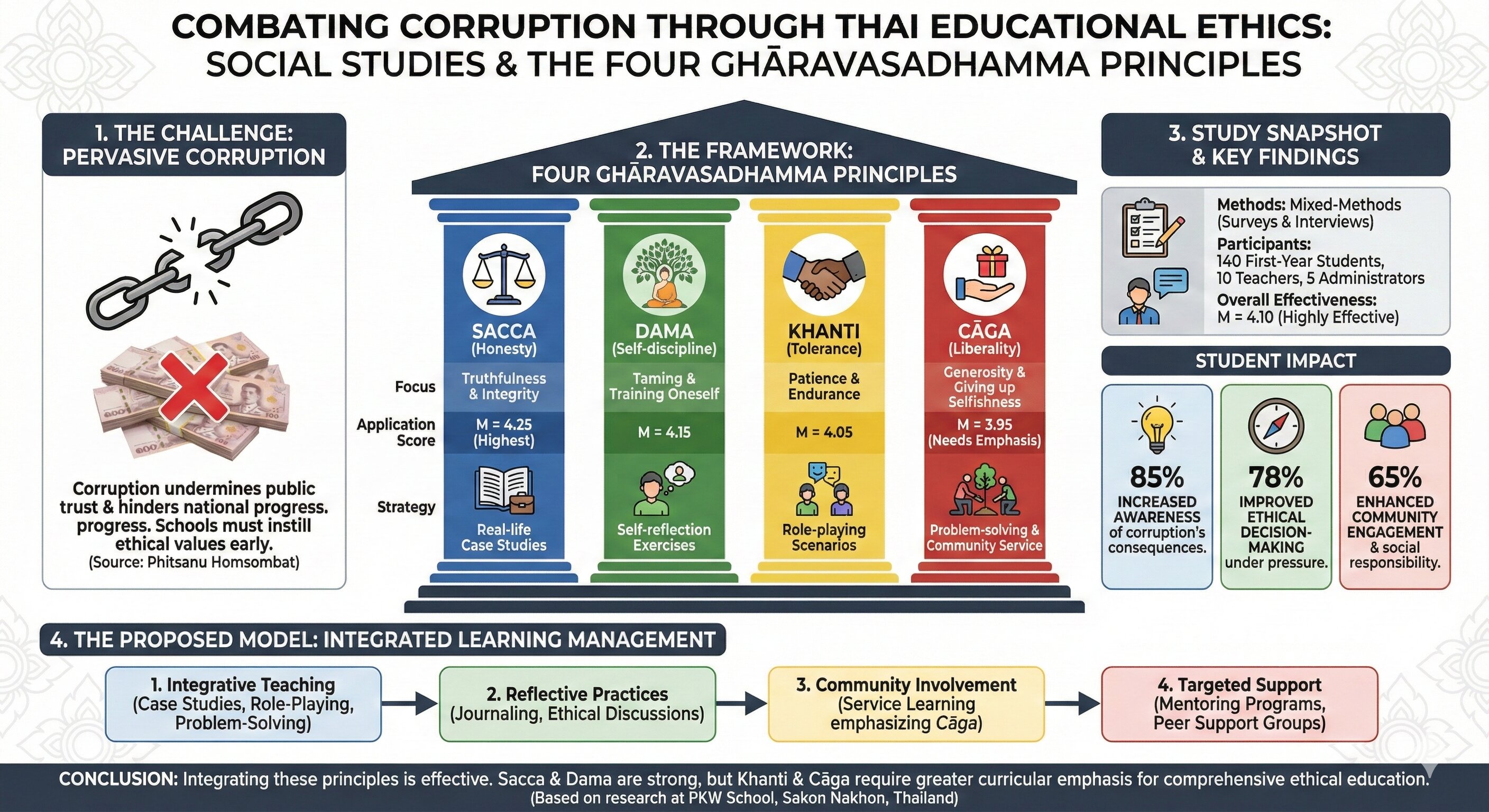
Purpose: This mixed-methods research aimed to examine the current application of the Four Ghāravasadhamma principles—Sacca (honesty), Dama (taming and training oneself), Khanti (tolerance), and Cāga (liberality)—in social studies learning management at PKW School, Sakon Nakhon Province, evaluate their impact on first-year secondary students' attitudes toward corruption and ethical behavior, compare their effectiveness across different demographic groups, and develop an evidence-based model for enhancing their integration into corruption prevention education.
Methods: The study employed a mixed-methods research design combining quantitative surveys and qualitative interviews. Using stratified random sampling, 140 first-year secondary students were selected from a population of approximately 200 students, ensuring representation across gender, socioeconomic backgrounds, and academic performance levels. Additionally, purposive sampling identified 10 social studies teachers and 5 school administrators for semi-structured interviews and focus group discussions. Data collection utilized structured questionnaires with 5-point Likert-scale items measuring the frequency and effectiveness of each Ghāravasadhamma principle's application, complemented by qualitative exploration of implementation challenges and pedagogical strategies. Quantitative data were analyzed using descriptive statistics (means, standard deviations, frequencies) and inferential statistics (t-tests, one-way ANOVA) to compare applications across demographic groups, while qualitative data underwent thematic analysis to identify key patterns and contextual insights.
Results: The overall application of Ghāravasadhamma principles in social studies learning management was rated highly effective (M = 4.10 on a 5-point scale), with significant variation across the four principles. Sacca (honesty) received the highest application score (M = 4.25), followed by Dama (self-discipline, M = 4.15), Khanti (tolerance, M = 4.05), and Cāga (liberality, M = 3.95). Student perceptions revealed substantial positive impacts: 85% reported increased awareness of corruption's consequences through lessons on honesty and self-discipline, 78% indicated improved ethical decision-making capabilities when facing pressure to act dishonestly, and 65% demonstrated enhanced community engagement and social responsibility through liberality-focused activities. Demographic comparisons showed no statistically significant differences in overall effectiveness, though female students reported slightly higher engagement with honesty and tolerance principles, while students from higher socioeconomic backgrounds exhibited greater opportunities for practicing liberality through community service activities. Qualitative findings identified successful pedagogical strategies including real-life case studies for teaching honesty, self-reflection exercises for developing self-discipline, role-playing scenarios for practicing tolerance, and problem-solving activities for fostering liberality.
Conclusions: The Ghāravasadhamma principles effectively promote corruption prevention awareness and ethical behavior among secondary students when systematically integrated into social studies curricula. The study's proposed learning management model incorporates integrative teaching approaches (case studies, role-playing, problem-solving activities), reflective practices (journaling, ethical discussions), community involvement opportunities (service learning emphasizing generosity), and targeted support systems (mentoring programs, peer support groups). While honesty and self-discipline principles demonstrated strong implementation and impact, tolerance and liberality require enhanced curricular emphasis to provide comprehensive ethical education. The culturally responsive framework offers replicable strategies for Thai educational institutions seeking to align traditional Buddhist values with modern anti-corruption education goals.
References
Dewey, J. (1916). Democracy and education: An introduction to the philosophy of education. Macmillan.
Dhammanada, S. K. (2005). Buddhism as a religion. Buddhist Mahavihara Publishing Ltd.
Kohlberg, L. (1984). Essays on moral development: Vol. 2. The psychology of moral development. Harper & Row.
Langer, E. J. (1989). Mindfulness. Da Capo Press.
Lin, S. (2015). Enhancing teacher effectiveness through reflective practice. Journal of Teacher Education, 9(4), 212–230.
Lopez, D. S. (2003). The encyclopedia of Buddhism. Macmillan.
Office of the Basic Education Commission (OBEC). (2017). Anti-corruption education curriculum. Ministry of Education.
Phongpaichit, P., & Piriyarangsan, S. (1994). Corruption and democracy in Thailand. Silkworm Books.
Phuvasant, P. (2019). Integrating Buddhist ethics in Thai education. Journal of Ethics in Education, 19(2), 88–105.
Pripkorn, W. (2018). Application of Iddhipada in modern education. Journal of Educational Studies, 22(4), 201–220.
Roberts, A. (2013). The role of spirituality in teacher professional development. Journal of Holistic Education, 21(2), 150–166.
Roeser, R. W., Skinner, E., Beers, J., & Jennings, P. A. (2012). Mindfulness training and teachers’ professional development: An emerging area of research and practice. Child Development Perspectives, 6(2), 167–173. https://doi.org/10.1111/j.1750-8606.2012.00238.x
Saengsai, P. (2016). The impact of Ghāravasadhamma on teaching performance. Journal of Buddhist Studies, 8(2), 25–42.
Saiprasert, P. (2017). Ethical teaching practices in Thailand. Journal of Global Education, 15(2), 144–163.
Senge, P. M. (1990). The fifth discipline: The art and practice of the learning organization. Doubleday.
Sukumal, P. (2020). Learning management based on the four Ghāravasadhamma principles. Journal of Buddhist Education and Research, 6(1), 1–16.
Transparency International. (2020). Corruption perceptions index 2019. https://www.transparency.org/en/cpi/2019/index
United Nations Development Programme (UNDP). (2016). Human development report 2016: Human development for everyone. UNDP.
Vichayapa, M. (2014). The role of Ghāravasadhamma in professional development. Journal of Buddhist Education and Research, 6(1), 17–32.
Wang, M. (2015). Cultural values and education in Thailand. Journal of Asian Studies, 10(3), 215–230.
Downloads
Published
How to Cite
Issue
Section
License
Copyright (c) 2025 Author(s)

This work is licensed under a Creative Commons Attribution 4.0 International License.