Promoting Inquiry-Based Learning in Thai Science Education: Enhancing Scientific Literacy and Critical Thinking
Keywords:
Inquiry-based learning, scientific literacy, critical thinking, Thai science education, constructivist pedagogyAbstract
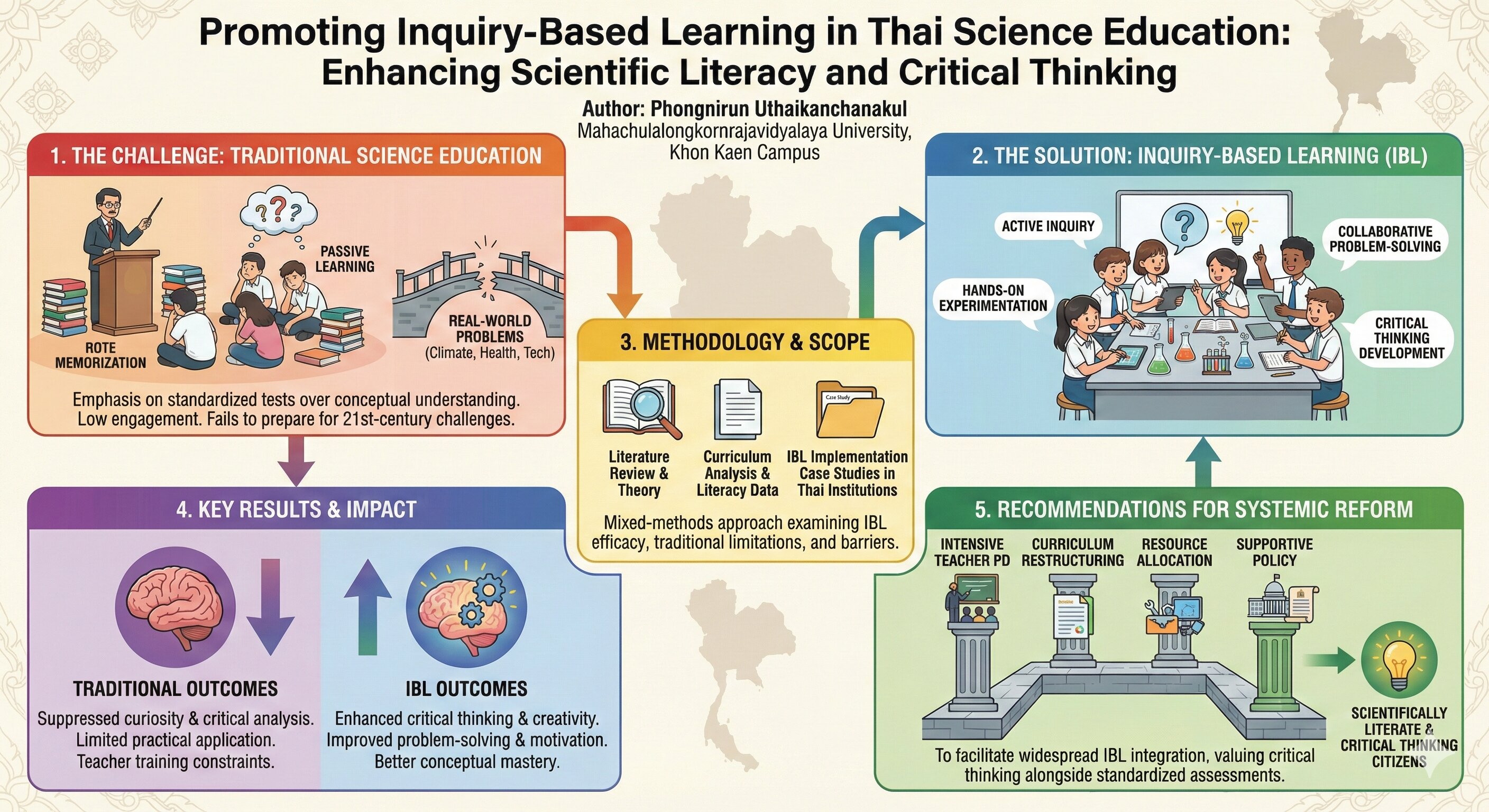
Background: Thai science education remains largely lecture-based, emphasizing rote memorization and standardized testing. Such approaches inadequately cultivate scientific literacy and critical thinking—competencies essential for addressing 21st-century challenges such as climate change, healthcare decision-making, and technological innovation. Passive knowledge transmission limits student engagement, constrains higher-order thinking, and weakens learners’ ability to apply scientific understanding to real-world contexts. This gap between memorization and authentic inquiry highlights the need for pedagogical transformation toward more student-centered, inquiry-driven learning models.
Purpose: This study investigated the potential of Inquiry-Based Learning (IBL) to enhance scientific literacy and critical thinking in Thai science education. It examined the limitations of traditional methodologies, evaluated IBL implementation through selected case studies, identified barriers to adoption—including teacher preparedness, resource constraints, and curricular rigidity—and proposed recommendations to support systemic reform through policy adjustment, professional development, and curriculum modernization aligned with inquiry principles.
Methods: A comprehensive analytical approach was employed, integrating literature review of constructivist learning theories underpinning IBL, analysis of the Thai National Science Curriculum, and review of science literacy assessment data indicating gaps in comprehension and application. Case studies of successful IBL implementation in Thai institutions were examined to evaluate student motivation, performance, and skill development. The study also assessed teacher preparation programs to identify professional development needs for effective inquiry facilitation. Pedagogical comparisons were conducted between traditional lecture-based instruction and student-centered strategies involving experimentation, collaborative problem-solving, hypothesis formation, and real-world application.
Results: Traditional science instruction demonstrated significant shortcomings, including overemphasis on memorization, limited conceptual understanding, minimal practical application, and insufficient teacher training in inquiry methods. In contrast, IBL case studies revealed improved student motivation, stronger conceptual mastery, enhanced analytical reasoning, and greater collaborative problem-solving skills. STEM models incorporating design thinking and hands-on experimentation further strengthened knowledge retention and contextual understanding. However, implementation challenges included student adjustment to active learning, inadequate teacher preparation, limited instructional resources, rigid curricular frameworks, and societal emphasis on standardized testing outcomes.
Conclusions: Inquiry-Based Learning offers an effective pathway for transforming Thai science education by fostering scientific literacy, critical thinking, creativity, and collaboration. Sustainable implementation requires systemic reform, including targeted teacher professional development, curriculum restructuring toward active exploration, improved resource support, and policy frameworks that value critical thinking alongside standardized assessments.
References
Ayuni Ratnayake, Cindy Naw, Karolyn R. Keir, Aarthi Ashok (2023). Facilitating Scientific Literacy Through Writing: A Write-to-Learn Assignment for Large Introductory Undergraduate Biology Courses. Retrieved from: https://www.semanticscholar.org/paper/95c3549bb27b980983de7c58112a20578f96f7d3
B. Cavas (2024). The Preface. Retrieved from: https://www.semanticscholar.org/paper/f31003af96ec535f3a3c244958558c6010cf1b84
Bülent Çavaş (2024). Editorial. Retrieved from: https://www.semanticscholar.org/paper/b5b0547cb320010088447f043ebfffe61d56ea97
Dana R. Ferris, John Hedgcock (2013-10-01). Teaching L2 Composition. Routledge. Retrieved from: http://books.google.com/books?id=5WEiAQAAQBAJ&dq=Inquiry-Based+Learning+definition+in+promoting+scientific+literacy+and+critical+thinking+in+Thai+science+education&hl=&source=gbs_api
Duangkamol Chongcharoen, Patcharaphon Pilasombat (2023). Effectiveness and Opinion of Using the Instructional Process Based on Inquiry Approach and Situated Learning Approach to Promote Skills in Conducting Research of Pre-Service Teachers. 4th International Conference on Management, Innovation, Economics and Social Sciences. Retrieved from: https://www.icmiess.com/14.Duangkamol146-156.pdf
Duongdearn Suwanjinda (2022). The Development of STEM Education Instruction Model for Science Teachers. ASEAN Journal of Open and Distance Learning, Vol. 14, No. 1. pp. 89-97. Retrieved from: https://ajodl.oum.edu.my/
Jonalyn S. Guerrero, Romiro G. Bautista (2023). INQUIRY-BASED TEACHING IN SECONDARY SCIENCE. Retrieved from: https://www.semanticscholar.org/paper/cefbc79f3919174ff45627b310f6fda47b6e9493
Krittawaya Thongkoo, Kannika Daungcharone, Patcharin Panjaburee (2024). Effects of Collaborative Inquiry-Based Online Approach in Thai University Students’ Computing Program. Vol. 14, No. 2. pp. 302. Retrieved from: https://www.ijiet.org/vol14/IJIET-V14N2-2052.pdf
Krittawaya Thongkoo, Kannika Daungcharone, Patcharin Panjaburee (2024). Effects of Collaborative Inquiry-Maizatulliza Muhammad, Robbie Lee Sabnani , Rangga Asmara, Widya Ratna Kusumaningrum , Atsani Wulansari , Gilang Fadhilia Arvianti, Winda Candra Hantari , Arum Nisma Wulanjani (2020-02-18). ICLLT 2019. European Alliance for Innovation. Retrieved from: https://play.google.com/store/books/details?id=X6ggEAAAQBAJ&source=gbs_api
Mei-Hung Chiu (2016). Science Education Research and Practice in Asia. Springer. Retrieved from: https://play.google.com/store/books/details?id=chRkDAAAQBAJ&source=gbs_api
National Research Council, Division of Behavioral and Social Sciences and Education, Board on Science Education, Committee on a Conceptual Framework for New K-12 Science Education Standards (2012). A Framework for K-12 Science Education. National Academies Press. Retrieved from: https://play.google.com/store/books/details?id=AFpnej8Xhq4C&source=gbs_api
OECD (2019-12-03). PISA 2018 Results (Volume I) What Students Know and Can Do. OECD Publishing. Retrieved from: https://play.google.com/store/books/details?id=smnBDwAAQBAJ&source=gbs_api
Pol Luangrangsee, Chadchom Ratsameemonthon (2024). Assessing the Alignment between Expected Learning Outcomes and Student Achievement in Research for Learning Development at a Higher Education Institution in Songkhla Province, Thailand. Pakistan Journal of Life and Social Sciences, Vol 22, Issue 2. pp. 4875-4888. Retrieved from: https://doi.org/10.57239/PJLSS-2024-22.2.00361
Samuel Kai Wah Chu, Rebecca B. Reynolds, Nicole J. Tavares, Michele Notari, Celina Wing Yi Lee (2018-04-30). 21st Century Skills Development Through Inquiry-Based Learning. Springer. Retrieved from: http://books.google.com/books?id=06zCtgEACAAJ&dq=Enhancing+inquiry-based+learning+in+Thai+science+education+while+addressing+challenges+in+implementing+IBL+within+traditional+education+systems.&hl=&source=gbs_api
Sasivimol Premthaisong, Wacharaporn Khaokhajorn, Pawat Chaipidech, Niwat Srisawasdi (2022). Elementary School Students’ Understanding of Nature of Scientific Inquiry: A Preliminary Results and Proposed Practical Framework. Asia-Pacific Society for Computers in Education. Retrieved from: https://icce2022.apsce.net/uploads/P2_W04_027.pdf
Downloads
Published
How to Cite
Issue
Section
License
Copyright (c) 2025 Author(s)

This work is licensed under a Creative Commons Attribution 4.0 International License.