Developing 21st Century Life Skills and Career Competencies Among University Students: A Case Study of Buddhist University in Thailand
Keywords:
21st century skills, life skills development, career competencies, Buddhist higher education, Thailand, research and development, SBU-LCK Model, experiential learning, competency-based educationAbstract
Background: The rapidly evolving 21st-century landscape demands that higher education institutions equip students with comprehensive life skills and career competencies extending beyond traditional academic knowledge. Buddhist universities in Thailand face distinctive challenges in integrating modern competency frameworks while preserving their philosophical foundations rooted in mindfulness, ethical conduct, and social responsibility.
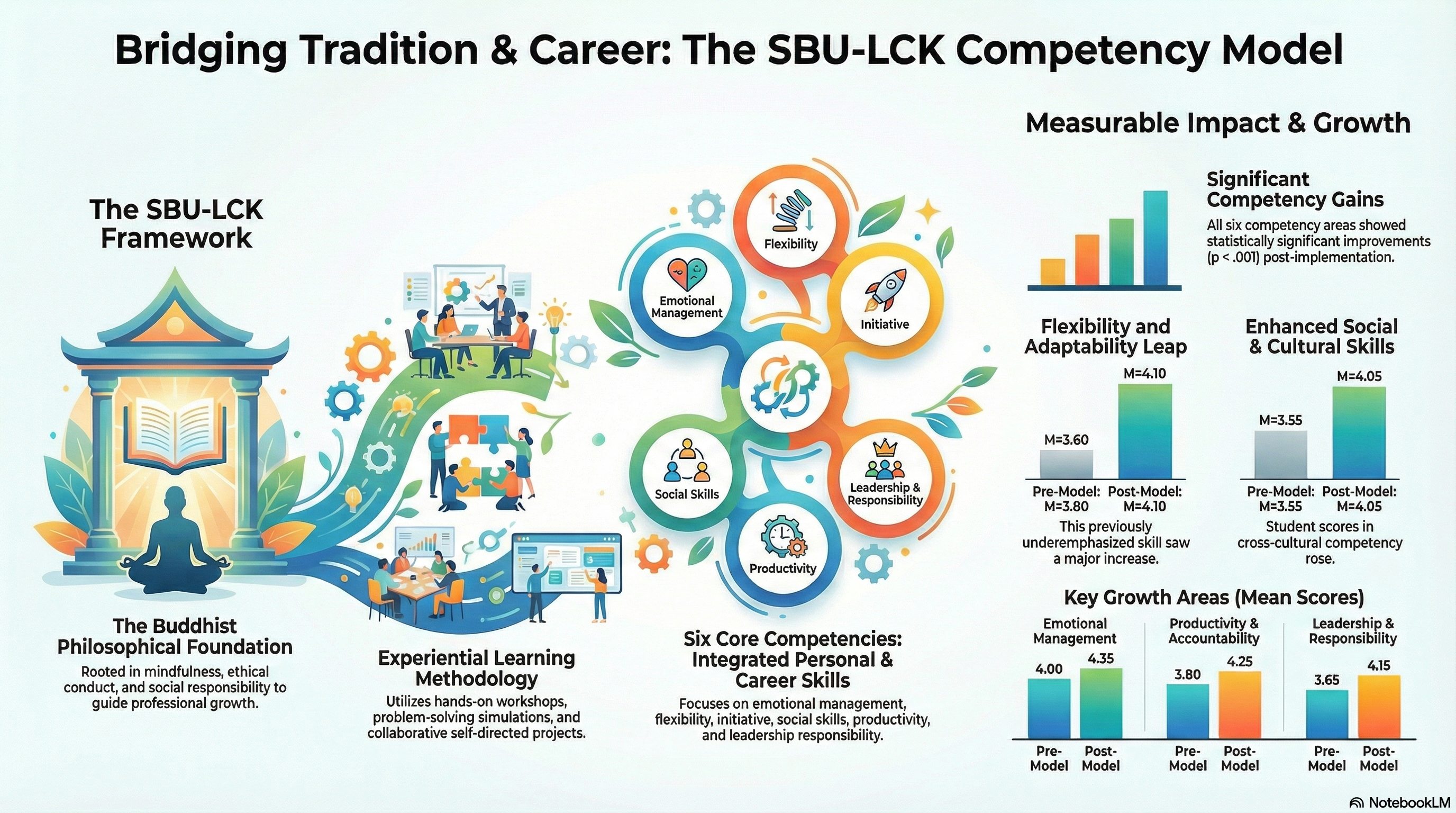
Purpose: This research and development study aimed to assess current life skills and career competencies among students at Mahachulalongkornrajavidyalaya University (SBU), develop an evidence-based intervention framework (SBU-LCK Model), and evaluate its effectiveness in enhancing six critical competencies: emotional management, flexibility and adaptability, initiative and self-direction, social and cross-cultural skills, productivity and accountability, and leadership and responsibility.
Methods: The study employed a four-phase research and development design incorporating needs assessment, model development, implementation trial, and effectiveness evaluation. Using stratified random sampling, 390 SBU students were selected for the needs assessment phase, with 100 students participating in the model implementation phase. Data collection utilized validated questionnaires assessing competency levels, semi-structured interviews with students and educators, and focus group discussions. Quantitative data were analyzed using descriptive statistics, Wilcoxon signed-rank tests, and Mann-Whitney U tests, while qualitative data underwent thematic analysis to identify curriculum gaps and implementation challenges.
Results: Pre-implementation assessment revealed moderately high baseline competencies (M = 3.75, SD = 0.62 on a 5-point Likert scale), with notable gaps in flexibility and adaptability (M = 3.60), social and cross-cultural skills (M = 3.55), and leadership and responsibility (M = 3.65). Post-implementation results demonstrated statistically significant improvements across all six competencies (p < 0.001): emotional management increased from M = 4.00 to M = 4.35, flexibility from M = 3.60 to M = 4.10, initiative from M = 3.70 to M = 4.20, social skills from M = 3.55 to M = 4.05, productivity from M = 3.80 to M = 4.25, and leadership from M = 3.65 to M = 4.15. Students reported high satisfaction with the experiential learning opportunities, hands-on activities, and real-world skill development integrated throughout the model. Educators noted the model's effectiveness in addressing previously underemphasized competencies and its flexibility for integration across diverse academic programs.
Conclusions: The SBU-LCK Model effectively enhanced 21st-century life skills and career competencies among Buddhist university students in Thailand. The integration of Buddhist philosophical principles—including mindfulness, ethical conduct, and social responsibility—with experiential learning methodologies, self-directed projects, and collaborative exercises created a culturally responsive framework applicable to similar educational contexts. Findings indicate that competency-based interventions incorporating structured workshops, problem-solving simulations, intercultural exchanges, and leadership development activities significantly improve student readiness for modern workforce demands while honoring traditional Buddhist educational values.
References
Binkley, M., Erstad, O., Herman, J., Raizen, S., Ripley, M., Miller-Ricci, M., & Rumble, M. (2012). Defining twenty-first-century skills. In Assessment and teaching of 21st-century skills (pp. 17-66). Springer.
Covey, S. R. (1989). The 7 habits of highly effective people: Restoring the character ethic. Simon and Schuster.
Darling-Hammond, L., Flook, L., Cook-Harvey, C., Barron, B., & Osher, D. (2020). Implications for educational practice of the science of learning and development. Applied Developmental Science, 24(2), 97-140.
Deardorff, D. K. (2006). Identification and assessment of intercultural competence as a student outcome of internationalization. Journal of Studies in International Education, 10(3), 241-266.
Dede, C. (2010). Comparing frameworks for 21st-century skills. In 21st-century skills: Rethinking how students learn (pp. 51-76). Solution Tree Press.
DeFillippi, R. J., & Arthur, M. B. (1994). The boundaryless career: A competency-based perspective. Journal of Organizational Behavior, 15(4), 307-324.
Dewey, J. (1938). Experience and education. Collier Books.
Fantini, A. E. (2009). Assessing intercultural competence. In The SAGE handbook of intercultural competence (pp. 456-476). SAGE Publications.
Fullan, M. (2013). The new pedagogy: Students and teachers as learning partners in education’s digital landscape. Pearson.
Goleman, D. (1995). Emotional intelligence: Why it can matter more than IQ. Bantam Books.
Greenstein, L. (2012). Assessing 21st-century skills: A guide to evaluating mastery and authentic learning. Corwin Press.
Heckman, J. J., & Kautz, T. (2012). Hard evidence on soft skills. Labour Economics, 19(4), 451-464.
Kolb, D. A. (1984). Experiential learning: Experience as the source of learning and development. Prentice-Hall.
Kouzes, J. M., & Posner, B. Z. (2007). The leadership challenge (4th ed.). Jossey-Bass.
Lombardi, M. M. (2007). Authentic learning for the 21st century: An overview. Educause Learning Initiative.
National Education Association. (2012). Preparing 21st century students for a global society: An educator’s guide to the “Four Cs”. National Education Association.
Northouse, P. G. (2018). Leadership: Theory and practice (8th ed.). Sage Publications.
P21 (Partnership for 21st Century Skills). (2007). Framework for 21st century learning. P21.
Petrides, K. V., Frederickson, N., & Furnham, A. (2004). The role of trait emotional intelligence in academic performance and deviant behavior at school. Personality and Individual Differences, 36(2), 277-293.
Phra Dhammasinghapuracariya. (2015). The application of Buddhist principles in Thai higher education. MCU Press.
Pintrich, P. R. (2004). A conceptual framework for assessing motivation and self-regulated learning in college students. Educational Psychology Review, 16(4), 385-407.
Salovey, P., & Mayer, J. D. (1990). Emotional intelligence. Imagination, Cognition and Personality, 9(3), 185-211.
Srikosamatara, S. (2014). Buddhist principles in the development of university education in Thailand. MCU Press.
Trilling, B., & Fadel, C. (2009). 21st century skills: Learning for life in our times. Jossey-Bass.
UNICEF. (2012). Global evaluation of life skills education programmes. UNICEF.
Van der Heijden, B. I., Boon, J., Van der Klink, M. R., & Meijs, E. M. (2009). Employability enhancement through formal and informal learning: An empirical study among Dutch non-academic university staff members. International Journal of Training and Development, 13(1), 19-37.
Voogt, J., & Roblin, N. P. (2012). A comparative analysis of international frameworks for 21st century competences: Implications for national curriculum policies. Journal of Curriculum Studies, 44(3), 299-321.
World Health Organization. (1997). Life skills education for children and adolescents in schools. World Health Organization.
Zimmerman, B. J. (2002). Becoming a self-regulated learner: An overview. Theory Into Practice, 41(2), 64-70.
Downloads
Published
How to Cite
Issue
Section
License
Copyright (c) 2025 Author(s)

This work is licensed under a Creative Commons Attribution 4.0 International License.