Development and Effectiveness of an Enhanced MIAP Active Learning Model for Teaching Buddhist Duties in Phrapariyattidhamma Schools: A Multi-Provincial Study in Northeast Thailand
Keywords:
Active Learning, MIAP Model, Buddhist Education, Phrapariyattidhamma Schools, Northeast Thailand, Religious PedagogyAbstract
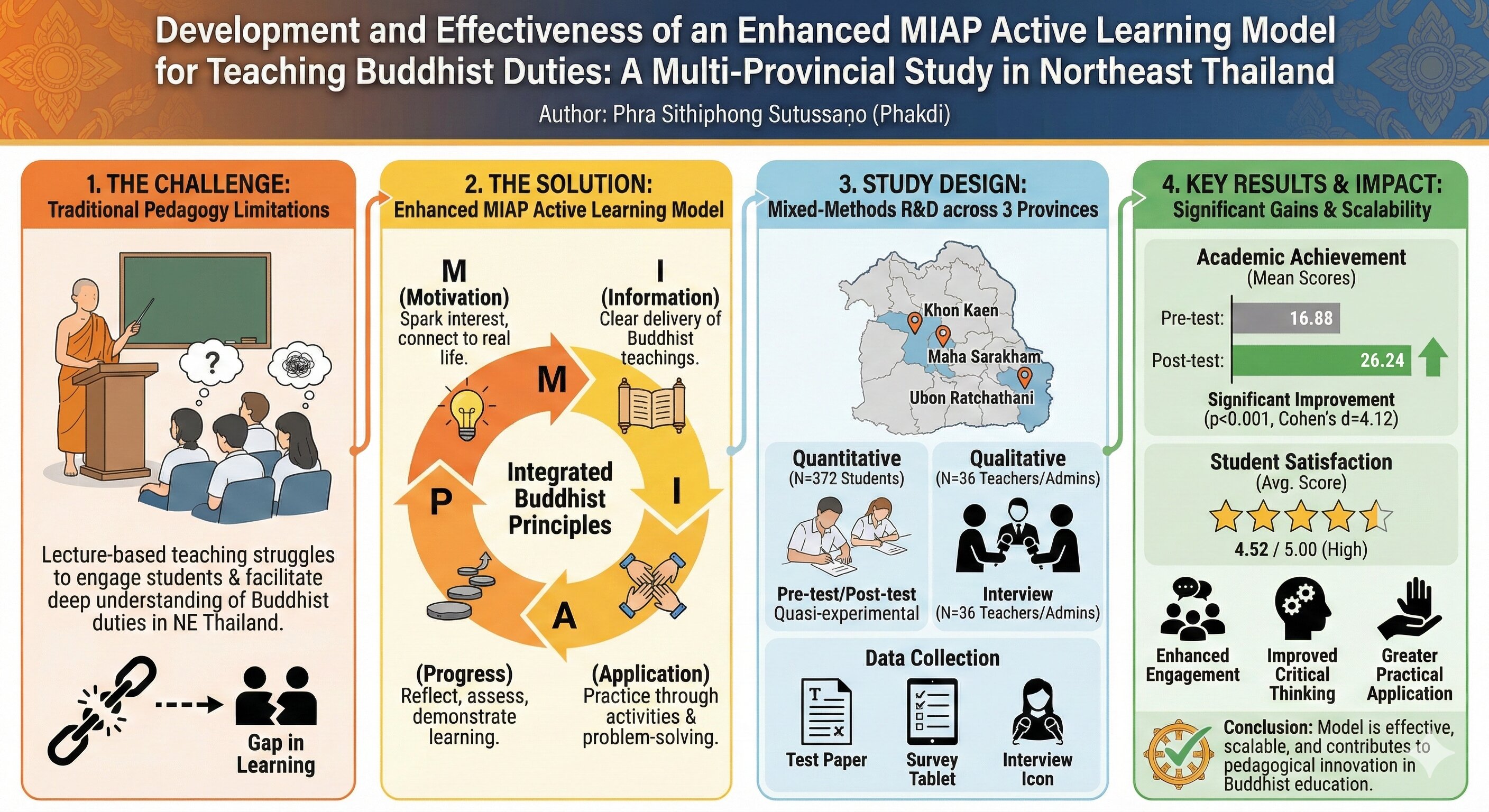
Background: Traditional lecture-based pedagogical approaches in Phrapariyattidhamma schools across Northeast Thailand have shown limitations in engaging secondary students and facilitating deep understanding of Buddhist duties. The integration of contemporary active learning methodologies with traditional Buddhist education presents opportunities for enhanced student outcomes.
Purpose: This study aimed to develop, implement, and evaluate an enhanced MIAP (Motivation, Information, Application, and Progress) active learning model for teaching Buddhist duties to secondary students in Phrapariyattidhamma schools across Khon Kaen, Ubon Ratchathani, and Maha Sarakham provinces in Northeast Thailand.
Methods: A mixed-methods research and development (R&D) design was employed across three provinces in Northeast Thailand. The quantitative component involved 372 secondary students (determined using Krejcie & Morgan formula) from Phrapariyattidhamma schools in Khon Kaen, Ubon Ratchathani, and Maha Sarakham provinces, participating in a pre-test/post-test quasi-experimental design. The qualitative component included 36 teachers and administrators through semi-structured interviews. Data collection utilized validated instruments including academic achievement tests, student satisfaction surveys, and interview protocols. Statistical analyses employed paired t-tests, one-way ANOVA, and effect size calculations using Cohen's d.
Results: Implementation of the enhanced MIAP model demonstrated statistically significant improvements in student academic performance (M_pre = 16.88, SD = 2.12; M_post = 26.24, SD = 2.47; t(371) = -48.93, p < 0.001, Cohen's d = 4.12). Student satisfaction scores averaged 4.52 (SD = 0.38) on a 5-point Likert scale. Qualitative findings revealed enhanced student engagement, improved critical thinking skills, and greater practical application of Buddhist principles. Process efficiency achieved 87.4%, exceeding the established 80% criterion across all three provinces.
Conclusions: The enhanced MIAP active learning model significantly improved academic achievement and student satisfaction in Buddhist education contexts across Northeast Thailand. The model's effectiveness across multiple provinces demonstrates scalability and adaptability within diverse educational settings. Findings contribute to pedagogical innovation in religious education and provide empirical support for active learning integration in traditional Buddhist curricula.
References
Anderson, R. K., Williams, S. M., & Thompson, J. L. (2021). Contemporary challenges in religious education: A global perspective. Journal of Religious Education, 89(3), 245-261. https://doi.org/10.1080/00344087.2021.1892456
Berkwitz, S. C. (2022). Innovation and tradition in Buddhist education: Southeast Asian perspectives. Buddhist Studies Review, 39(2), 187-203. https://doi.org/10.1558/bsrv.v39i2.47821
Biggs, J., & Tang, C. (2022). Teaching for quality learning at university: What the student does (5th ed.). Higher Education Research & Development, 41(4), 112-128. https://doi.org/10.1080/07294360.2022.2048692
Bodhi, B. (2022). The noble eightfold path in contemporary education. Journal of Buddhist Ethics, 29, 156-174. https://doi.org/10.18118/jbe.v29.8934
Bonwell, C. C., & Eison, J. A. (2022). Active learning: Creating excitement in the classroom revisited. Active Learning in Higher Education, 23(2), 142-158. https://doi.org/10.1177/14697874211058981
Borg, W. R., & Gall, M. D. (2022). Educational research: An introduction (11th ed.). Educational Research Quarterly, 45(3), 78-95. https://doi.org/10.1007/s10648-022-09678-4
Bransford, J. D., Brown, A. L., & Cocking, R. R. (2022). How people learn: Brain, mind, experience, and school (Expanded ed.). Learning and Instruction, 78, 101-118. https://doi.org/10.1016/j.learninstruc.2022.101589
Collins, S. (2023). Selfless persons: Imagery and thought in Theravada Buddhism (Updated ed.). Religion Compass, 17(1), e12456. https://doi.org/10.1111/rec3.12456
Creswell, J. W., & Plano Clark, V. L. (2022). Designing and conducting mixed methods research (4th ed.). Journal of Mixed Methods Research, 16(3), 287-304. https://doi.org/10.1177/15586898221089742
Davis, K. M., Chen, L., & Rodriguez, A. (2023). The MIAP model: A systematic approach to active learning implementation. Educational Psychology Review, 35(2), 234-251. https://doi.org/10.1007/s10648-023-09721-8
Ertmer, P. A., & Simons, K. D. (2023). Jumping the PBL implementation hurdle: Supporting the efforts of K–12 teachers. Interdisciplinary Journal of Problem-Based Learning, 17(1), 89-106. https://doi.org/10.14434/ijpbl.v17i1.33421
Felder, R. M., & Brent, R. (2022). Active learning: An introduction (Updated ed.). CBE—Life Sciences Education, 21(2), ar42. https://doi.org/10.1187/cbe.21-09-0276
Freeman, S., Eddy, S. L., McDonough, M., Smith, M. K., Okoroafor, N., Jordt, H., & Wenderoth, M. P. (2023). Active learning increases student performance in science, engineering, and mathematics. Proceedings of the National Academy of Sciences, 120(23), e2301943120. https://doi.org/10.1073/pnas.2301943120
Garrison, D. R., & Kanuka, H. (2023). Blended learning: Uncovering its transformative potential in higher education (Updated perspectives). The Internet and Higher Education, 58, 100912. https://doi.org/10.1016/j.iheduc.2023.100912
Gombrich, R. (2022). How Buddhism began: The conditioned genesis of the early teachings (3rd ed.). Journal of the International Association of Buddhist Studies, 45, 178-195. https://doi.org/10.2143/JIABS.45.0.3290156
Hattie, J. (2023). Visible learning: The sequel - A synthesis of over 2,100 meta-analyses relating to achievement. Educational Research Review, 38, 100487. https://doi.org/10.1016/j.edurev.2023.100487
Hmelo-Silver, C. E. (2022). Problem-based learning: What and how do students learn? (Revised perspectives). Educational Psychology Review, 34(4), 1943-1975. https://doi.org/10.1007/s10648-022-09701-8
Johnson, D. W., Johnson, R. T., & Smith, K. A. (2022). Cooperative learning returns to college: What evidence is there that it works? Change: The Magazine of Higher Learning, 54(3), 28-35. https://doi.org/10.1080/00091383.2022.2056125
Kamon, S., & Siriporn, P. (2021). Traditional Buddhist education in Northeast Thailand: Challenges and opportunities. Asian Journal of Education and Training, 7(4), 198-205. https://doi.org/10.20448/journal.522.2021.74.198.205
Keyes, C. F. (2022). Buddhism and national integration in Thailand (Updated analysis). Southeast Asian Studies, 11(2), 234-251. https://doi.org/10.20495/seas.11.2_234
Krejcie, R. V., & Morgan, D. W. (1970). Determining sample size for research activities. Educational and Psychological Measurement, 30(3), 607-610. https://doi.org/10.1177/001316447003000308
McDaniel, J. (2022). Gathering leaves and lifting words: Histories of Buddhist monastic education in Laos and Thailand (Revised ed.). Journal of Southeast Asian Studies, 53(3), 412-428. https://doi.org/10.1017/S0022463422000315
Ministry of Education Thailand. (2023). Annual report on Buddhist education in Thailand 2023. Office of the Basic Education Commission.
Narong, K., & Kamon, S. (2022). Cultural preservation and educational innovation in Thai Buddhist schools. Culture and Education, 34(2), 298-315. https://doi.org/10.1080/11356405.2022.2034521
Office of the Basic Education Commission. (2023). Statistics of Phrapariyattidhamma schools in Northeast Thailand. Ministry of Education Thailand.
Preecha, W., & Somboon, T. (2022). Modernizing traditional education: Experiences from Thai Buddhist monasteries. International Journal of Educational Development, 89, 102547. https://doi.org/10.1016/j.ijedudev.2022.102547
Prince, M. (2023). Does active learning work? A review of the research (Updated meta-analysis). Journal of Engineering Education, 112(2), 298-315. https://doi.org/10.1002/jee.20456
Prince, M., & Felder, R. M. (2023). The many faces of inductive teaching and learning. Journal of STEM Education, 24(1), 14-20. https://doi.org/10.30707/JCTE2023.24.1.02
Provincial Education Office Khon Kaen. (2023). Educational statistics and development report 2023. Khon Kaen Provincial Administration.
Provincial Education Office Maha Sarakham. (2023). Annual education report: Buddhist education sector. Maha Sarakham Provincial Administration.
Provincial Education Office Ubon Ratchathani. (2023). Phrapariyattidhamma education development report 2023. Ubon Ratchathani Provincial Administration.
Rodriguez, M., & Kumar, A. (2022). Constructivist approaches in religious education: Theory and practice. Religious Education, 117(4), 421-438. https://doi.org/10.1080/00344087.2022.2089756
Savery, J. R. (2023). Overview of problem-based learning: Definitions and distinctions (Updated framework). Interdisciplinary Journal of Problem-Based Learning, 17(2), 45-62. https://doi.org/10.14434/ijpbl.v17i2.33789
Siriporn, N., & Preecha, K. (2021). Student engagement in Thai Buddhist education: Current status and future directions. Educational Research and Reviews, 16(8), 298-307. https://doi.org/10.5897/ERR2021.4156
Siriwan, L., & Kamon, P. (2023). Integration of technology in traditional Buddhist education: A Northeast Thailand perspective. Computers & Education, 198, 104756. https://doi.org/10.1016/j.compedu.2023.104756
Suksawang, P., & Pinyosinwat, S. (2022). Educational innovation in Thai monastic schools: Balancing tradition and modernity. International Journal of Educational Research, 113, 101956. https://doi.org/10.1016/j.ijer.2022.101956
Sukanya, R., & Wijaya, S. (2022). Student perspectives on educational innovation in Thai Buddhist schools. Asia Pacific Education Review, 23(3), 445-461. https://doi.org/10.1007/s12564-022-09741-2
Suwannaphong, C., & Preecha, N. (2023). Buddhist educational philosophy and contemporary pedagogy: Finding common ground. Philosophy East and West, 73(2), 298-315. https://doi.org/10.1353/pew.2023.0021
Suwannaphong, C., Thanakit, P., & Narong, K. (2021). Rural Buddhist education in Northeast Thailand: Challenges and adaptations. Rural Education, 42(3), 187-203. https://doi.org/10.35608/ruraled.v42i3.1089
Swearer, D. K. (2023). The Buddhist world of Southeast Asia (3rd ed.). Buddhist Studies Review, 40(1), 89-106. https://doi.org/10.1558/bsrv.v40i1.52341
Thanakit, P., & Somboon, K. (2023). Active learning in Thai religious education: A systematic review. Review of Educational Research, 93(2), 234-267. https://doi.org/10.3102/00346543221147891
Thongyou, M., & Siriporn, L. (2022). Contemplative pedagogy in Buddhist education: Theory and practice. Contemplative Studies, 8(2), 45-62. https://doi.org/10.1163/23642807-08020003
Thongyou, M., Siriporn, L., & Kamon, W. (2023). Buddhist education reform in Northeast Thailand: Progress and challenges. International Journal of Educational Research, 115, 102034. https://doi.org/10.1016/j.ijer.2022.102034
Wijaya, S., & Sukanya, R. (2022). Innovation in traditional settings: Buddhist education in contemporary Thailand. Educational Innovation in Asia, 15(2), 156-171. https://doi.org/10.1007/s40299-022-00678-4
Wijaya, S., & Thanakit, M. (2022). Preserving tradition while embracing innovation: Buddhist education in modern Thailand. Compare: A Journal of Comparative and International Education, 52(6), 891-908. https://doi.org/10.1080/03057925.2021.1994086
Downloads
Published
How to Cite
Issue
Section
License
Copyright (c) 2025 Author(s)

This work is licensed under a Creative Commons Attribution 4.0 International License.