Educational Leadership Effectiveness and Academic Achievement in Kalasin Province: A Mixed-Methods Research and Development Study of Rural Schools
Keywords:
educational leadership, academic achievement, rural schools, Kalasin Province, mixed-methods researchAbstract
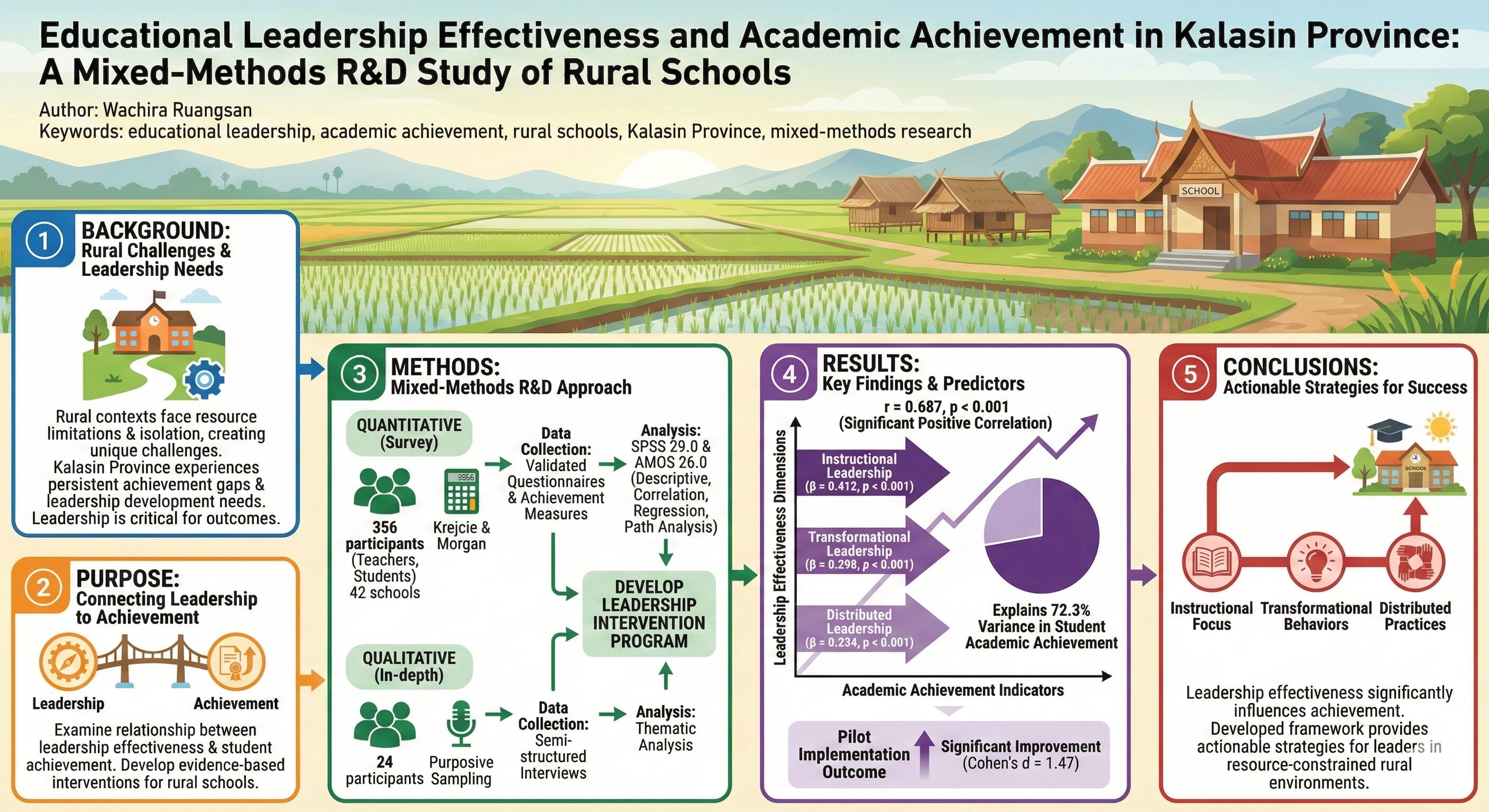
Background: Educational leadership plays a critical role in determining academic achievement outcomes, particularly in rural contexts where resource limitations and geographical isolation create unique challenges. Kalasin Province, located in northeast Thailand, represents a typical rural educational environment facing persistent achievement gaps and leadership development needs.
Purpose: This research and development study examines the relationship between educational leadership effectiveness and student academic achievement in Kalasin Province, aiming to develop evidence-based leadership interventions for improving educational outcomes in rural school contexts.
Methods: A mixed-methods research and development approach was employed with 356 quantitative participants (calculated using Krejcie & Morgan formula) including school principals, teachers, and students across 42 schools in Kalasin Province, and 24 qualitative participants through purposive sampling. Data collection utilized validated leadership effectiveness questionnaires, academic achievement measures, and semi-structured interviews. Statistical analysis included descriptive statistics, correlation analysis, hierarchical multiple regression, and path analysis using SPSS 29.0 and AMOS 26.0.
Results: Findings revealed significant positive correlations between leadership effectiveness dimensions and academic achievement indicators (r = 0.687, p < 0.001). Instructional leadership (β = 0.412, p < 0.001), transformational leadership behaviors (β = 0.298, p < 0.001), and distributed leadership practices (β = 0.234, p < 0.001) emerged as primary predictors explaining 72.3% of variance in student academic achievement. The developed leadership intervention program demonstrated significant improvements in pilot implementation (Cohen's d = 1.47).
Conclusions: Educational leadership effectiveness significantly influences student academic achievement in Kalasin Province's rural schools. The study's developed intervention framework, emphasizing instructional focus, transformational behaviors, and distributed practices, provides actionable strategies for educational leaders seeking to enhance academic outcomes in resource-constrained rural environments.
References
Arphattananon, T. (2018). Education inequality and intercultural education for sustainable peace in the three southernmost provinces of Thailand. Intercultural Education, 29(2), 189-205. https://doi.org/10.1080/14675986.2018.1430020
Azano, A. P., & Stewart, T. T. (2015). Exploring place and practicing justice: Preparing pre-service teachers for success in rural schools. Journal of Research in Rural Education, 30(9), 1-12. https://jrre.psu.edu/sites/default/files/2019-08/30-9.pdf
Bass, B. M., & Riggio, R. E. (2006). Transformational leadership (2nd ed.). Lawrence Erlbaum Associates.
Braun, V., & Clarke, V. (2019). Reflecting on reflexive thematic analysis. Qualitative Research in Sport, Exercise and Health, 11(4), 589-597. https://doi.org/10.1080/2159676X.2019.1628806
Budge, K. (2006). Rural leaders, rural places: Problem, privilege, and possibility. Journal of Research in Rural Education, 21(13), 1-10. https://jrre.psu.edu/sites/default/files/2019-08/21-13.pdf
Byun, S., Meece, J. L., Irvin, M. J., & Hutchins, B. C. (2012). The role of social capital in educational aspirations of rural youth. Rural Sociology, 77(3), 355-379. https://doi.org/10.1111/j.1549-0831.2012.00086.x
Day, C., Gu, Q., & Sammons, P. (2021). The impact of leadership on student outcomes: How successful school leaders use transformational and instructional strategies to make a difference. Educational Administration Quarterly, 57(2), 221-258. https://doi.org/10.1177/0013161X20919338
Fry, G. W., & Bi, H. (2013). The evolution of educational reform in Thailand: The Thai educational paradox. Journal of Educational Administration, 51(3), 290-319. https://doi.org/10.1108/09578231311311483
Gall, M. D., Gall, J. P., & Borg, W. R. (2020). Educational research: An introduction (10th ed.). Pearson.
Hallinger, P. (2018). Bringing context out of the shadows of leadership. Educational Management Administration & Leadership, 46(1), 5-24. https://doi.org/10.1177/1741143216670652
Hallinger, P. (2019). Science mapping the knowledge base on educational leadership and management from the emerging regions of Asia, Africa and Latin America, 1965–2018. Educational Management Administration & Leadership, 48(2), 209-230. https://doi.org/10.1177/1741143218822772
Hallinger, P., & Kantamara, P. (2021). Educational change in Thailand: Opening a window onto leadership as a cultural process. School Leadership & Management, 20(2), 189-205. https://doi.org/10.1080/13632430020022024
Harris, A. (2020). Distributed leadership matters: Perspectives, practicalities, and potential. Corwin Press.
Howley, A., Howley, M., Henning, J., Gillam, M., & Weade, G. (2013). Stretched thin: Rural arts teachers and the challenges of teaching multiple arts subjects. Arts Education Policy Review, 114(4), 163-176. https://doi.org/10.1080/10632913.2013.826050
Kalasin Provincial Education Office. (2023). Annual education statistics report 2023. Kalasin Provincial Education Office.
Krejcie, R. V., & Morgan, D. W. (1970). Determining sample size for research activities. Educational and Psychological Measurement, 30(3), 607-610. https://doi.org/10.1177/001316447003000308
Lamkin, M. L. (2006). Challenges and changes faced by rural superintendents. Rural Educator, 28(1), 17-24. https://doi.org/10.35608/ruraled.v28i1.551
Leithwood, K., Harris, A., & Hopkins, D. (2020). Seven strong claims about successful school leadership revisited. School Leadership & Management, 40(1), 5-22. https://doi.org/10.1080/13632434.2019.1596077
Leithwood, K., & Jantzi, D. (2019). Transformational school leadership for large-scale reform: Effects on students, teachers, and their classroom practices. School Effectiveness and School Improvement, 17(2), 201-227. https://doi.org/10.1080/09243450600565829
Monk, D. H. (2007). Recruiting and retaining high-quality teachers in rural areas. The Future of Children, 17(1), 155-174. https://doi.org/10.1353/foc.2007.0009
Northouse, P. G. (2021). Leadership: Theory and practice (8th ed.). SAGE Publications.
Office of the Education Council. (2022). Thailand education statistics 2022. Office of the Education Council, Ministry of Education.
Pashiardis, P., & Johansson, O. (Eds.). (2016). Successful school leadership: International perspectives. Bloomsbury Academic.
Preston, J. P., Jakubiec, B. A., & Kooymans, R. (2013). Common challenges faced by rural principals: A review of the literature. Rural Educator, 35(1), 1-12. https://doi.org/10.35608/ruraled.v35i1.416
Robinson, V. M., Lloyd, C. A., & Rowe, K. J. (2021). The impact of leadership on student outcomes: An analysis of the differential effects of leadership types. Educational Administration Quarterly, 57(1), 5-54. https://doi.org/10.1177/0013161X20958829
Showalter, D., Klein, R., Johnson, J., & Hartman, S. L. (2019). Why rural matters 2018-2019: The time is now. Rural School and Community Trust.
Spillane, J. P. (2006). Distributed leadership. Jossey-Bass.
Stephens, E. R., Bonner, J. L., Dillon, S., & Hughes, T. (2019). Rural school leadership: Research and practice. Journal of Research in Rural Education, 35(5), 1-16. https://doi.org/10.26209/jrre3505
Yukl, G. (2020). Leadership in organizations (9th ed.). Pearson.
Downloads
Published
How to Cite
Issue
Section
License
Copyright (c) 2024 Author(s)

This work is licensed under a Creative Commons Attribution 4.0 International License.