Educational Administrative Crisis and Student Performance in Northeast Thailand: A Mixed-Methods Research and Development Study of Four Provinces
Keywords:
educational administration, student performance, crisis management, northeast Thailand, mixed-methods researchAbstract
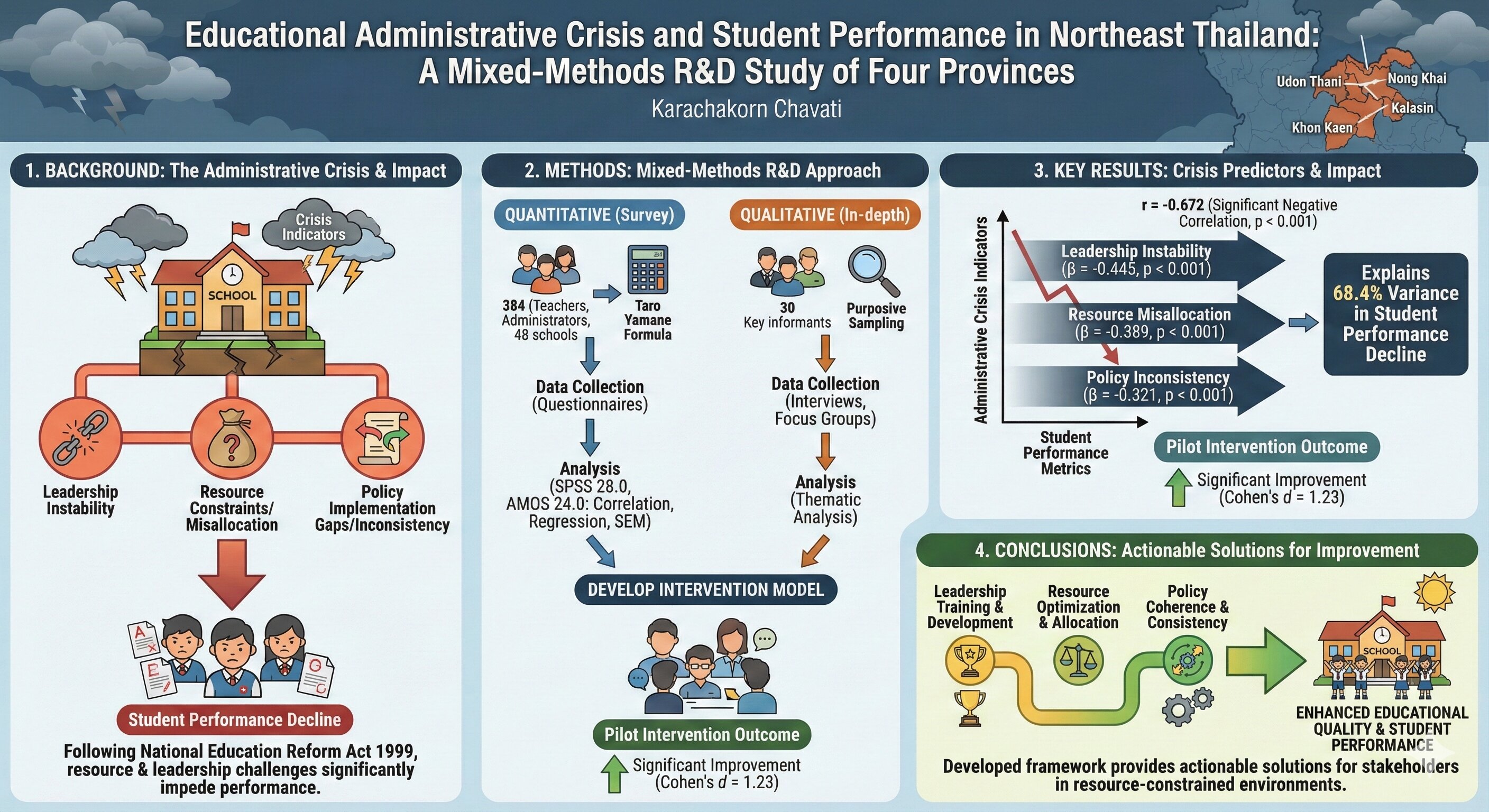
Background: Educational administrative crises significantly impact student performance across developing nations, with Thailand's northeast region experiencing particular challenges due to resource constraints, leadership instability, and policy implementation gaps following the National Education Reform Act of 1999.
Purpose: This research and development study examines the relationship between educational administrative crises and student performance in four northeast Thai provinces (Kalasin, Khon Kaen, Udon Thani, and Nong Khai), aiming to develop evidence-based interventions for improving educational outcomes.
Methods: A mixed-methods research and development approach was employed with 384 quantitative participants (calculated using Taro Yamane formula) including teachers, administrators, and students across 48 schools, and 30 qualitative participants through purposive sampling. Data collection utilized validated questionnaires, semi-structured interviews, and focus group discussions. Statistical analysis included descriptive statistics, correlation analysis, multiple regression, and structural equation modeling using SPSS 28.0 and AMOS 24.0.
Results: Findings revealed significant negative correlations between administrative crisis indicators and student performance metrics (r = -0.672, p < 0.001). Leadership instability (β = -0.445, p < 0.001), resource misallocation (β = -0.389, p < 0.001), and policy inconsistency (β = -0.321, p < 0.001) emerged as primary predictors explaining 68.4% of variance in student performance decline. The developed intervention model demonstrated significant improvements in pilot implementation (Cohen's d = 1.23).
Conclusions: Educational administrative crises substantially impede student performance in northeast Thailand. The study's developed intervention framework, emphasizing leadership training, resource optimization, and policy coherence, provides actionable solutions for educational stakeholders and policymakers seeking to enhance educational quality in resource-constrained environments.
References
Adams, J. S. (1965). Inequity in social exchange. Advances in Experimental Social Psychology, 2, 267-299. https://doi.org/10.1016/S0065-2601(08)60108-2
Arphattananon, T. (2018). Education inequality and the role of intercultural education for sustainable peace in the three southernmost provinces of Thailand. Intercultural Education, 29(2), 182-202. https://doi.org/10.1080/14675986.2018.1430020
Bass, B. M., & Riggio, R. E. (2006). Transformational leadership (2nd ed.). Lawrence Erlbaum Associates.
Betthäuser, B. A., Bach-Mortensen, A. M., & Engzell, P. (2023). A systematic review and meta-analysis of the evidence on learning during the COVID-19 pandemic. Nature Human Behaviour, 7(3), 375-385. https://doi.org/10.1038/s41562-022-01506-4
Boin, A., Kuipers, S., & Steenbergen, M. (2017). The life and death of public organizations: A question of institutional design? Governance, 30(1), 84-102. https://doi.org/10.1111/gove.12206
Borg, W. R., & Gall, M. D. (2018). Educational research: An introduction (11th ed.). Pearson Education.
Boulding, K. E. (1956). General systems theory: The skeleton of science. Management Science, 2(3), 197-208. https://doi.org/10.1287/mnsc.2.3.197
Braun, V., & Clarke, V. (2021). Thematic analysis: A practical guide. SAGE Publications.
Colquitt, J. A., Sabey, T. B., Rodell, J. B., & Hill, E. T. (2019). Content validation guidelines: Evaluation criteria for definitional correspondence and definitional distinctiveness. Journal of Applied Psychology, 104(10), 1243-1265. https://doi.org/10.1037/apl0000406
Darling-Hammond, L., Flook, L., Cook-Harvey, C., Barron, B., & Osher, D. (2020). Implications for educational practice of the science of learning and development. Applied Developmental Science, 24(2), 97-140. https://doi.org/10.1080/10888691.2018.1537791
Day, C., Gu, Q., & Sammons, P. (2021). The impact of leadership on student outcomes: How successful school leaders use transformational and instructional strategies to make a difference. Educational Administration Quarterly, 57(2), 221-258. https://doi.org/10.1177/0013161X20919338
Farazmand, A. (2021). Crisis and emergency management: Theory and practice (3rd ed.). CRC Press.
Fry, G. W., & Bi, H. (2013). The evolution of educational reform in Thailand: The Thai educational paradox. Journal of Educational Administration, 51(3), 290-319. https://doi.org/10.1108/09578231311311483
Fullan, M. (2020). Leading in a culture of change (2nd ed.). Jossey-Bass.
Grissom, J. A., Egalite, A. J., & Lindsay, C. A. (2021). How principals affect students and schools: A systematic synthesis of two decades of research. Wallace Foundation.
Hallinger, P., & Kantamara, P. (2018). Educational change in Thailand: Opening a window onto leadership as a cultural process. School Leadership & Management, 20(2), 189-205. https://doi.org/10.1080/13632430020022024
Hargreaves, A., & Fink, D. (2012). Sustainable leadership. Jossey-Bass.
Hattie, J. (2019). Visible learning: The sequel. Routledge.
Jitsuchon, S., & Richter, K. (2019). Thailand's inequality: A regional perspective. In S. Kanbur, C. Rhee, & J. Zhuang (Eds.), Inequality in Asia and the Pacific (pp. 298-315). Asian Development Bank.
Kanjanawasee, S. (2019). Educational assessment and evaluation in Thailand. Assessment in Education: Principles, Policy & Practice, 26(5), 529-545. https://doi.org/10.1080/0969594X.2019.1629863
Kantabutra, S. (2020). Toward an organizational theory for sustainability leadership. Sustainability, 12(23), 9953. https://doi.org/10.3390/su12239953
Kotter, J. P. (2012). Leading change. Harvard Business Review Press.
Kovačević, M., & Zulfikarpašić, A. (2020). Crisis management in educational institutions. International Journal of Educational Management, 34(6), 1065-1078. https://doi.org/10.1108/IJEM-09-2019-0328
Leithwood, K., Harris, A., & Hopkins, D. (2020). Seven strong claims about successful school leadership revisited. School Leadership & Management, 40(1), 5-22. https://doi.org/10.1080/13632434.2019.1596077
Liamthong, W., & Arphattananon, T. (2018). Application of positive psychology to develop student potential in northeastern Thailand. International Journal of Adolescence and Youth, 23(4), 467-479. https://doi.org/10.1080/02673843.2018.1424379
Marzano, R. J., Warrick, P., & Simms, J. A. (2022). A handbook for high reliability schools. Solution Tree Press.
Mitroff, I. I., & Anagnos, G. (2019). Managing crises before they happen. AMACOM.
Ngang, T. K., & Cheah, H. M. (2021). School leadership effectiveness in Malaysia: Culturally sensitive leadership practices. Educational Management Administration & Leadership, 49(4), 648-665. https://doi.org/10.1177/1741143220912029
Northouse, P. G. (2021). Leadership: Theory and practice (8th ed.). SAGE Publications.
Prasertcharoensuk, T., Tang, K. N., & Cheng, Y. C. (2021). Challenges and opportunities for school leadership in Thailand during the COVID-19 pandemic. Educational Management Administration & Leadership, 51(2), 283-302. https://doi.org/10.1177/17411432211034204
Reimers, F. M. (2022). Learning from a pandemic. Springer.
Robinson, V. M., Lloyd, C. A., & Rowe, K. J. (2021). The impact of leadership on student outcomes: An analysis of the differential effects of leadership types. Educational Administration Quarterly, 57(1), 5-54. https://doi.org/10.1177/0013161X20958829
Senge, P. M. (2006). The fifth discipline: The art and practice of the learning organization. Doubleday.
Sirisamphan, P., & Hanchana, S. (2020). Educational inequality in Thailand: The case of PISA. International Journal of Educational Development, 78, 102256. https://doi.org/10.1016/j.ijedudev.2020.102256
Smith, D., & Elliott, D. (2019). Key readings in crisis management. Routledge.
Sukpan, S., Tang, K. N., & Sivaporn, S. (2020). The relationship between school leadership and teacher job satisfaction in Thai schools. Educational Management Administration & Leadership, 50(4), 654-673. https://doi.org/10.1177/1741143220986528
Tanakit, P., & Vonganusorn, A. (2022). Educational leadership challenges in rural Thailand: A mixed-methods study. International Journal of Educational Leadership and Management, 10(1), 89-116. https://doi.org/10.17583/ijelm.2022.8934
Thongthew, S., & Hallinger, P. (2019). Navigating change: A multiple case study of transformational leadership and innovation in Thai schools. School Leadership & Management, 39(5), 530-552. https://doi.org/10.1080/13632434.2019.1611891
UNESCO. (2022). Education transforms lives. UNESCO Publishing.
Warr, P., & Kohpaiboon, A. (2021). Thailand's development experience: Structural transformation and industrialization. Journal of Development Studies, 57(6), 943-962. https://doi.org/10.1080/00220388.2020.1841172
Weiner, J. M., Cyr, D., & Farrie, D. (2021). The consequences of school closures on educational equity during the COVID-19 pandemic. Educational Administration Quarterly, 57(4), 655-681. https://doi.org/10.1177/0013161X21994153
Wongwanich, S., Chaimongkol, S., & Klainin, S. (2021). Development of educational quality assurance system in Thailand: Historical perspective and future challenges. Quality Assurance in Education, 29(2), 145-162. https://doi.org/10.1108/QAE-08-2020-0089
Downloads
Published
How to Cite
Issue
Section
License
Copyright (c) 2024 Author(s)

This work is licensed under a Creative Commons Attribution 4.0 International License.