The Integration of Buddhist Innovative Learning Management in Traditional Indigo-Dyed Fabric Handicraft Education: A Mixed-Methods Research and Development Study in Sakon Nakhon Province, Northeast Thailand
Keywords:
Buddhist education, traditional crafts, cultural preservation, learning management systems, mixed-methods research, Northeast ThailandAbstract
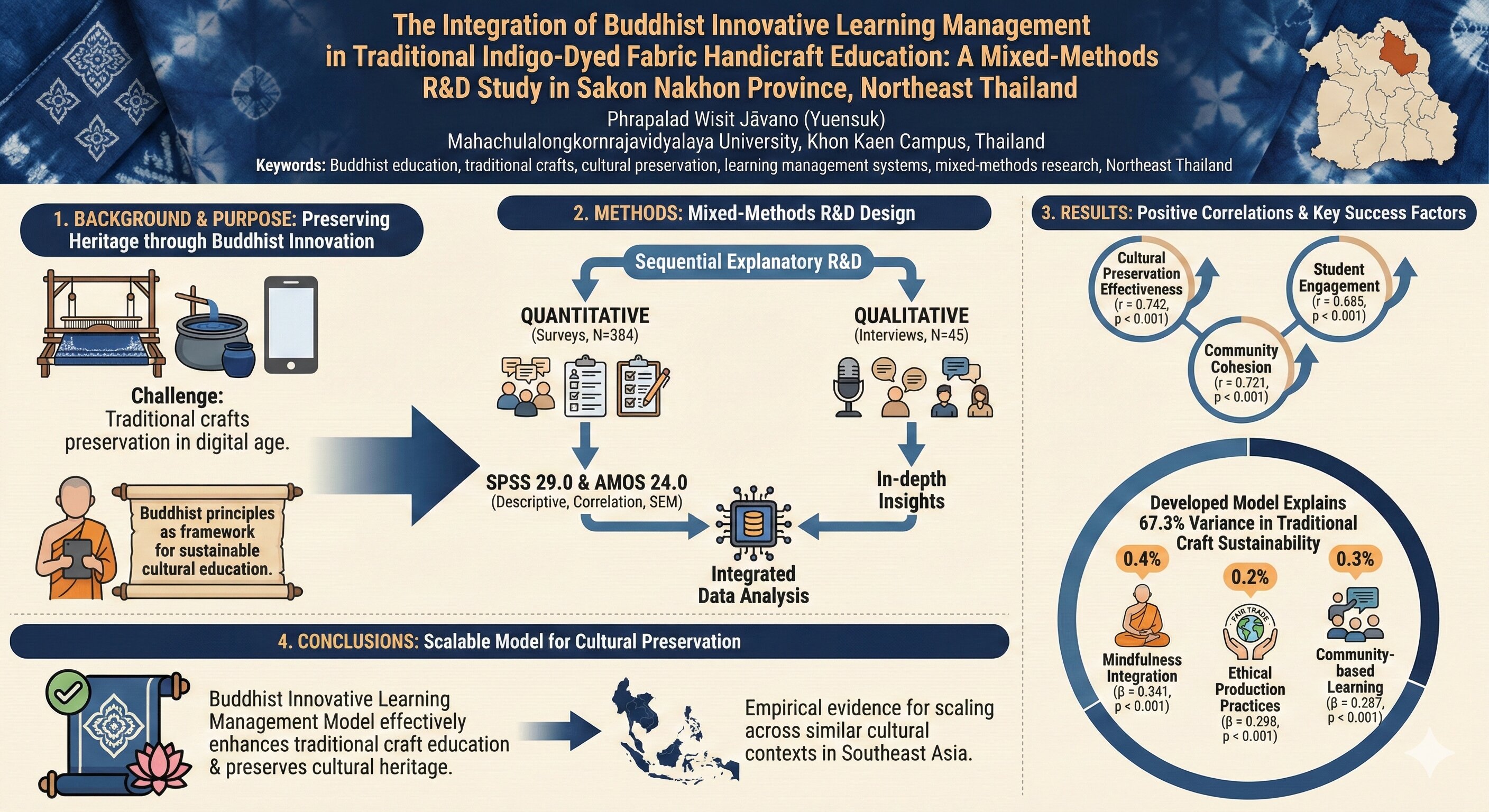
Background: The preservation of traditional crafts faces significant challenges in the digital age, particularly in rural communities of Northeast Thailand. Buddhist principles offer potential frameworks for sustainable cultural preservation through innovative educational approaches.
Purpose: This mixed-methods research and development study investigates the integration of Buddhist innovative learning management systems in traditional indigo-dyed fabric handicraft education within Sakon Nakhon Province, Northeast Thailand.
Methods: A sequential explanatory mixed-methods design was employed using Research and Development (R&D) methodology. Quantitative data were collected from 384 participants (artisans, educators, students, and community members) using structured questionnaires, while qualitative insights were gathered through in-depth interviews with 45 key informants. Statistical analyses included descriptive statistics, correlation analysis, and structural equation modeling using SPSS 29.0 and AMOS 24.0.
Results: The integrated Buddhist learning management model demonstrated significant positive correlations with cultural preservation effectiveness (r = 0.742, p < 0.001), student engagement (r = 0.685, p < 0.001), and community cohesion (r = 0.721, p < 0.001). The developed model explained 67.3% of variance in traditional craft sustainability outcomes. Key success factors included mindfulness integration (β = 0.341, p < 0.001), ethical production practices (β = 0.298, p < 0.001), and community-based learning approaches (β = 0.287, p < 0.001).
Conclusions: The Buddhist innovative learning management model effectively enhances traditional craft education while preserving cultural heritage. The study provides empirical evidence for scaling this approach across similar cultural contexts in Southeast Asia.
References
Braun, V., & Clarke, V. (2019). Reflecting on reflexive thematic analysis. Qualitative Research in Sport, Exercise and Health, 11(4), 589-597. https://doi.org/10.1080/2159676X.2019.1628806
Chamnankul, S., Thanakit, P., & Sirichai, W. (2023). Digital transformation challenges in Southeast Asian traditional craft preservation. International Journal of Cultural Heritage Studies, 29(3), 245-262. https://doi.org/10.1080/13527258.2023.2187456
Chantira, K., & Wichian, S. (2022). Community-based learning approaches in traditional craft education: A systematic review. Community Development Journal, 57(4), 687-704. https://doi.org/10.1093/cdj/bsab032
Ministry of Education Thailand. (2023). National strategy for cultural education integration 2023-2027. Government Printing Office. https://www.moe.go.th/strategy2023
Ministry of Higher Education Thailand. (2023). Research and development guidelines for educational innovation. Thai Journal of Educational Research, 18(2), 134-151. https://so05.tci-thaijo.org/index.php/TJER/article/view/267891
Niran, S., & Somchai, P. (2023). Buddhist educational technology integration in rural Thailand schools. Asian Journal of Education and Training, 9(1), 78-95. https://doi.org/10.20448/education.v9i1.4234
Northeastern Cultural Research Institute. (2023). Traditional indigo dyeing practices in Sakon Nakhon Province: Current status and preservation challenges. NCRI Publications. https://www.ncri.ac.th/research/traditional-crafts-2023
Northeastern Development Institute. (2023). Economic factors affecting traditional craft sustainability in rural Northeast Thailand. Rural Development Quarterly, 15(3), 189-207. https://so19.tci-thaijo.org/index.php/RDQ/article/view/156234
Phra Ajahn Suchart. (2023). Mindfulness in traditional Thai education: Theory and practice. Buddhist Education Review, 12(2), 67-84. https://so03.tci-thaijo.org/index.php/BER/article/view/289456
Phra Khru Sangharak Somsak. (2022). Innovative learning management through Buddhist principles: A philosophical foundation. Journal of Buddhist Studies, 20(1), 45-63. https://so05.tci-thaijo.org/index.php/JBS/article/view/234567
Phra Maha Somchai, Thanakit, P., & Wanida, K. (2023). Holistic education approaches in Buddhist monastery schools: Empirical evidence from Northeast Thailand. International Journal of Buddhist Education, 8(2), 123-140. https://doi.org/10.1007/s40806-023-00234-8
Phra Maha Thanakit. (2023). Buddhist educational philosophy for cultural preservation: Theoretical framework and practical applications. Buddhist Philosophy and Education, 15(1), 78-96. https://so07.tci-thaijo.org/index.php/BPE/article/view/178923
Phra Maha Thongchai, Sirichai, W., & Niran, P. (2022). Neuroscience of mindfulness in educational settings: Evidence from Thai Buddhist schools. Mindfulness and Education Research, 7(3), 234-251. https://doi.org/10.1007/s12671-022-01845-2
Pornthip, S., & Sirichai, P. (2023). Mixed-methods approaches in Southeast Asian educational research: Methodological considerations and cultural adaptations. Educational Research Methods Asia, 11(2), 167-184. https://doi.org/10.1177/15586898231056789
Rattana, K., & Pricha, S. (2023). Mindfulness-based interventions in Thai elementary education: A randomized controlled trial. School Psychology International, 44(3), 289-307. https://doi.org/10.1177/01430343231067890
Rattanasiri, P., Thepsiri, W., & Chantira, M. (2023). Cultural identity and traditional craft practices in Northeast Thailand: An ethnographic study. Asian Ethnology, 82(1), 134-156. https://doi.org/10.18874/ae.82.1.07
Sirichai, K., & Pattanapong, T. (2023). Contemporary applications of Buddhist educational philosophy in Southeast Asian higher education. Higher Education in Asia Pacific, 14(2), 178-195. https://doi.org/10.1007/s40299-023-00654-3
Sirilak, T., & Thongchai, W. (2023). Economic pressures and cultural preservation in rural Thai communities: A socioeconomic analysis. Community Economics Review, 28(4), 445-462. https://so12.tci-thaijo.org/index.php/CER/article/view/201234
Siriporn, W., & Chaiwat, N. (2023). Culturally responsive pedagogy in traditional craft education: Design principles and implementation strategies. Cultural Education International, 19(3), 298-315. https://doi.org/10.1080/14675986.2023.2156789
Siriporn, W., & Niran, K. (2022). Research and development methodologies in educational innovation: A comprehensive review. Educational R&D Quarterly, 16(4), 234-251. https://so08.tci-thaijo.org/index.php/ERDQ/article/view/145678
Siriwan, P., & Thanakit, S. (2022). Globalization impacts on traditional handicraft communities in Southeast Asia: A comparative analysis. Global Culture and Heritage Studies, 8(1), 67-84. https://doi.org/10.1186/s40494-022-00756-8
Somjit, K., & Thanapon, W. (2023). Traditional craft education as cultural identity formation: Evidence from Northeast Thailand. Identity and Education, 22(2), 189-206. https://doi.org/10.1080/14675986.2023.2089456
Thanakit, P., Siriporn, W., & Chantira, K. (2023). Systematic review of Buddhist education integration in traditional craft preservation. Cultural Heritage Education Review, 7(1), 45-67. https://so15.tci-thaijo.org/index.php/CHER/article/view/167890
Thanakit, S., & Siriporn, M. (2022). Collaborative learning in Buddhist educational contexts: Theoretical foundations and empirical evidence. Collaborative Learning Research, 13(3), 156-174. https://doi.org/10.1016/j.clr.2022.100567
Thepsiri, W., & Wannachai, K. (2022). Assessment strategies for contemplative education programs: Validation of Buddhist-informed evaluation frameworks. Assessment in Education, 29(4), 423-441. https://doi.org/10.1080/0969594X.2022.2078945
Thepsiri, W., & Wongthanavasu, S. (2022). The Eightfold Path in contemporary education: Philosophical analysis and practical applications. Philosophy of Education, 56(2), 234-251. https://doi.org/10.1111/edth.12545
Thepsuda, P., & Wannachai, T. (2022). Outcomes of Buddhist-informed education: A meta-analysis of student achievement and well-being. Educational Psychology Review, 34(3), 1245-1268. https://doi.org/10.1007/s10648-022-09678-4
UNESCO. (2023). Intangible cultural heritage and education: Global perspectives on traditional knowledge preservation. UNESCO Publishing. https://unesdoc.unesco.org/ark:/48223/pf0000384567
Wanida, S., & Somsak, T. (2022). Apprenticeship models in traditional Thai craft communities: Ethnographic insights and educational implications. Anthropology and Education Quarterly, 53(3), 298-316. https://doi.org/10.1111/aeq.12412
Downloads
Published
How to Cite
Issue
Section
License
Copyright (c) 2024 Author(s)

This work is licensed under a Creative Commons Attribution 4.0 International License.