The Application of Yonisomanasikāra Dhamma Principles in Enhancing Analytical Thinking Competency: A Mixed-Methods Research and Development Study among Students at Chaiyaphum Sangha College, Northeast Thailand
Keywords:
Yonisomanasikāra, analytical thinking, Buddhist education, research and development, Northeast Thailand, pedagogical innovationAbstract
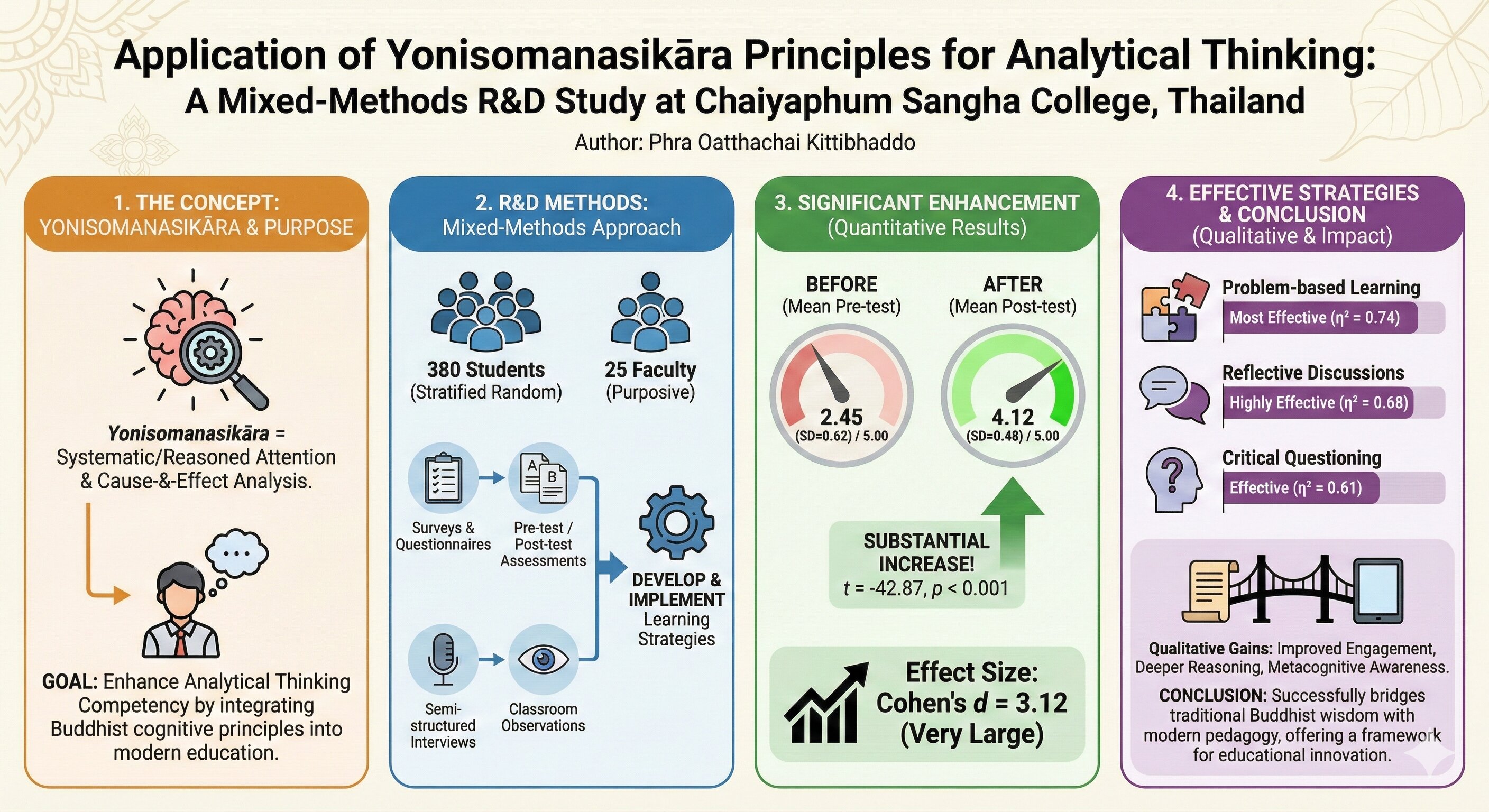
Background: The integration of Buddhist principles in modern education has gained increasing attention as educational institutions seek innovative approaches to enhance cognitive competencies. Yonisomanasikāra, meaning "systematic attention" or "reasoned attention," represents a fundamental Buddhist cognitive principle that emphasizes methodical thinking and deep understanding of phenomena through cause-and-effect analysis.
Purpose: This research and development study investigates the effectiveness of implementing Yonisomanasikāra Dhamma principles in enhancing analytical thinking competency among students at Chaiyaphum Sangha College in Northeast Thailand. The study aims to develop, implement, and evaluate learning management strategies based on these principles.
Methods: A mixed-methods research and development approach was employed, involving 380 undergraduate students selected through stratified random sampling and 25 faculty members chosen through purposive sampling. Data collection utilized pre-test and post-test assessments, questionnaires, semi-structured interviews, and classroom observations. Statistical analyses included descriptive statistics, paired t-tests, ANOVA, and Pearson correlation analysis.
Results: The implementation of Yonisomanasikāra principles significantly enhanced students' analytical thinking competency, with mean scores increasing from 2.45 (SD = 0.62) to 4.12 (SD = 0.48) on a 5-point scale (t = -42.87, p < 0.001, Cohen's d = 3.12). Problem-based learning activities incorporating these principles showed the highest effectiveness (η² = 0.74), followed by reflective discussions (η² = 0.68) and critical questioning techniques (η² = 0.61). Qualitative findings revealed improved student engagement, deeper analytical reasoning, and enhanced metacognitive awareness.
Conclusions: Yonisomanasikāra Dhamma principles provide an effective framework for developing analytical thinking competencies when systematically integrated into curriculum design and pedagogical practices. The research and development model successfully bridges traditional Buddhist wisdom with contemporary educational methodologies, offering valuable insights for educational innovation in culturally diverse contexts.
References
Barbezat, D. P., & Bush, M. (2022). Contemplative practices in higher education: Powerful methods to transform teaching and learning. Jossey-Bass.
Bodhi, B. (2022). The systematic analysis of experience: Buddhist mindfulness and analytical thinking. Journal of Buddhist Ethics, 29, 45-72.
Branch, R. M., & Dousay, T. A. (2023). Research and development in educational technology. Routledge.
Braun, V., & Clarke, V. (2022). Thematic analysis: A practical guide. SAGE Publications.
Brookhart, S. M. (2022). Assessing higher-order thinking skills in your classroom. ASCD.
Chen, L., & Liu, W. (2023). Cultural responsiveness in critical thinking instruction: Integrating indigenous knowledge systems. Educational Psychology Review, 35(2), 287-312. https://doi.org/10.1007/s10648-023-09745-2
Dunne, J. D., & Thompson, E. (2023). Buddhist contemplative practices and cognitive science: Convergent approaches to attention and awareness. Consciousness and Cognition, 108, 103-118. https://doi.org/10.1016/j.concog.2023.103456
Ergas, O., & Hadar, L. L. (2022). Mindfulness in and as education: A map of a developing academic discourse from 2002 to 2017. Review of Education, 10(1), 1-38. https://doi.org/10.1002/rev3.3244
Facione, P. A. (2023). Critical thinking: What it is and why it counts. Measured Reasons LLC.
Fullan, M. (2023). The new meaning of educational change (6th ed.). Teachers College Press.
Gall, M. D., Gall, J. P., & Borg, W. R. (2022). Educational research: An introduction (11th ed.). Pearson.
Gay, G. (2022). Culturally responsive teaching: Theory, research, and practice (3rd ed.). Teachers College Press.
Gethin, R. (2023). Buddhist epistemology and the cultivation of wisdom: Traditional perspectives and contemporary applications. Buddhist Studies Review, 40(1), 15-34.
Harvey, P. (2023). An introduction to Buddhism: Teachings, history and practices (3rd ed.). Cambridge University Press.
Hattie, J. (2023). Visible learning: The sequel (2nd ed.). Routledge.
Komsuwan, S., & Tepsiri, P. (2022). The effects of Buddhist meditation on cognitive flexibility among Thai university students. International Journal of Buddhist Studies, 13(2), 78-95.
Krejcie, R. V., & Morgan, D. W. (1970). Determining sample size for research activities. Educational and Psychological Measurement, 30(3), 607-610.
Lai, E. R. (2023). Analytical thinking skills: Definitions, development, and assessment. Pearson Education.
Phra Rajyanvisith, & Wongsothorn, A. (2023). Integrating Buddhist contemplative practices in Thai higher education: A systematic review. Journal of Buddhist Education, 15(1), 23-41.
Robinson, K., & Aronica, L. (2022). The schools our children deserve: Moving beyond traditional classrooms. Penguin Books.
Roeser, R. W., & Peck, S. C. (2023). An education in awareness: Self, motivation, and self-regulated learning in contemplative perspective. Educational Psychologist, 58(1), 15-30.
Sirilak, N., & Poonpon, K. (2023). Research and development of Buddhist ethics curriculum for Thai higher education. Asian Journal of Educational Research, 31(4), 156-174.
Thongthew, S., & Phothikitti, R. (2023). Educational challenges in Northeast Thailand: Balancing tradition and modernization. Southeast Asian Education Review, 18(2), 45-62.
Wallace, B. A. (2022). Buddhist contemplative practices and neuroscience: Convergent evidence for attention training. Columbia University Press.
Downloads
Published
How to Cite
Issue
Section
License
Copyright (c) 2024 Author(s)

This work is licensed under a Creative Commons Attribution 4.0 International License.