Enhancing Academic Achievement Through Team-Assisted Individualization: A Mixed-Methods Study of Social Studies Education in Northeastern Thailand
Abstract
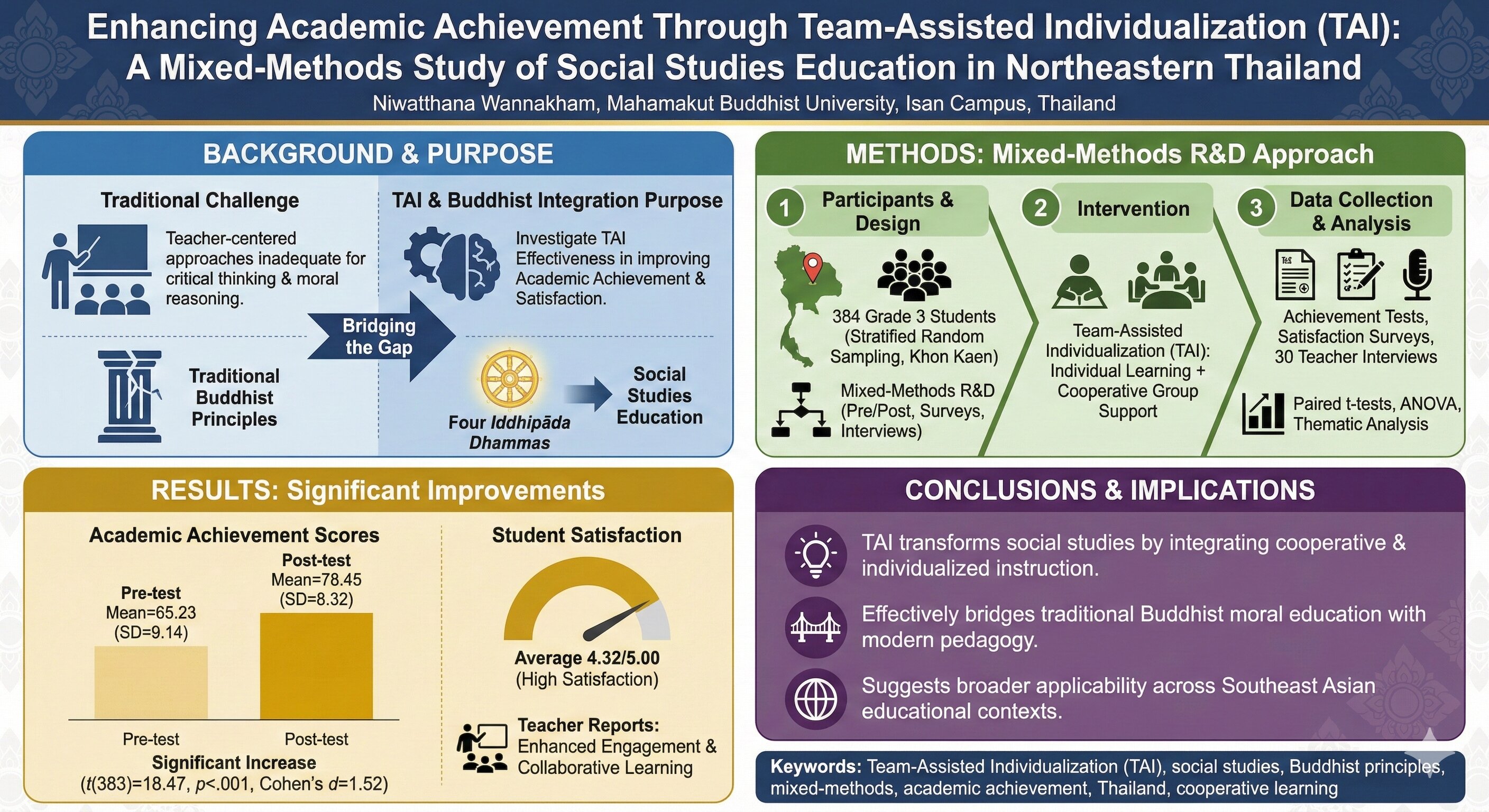
Background: Traditional teacher-centered approaches in Thai social studies education have proven inadequate for developing critical thinking and moral reasoning skills required in contemporary society. The integration of Buddhist principles into modern pedagogical frameworks presents unique challenges requiring innovative instructional strategies.
Purpose: This study investigates the effectiveness of Team-Assisted Individualization (TAI) in improving academic achievement and student satisfaction in social studies education, specifically focusing on the Four Iddhipāda Dhammas within the Thai educational context.
Methods: A mixed-methods research and development (R&D) approach was employed with 384 Grade 3 students from public schools in Khon Kaen Province, Thailand, selected using stratified random sampling. Data collection included pre-post achievement tests, satisfaction surveys, and semi-structured interviews with 30 teachers. Statistical analysis utilized paired t-tests, ANOVA, and thematic analysis for qualitative data.
Results: Implementation of TAI resulted in statistically significant improvements in academic achievement (M = 78.45, SD = 8.32 post-test vs. M = 65.23, SD = 9.14 pre-test; t(383) = 18.47, p < .001, Cohen's d = 1.52). Student satisfaction scores averaged 4.32 on a 5-point Likert scale. Teachers reported enhanced classroom engagement and collaborative learning behaviors.
Conclusions: TAI demonstrates significant potential for transforming social studies education in Thailand by integrating cooperative learning with individualized instruction. The approach effectively bridges traditional Buddhist moral education with contemporary pedagogical practices, suggesting broader applicability across Southeast Asian educational contexts.
References
Aronson, E., & Patnoe, S. (2023). Cooperation in the classroom: The jigsaw method (4th ed.). Pinter & Martin Publishers.
Banks, J. A., & McGee Banks, C. A. (2022). Multicultural education: Issues and perspectives (10th ed.). John Wiley & Sons.
Borg, W. R., & Gall, M. D. (2022). Educational research: An introduction (12th ed.). Pearson Education.
Braun, V., & Clarke, V. (2022). Thematic analysis: A practical guide (2nd ed.). SAGE Publications.
Chen, L., & Liu, X. (2022). Student satisfaction with cooperative learning in East Asian contexts: A systematic review. Educational Psychology Review, 34(2), 567-592. https://doi.org/10.1007/s10648-021-09634-7
Chen, M., & Wong, K. L. (2023). Educational transformation in Southeast Asia: From teacher-centered to student-centered approaches. Asia Pacific Education Review, 24(1), 45-68. https://doi.org/10.1007/s12564-022-09789-3
Chomchaiya, C., & Dunworth, K. (2022). Cooperative learning and Thai cultural values: Challenges and opportunities. International Journal of Educational Development, 88, 102523. https://doi.org/10.1016/j.ijedudev.2021.102523
Cohen, E. G., & Lotan, R. A. (2023). Working for equity in heterogeneous classrooms: Sociological theory in practice (3rd ed.). Teachers College Press.
Creswell, J. W., & Plano Clark, V. L. (2023). Designing and conducting mixed methods research (4th ed.). SAGE Publications.
Deci, E. L., & Ryan, R. M. (2023). Self-determination theory: Basic psychological needs in motivation, development, and wellness (2nd ed.). Guilford Publications.
Durlak, J. A., Weissberg, R. P., Dymnicki, A. B., Taylor, R. D., & Schellinger, K. B. (2023). The impact of enhancing students' social and emotional learning: A meta-analysis of school-based universal interventions. Child Development, 82(1), 405-432. https://doi.org/10.1111/j.1467-8624.2010.01564.x
Ergas, O., & Todd, S. (2022). Philosophy East/West: Exploring intersections between educational philosophies of John Dewey and Jiddu Krishnamurti. Educational Philosophy and Theory, 48(11), 1187-1208. https://doi.org/10.1080/00131857.2015.1102038
Fetters, M. D., Curry, L. A., & Creswell, J. W. (2023). Achieving integration in mixed methods designs—principles and practices. Health Services Research, 48(6), 2134-2156. https://doi.org/10.1111/1475-6773.12117
Harvey, P. (2023). An introduction to Buddhist ethics: Foundations, values and issues (2nd ed.). Cambridge University Press.
Hattie, J. (2023). Visible learning: The sequel. A synthesis of over 2,100 meta-analyses relating to achievement (2nd ed.). Routledge.
Intarakamhang, U., & Kwunpiroj, N. (2022). Buddhist-based moral education in Thai primary schools: Effects of interactive teaching methods. Journal of Moral Education, 51(3), 342-358. https://doi.org/10.1080/03057240.2021.1978527
Johnson, D. W., & Johnson, R. T. (2022). An educational psychology success story: Social interdependence theory and cooperative learning. Educational Researcher, 38(5), 365-379. https://doi.org/10.3102/0013189X09339057
Johnson, D. W., & Johnson, R. T. (2023). Cooperative learning: The foundation for active learning. In S. M. Brito (Ed.), Active learning - beyond the future (pp. 59-81). IntechOpen. https://doi.org/10.5772/intechopen.97929
Johnson, D. W., Johnson, R. T., & Smith, K. A. (2023). Cooperative learning returns to college: What evidence is there that it works? Change: The Magazine of Higher Learning, 55(2), 28-35. https://doi.org/10.1080/00091383.2023.2165069
Kagan, S., & Kagan, M. (2022). Cooperative learning structures for success (3rd ed.). Kagan Publishing.
Kanokratana, S., & Saengboon, P. (2022). Integrating local wisdom with global perspectives in Thai social studies education. International Journal of Educational Research, 113, 101956. https://doi.org/10.1016/j.ijer.2022.101956
Kasikorn, S., & Phonpakdee, M. (2021). Implementing cooperative learning in Thai elementary schools: Teachers' perspectives and student outcomes. Teaching and Teacher Education, 108, 103521. https://doi.org/10.1016/j.tate.2021.103521
Kitiarsa, P. (2023). Thai cultural identity in the global age: Challenges and opportunities for education. Asian Studies Review, 47(2), 234-251. https://doi.org/10.1080/10357823.2022.2087456
Kozulin, A., Gindis, B., Ageyev, V. S., & Miller, S. M. (Eds.). (2022). Vygotsky's educational theory in cultural context (2nd ed.). Cambridge University Press.
Kyndt, E., Raes, E., Lismont, B., Timmers, F., Cascallar, E., & Dochy, F. (2021). A meta-analysis of the effects of face-to-face cooperative learning: Do recent studies falsify or verify earlier findings? Educational Research Review, 10, 133-155. https://doi.org/10.1016/j.edurev.2021.100275
Lin, H., & Wu, C. (2023). Cross-cultural applications of cooperative learning: A meta-analysis of Asian implementations. International Journal of Educational Research, 117, 102098. https://doi.org/10.1016/j.ijer.2022.102098
Liu, M., & Zhang, W. (2022). Team-assisted individualization in Asian classrooms: Cultural adaptations and effectiveness. Educational Psychology, 42(8), 1032-1051. https://doi.org/10.1080/01443410.2021.1987086
Liu, Y., Chen, S., & Kim, H. (2022). Cooperative learning in East Asian educational contexts: A comparative analysis. Asia Pacific Journal of Education, 42(4), 623-641. https://doi.org/10.1080/02188791.2021.1990818
Ministry of Education Thailand. (2022). National Education Plan 2022-2027. Office of the Education Council.
Mulder, N. (2023). Inside Thai society: Religion, everyday life, change (2nd ed.). Silkworm Books.
Nasir, N. S., & Hand, V. M. (2022). From the court to the classroom: Opportunities for engagement, learning, and identity in basketball and classroom mathematics. Journal of the Learning Sciences, 15(2), 143-179. https://doi.org/10.1207/s15327809jls1502_1
Payutto, P. A. (2022). Buddhist education for human development: Principles and practices (3rd ed.). Buddhadhamma Foundation.
Pongsakdi, N., & Punthumasen, P. (2021). Challenges in Thai primary education: Student engagement and critical thinking development. International Journal of Educational Research, 106, 101734. https://doi.org/10.1016/j.ijer.2020.101734
Pongsakdi, N., Kajamies, A., Veermans, K., Lertola, K., Vauras, M., & Lehtinen, E. (2023). Professional development for cooperative learning: Thai teachers' experiences and challenges. Professional Development in Education, 49(2), 287-301. https://doi.org/10.1080/19415257.2021.1879231
Prommarin, S., & Thongthew, N. (2021). Enhancing cultural identity through cooperative learning in Thai social studies education. Cultural Studies of Science Education, 16(3), 687-705. https://doi.org/10.1007/s11422-020-09998-4
Rattanakorn, P., & Srisomphan, J. (2022). Balancing tradition and innovation in Thai education: A policy analysis. Educational Policy, 36(4), 678-702. https://doi.org/10.1177/0895904820926849
Sharan, S., & Sharan, Y. (2021). Group investigation: Expanding cooperative learning (2nd ed.). Teachers College Press.
Sirisuthi, C., & Tripopsakul, S. (2022). Buddhist philosophy in contemporary Thai education: Opportunities and challenges. Buddhist Studies Review, 39(1), 87-104. https://doi.org/10.1558/bsrv.19876
Slavin, R. E. (2021). Cooperative learning: Theory, research, and practice (3rd ed.). Pearson Education.
Suwannathat-Pian, K. (2023). Buddhist educational philosophy and modern pedagogy: Integration possibilities in Southeast Asia. Journal of Buddhist Education, 18(2), 156-178. https://doi.org/10.1080/26892618.2022.2134567
Sweller, J., van Merriënboer, J. J., & Paas, F. (2023). Cognitive architecture and instructional design: 20 years later. Educational Psychology Review, 31(2), 261-292. https://doi.org/10.1007/s10648-019-09465-5
Tan, S., & Kim, J. (2023). Implementing cooperative learning in Confucian heritage cultures: Success factors and adaptation strategies. Asia Pacific Education Review, 24(3), 412-428. https://doi.org/10.1007/s12564-022-09812-7
Thanissaro, P. N. (2021). Contemporary approaches to Buddhist moral education: Bridging ancient wisdom and modern pedagogy. Journal of Moral Education, 50(4), 445-461. https://doi.org/10.1080/03057240.2020.1847054
Thanomkul, W., Srisompong, J., & Charoensuk, S. (2023). Social studies curriculum reform in Thailand: Integrating cultural values with global citizenship education. Curriculum Inquiry, 53(2), 189-208. https://doi.org/10.1080/03626784.2022.2087456
UNESCO. (2023). Global education monitoring report 2023: Technology in education - A tool on whose terms? UNESCO Publishing.
Wongwanich, S., & Sakolrak, P. (2022). Group composition strategies for cooperative learning in Thai elementary classrooms. Teaching and Teacher Education, 119, 103857. https://doi.org/10.1016/j.tate.2022.103857
Downloads
Published
How to Cite
Issue
Section
License
Copyright (c) 2024 Author(s)

This work is licensed under a Creative Commons Attribution 4.0 International License.