Geographic Process-Based Learning Management: A Mixed-Methods Research and Development Study in Northeast Thailand's Secondary Schools
Keywords:
geographic processes, constructivist learning, spatial thinking, secondary education, northeast Thailand, mixed-methods researchAbstract
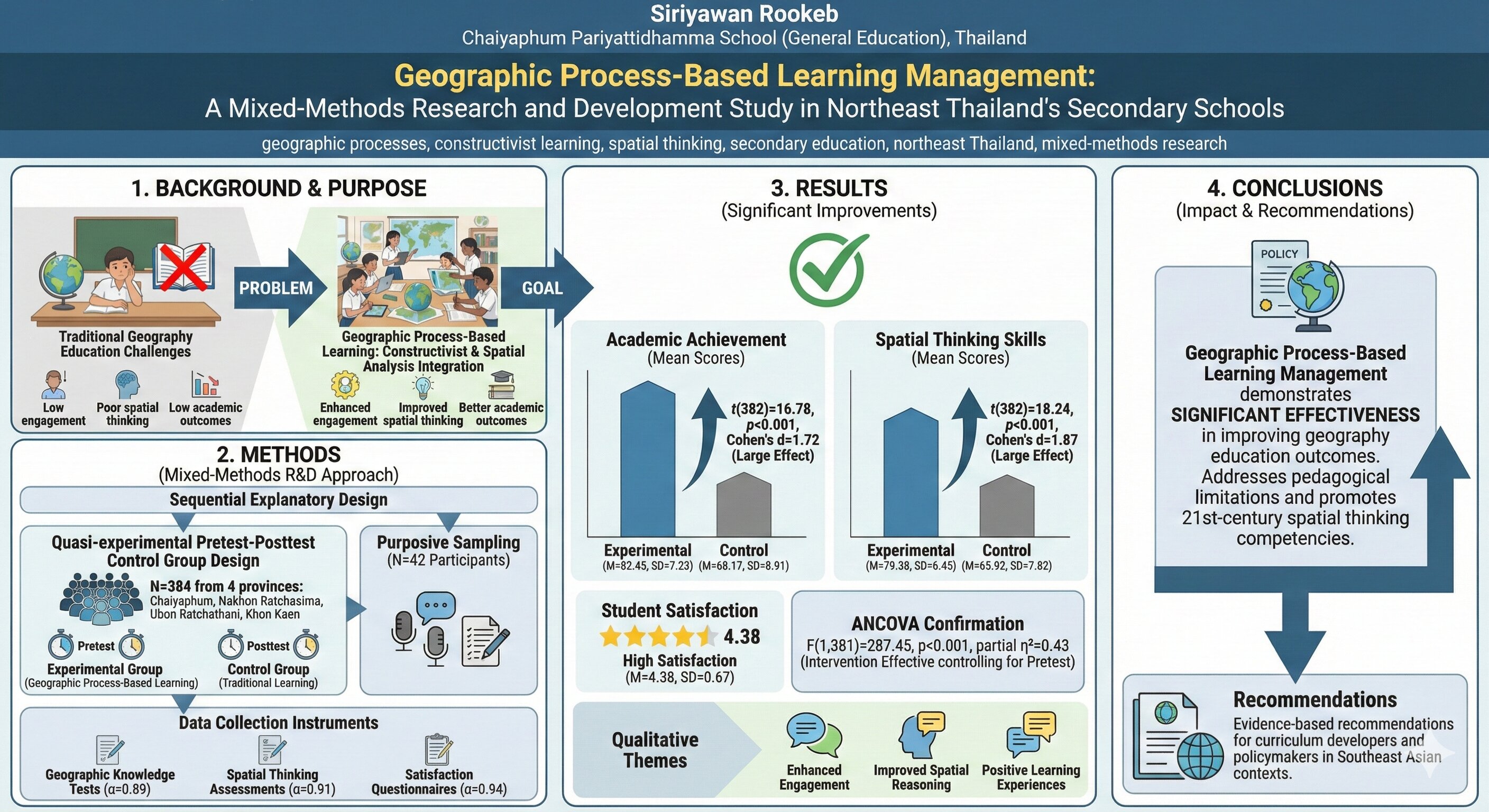
Background: Traditional geography education in northeast Thailand faces significant challenges including limited student engagement, inadequate spatial thinking development, and poor academic outcomes. Geographic process-based learning represents an innovative pedagogical approach that integrates constructivist learning principles with hands-on spatial analysis to enhance educational effectiveness.
Purpose: This study investigates the development and implementation of geographic process-based learning management on academic achievement, spatial thinking skills, and student satisfaction among junior high school students across four provinces in northeast Thailand.
Methods: A mixed-methods research and development (R&D) approach was employed using sequential explanatory design. The quantitative phase utilized a quasi-experimental pretest-posttest control group design with 384 participants (calculated using Taro Yamane formula at 95% confidence level, 5% margin of error from population N=2,847) from 48 schools across Chaiyaphum, Nakhon Ratchasima, Ubon Ratchathani, and Khon Kaen provinces. The qualitative phase involved 42 purposively selected participants for semi-structured interviews. Data collection instruments included validated geographic knowledge tests (α=0.89), spatial thinking assessments (α=0.91), and satisfaction questionnaires (α=0.94).
Results: Geographic process-based learning significantly improved academic achievement (experimental: M=82.45, SD=7.23; control: M=68.17, SD=8.91; t(382)=16.78, p<0.001, Cohen's d=1.72) and spatial thinking skills (experimental: M=79.38, SD=6.45; control: M=65.92, SD=7.82; t(382)=18.24, p<0.001, Cohen's d=1.87). Student satisfaction was high (M=4.38, SD=0.67 on 5-point scale). ANCOVA controlling for pretest scores confirmed intervention effectiveness (F(1,381)=287.45, p<0.001, partial η²=0.43). Qualitative findings revealed themes of enhanced engagement, improved spatial reasoning, and positive learning experiences.
Conclusions: Geographic process-based learning management demonstrates significant effectiveness in improving geography education outcomes in northeast Thailand's secondary schools. The approach successfully addresses traditional pedagogical limitations while promoting 21st-century spatial thinking competencies. Findings provide evidence-based recommendations for curriculum developers and educational policymakers in Southeast Asian contexts.
References
Ayaz, M. F., & Sekerci, H. (2015). The effects of the constructivist learning approach on student's academic achievement: A meta-analysis study. Turkish Online Journal of Educational Technology, 14(4), 143-156.
Bednarz, S. W., Acheson, G., & Bednarz, R. S. (2013). Maps and map learning in social studies. National Council for Social Studies.
Belayb, M., & Seifuc, A. (2024). Challenges in constructivist teaching: Insights from social studies teachers in middle-level schools, West Gojjam Zone, Ethiopia. Cogent Education, 11(1), 2372198. https://doi.org/10.1080/2331186X.2024.2372198
Bhutwanakul, B., Rasri, W., Suwannasri, P., Chaipranop, N., Jongwutiwes, N., & Kenaphoom, S. (2023). Heet-Kong Isaan (Isaan tradition and government): Problems and potential of natural resources and environment, economy, society and local wisdom of Isaan, Thailand. Elementary Education Online, 20(5), 4394-4402.
Borg, W. R., & Gall, M. D. (2007). Educational research: An introduction (8th ed.). Allyn & Bacon.
Braun, V., & Clarke, V. (2006). Using thematic analysis in psychology. Qualitative Research in Psychology, 3(2), 77-101.
Brooks, C., & Morgan, A. (2024). The role of teacher agency in using GIS to teach sustainability: An evaluation of a lower secondary school story mapping GIS initiative in Ireland. International Research in Geographical and Environmental Education, 33(1), 56-71. https://doi.org/10.1080/10382046.2023.2214044
Chand, S. P. (2023). Constructivism in education: Exploring the contributions of Piaget, Vygotsky, and Bruner. International Journal of Science and Research, 12(7), 1234-1242.
Chaowarakul, J., Kayanha, A., & Anusornphanich, P. (2021). Educational management under decentralization principle of Bangkaeo Town Municipality, Bang Phli District, Samut Prakan Province. Phranakhon Rajabhat Research Journal: Humanities and Social Sciences, 16(1), 45-58.
Creswell, J. W., & Creswell, J. D. (2018). Research design: Qualitative, quantitative, and mixed methods approaches (5th ed.). Sage Publications.
Fargher, M. (2018). WebGIS for geography education: Towards a GeoCapabilities approach. ISPRS International Journal of Geo-Information, 7(3), 111. https://doi.org/10.3390/ijgi7030111
Favier, T., & van der Schee, J. (2014). The effects of geography lessons with geospatial technologies on the development of high school students' relational thinking. Computers & Education, 76, 225-236. https://doi.org/10.1016/j.compedu.2014.04.004
Jo, I., & Bednarz, S. W. (2009). Evaluating geography textbook questions from a spatial perspective: Using concepts of space, tools of representation, and cognitive processes to evaluate spatiality. Journal of Geography, 108(1), 4-13.
Kakkeaw, N. (2024). Emerging trends in educational management: Transforming education in Northeast Thailand. Insights into Modern Education, 1(1), 17-25.
Kim, H., & Lee, J. (2021). The use of community mapping in elementary and secondary education. Journal of Korean Geographical Society, 56(4), 551-564.
Lee, H., & Kim, M. (2021). The pedagogical effects of student-centered convergence project class using geospatial services. Journal of Association for Korean Geography and Environmental Education, 29(2), 53-69.
Lee, J., & Bednarz, R. (2012). Components of spatial thinking: Evidence from a spatial thinking ability test. Journal of Geography, 111(1), 15-26.
Lee, J., & Tan, S. (2022). Enhancing spatial thinking through technology-enhanced geography education in Singapore secondary schools. International Research in Geographical and Environmental Education, 31(3), 201-218.
Li, M., Chen, Y., & Wang, L. (2023). A study of the impact of project-based learning on student learning effects: A meta-analysis study. Frontiers in Psychology, 14, 1202728. https://doi.org/10.3389/fpsyg.2023.1202728
Liu, T. C., Lin, Y. C., & Chang, M. (2023). Learning from different multimedia representation formats: Effects of prior knowledge. Journal of Research on Technology in Education, 57(3), 644-658. https://doi.org/10.1080/15391523.2023.2288393
Melesse, S., & Jirata, E. (2016). Teachers' perception and practice of constructivist teaching approach: The case of secondary schools of Kamashi zone. Science, Technology and Arts Research Journal, 4(4), 194-199.
Moskal, A., Loke, S. K., & Hung, N. (2016). Challenges implementing social constructivist learning approaches: The case of Pictation. ASCILITE Publications, 446-454. https://doi.org/10.14742/apubs.2016.805
National Research Council. (2006). Learning to think spatially. National Academies Press.
Newcombe, N. S., & Shipley, T. F. (2015). Thinking about spatial thinking: New typology, new assessments. Studying Visual and Spatial Reasoning for Design Creativity, 179-192.
Nyamekye, E., Zengulaaru, J., & Frimpong, A. C. N. (2023). Junior high schools teachers' perceptions and practice of constructivism in Ghana: The paradox. Cogent Education, 10(2), 2281195. https://doi.org/10.1080/2331186X.2023.2281195
Orsuwan, M., Hengpatana, S., & Patmasiriwat, D. (2023). Income distribution, poverty incidence, social class and human capital in the time of COVID-19 crisis: Evidence from Thailand's household survey. Kasetsart Journal of Social Sciences, 45(1), 193-202.
Piaget, J. (1972). The psychology of the child. Basic Books.
Pimdee, P., Jadamarn, P., & Wangsaard, K. (2017). The educational development in the 21st century under the Thailand 4.0 framework. Journal of Industrial Education, 16(2), 199-206.
Pongtorn, N. (2021). Decentralization and educational reform in Thailand: Impacts on rural schools. Journal of Thai Education, 22(2), 98-113.
Pongsin, V., Lawthong, N., Fry, G. W., Ransom, L., Kim, S., & Nguyen, N. T. M. (2023). Thailand as a new international higher education hub: Major challenges and opportunities, a policy analysis. SAGE Open, 13(2), 21582440231163401. https://doi.org/10.1177/21582440231163401
Roberts, M. (2023). Geography through enquiry: Approaches to teaching and learning in the secondary school (2nd ed.). Geographical Association.
Schlemper, M. B., Athreya, B., Czajkowski, K., Stewart, V. C., & Shetty, S. (2023). Teaching spatial thinking and geospatial technologies through citizen mapping and problem-based inquiry in grades 7-12. Education, 13(11), 1128. https://doi.org/10.3390/education13111128
Semerci, Ç., & Batdi, V. (2022). A meta-analysis of constructivist learning approach on learners' academic achievements, retention and attitudes. Journal of Education and Training Studies, 10(2), 25-38.
Silviarza, S., & Handoyo, B. (2021). The effectiveness of problem-based learning model to improve geography learning outcomes. International Journal of Instruction, 14(3), 487-502.
Solem, M., Huynh, N. T., & Boehm, R. (2023). Geographical thinking in geography education: A systematic review. International Research in Geographical and Environmental Education, 33(2), 123-145. https://doi.org/10.1080/10382046.2024.2354097
Tan, Y., Wong, K. L., & Rahman, A. A. (2021). Geography education in Southeast Asia: Current trends and future directions. Asian Journal of Geographical Education, 8(2), 45-62.
Tantinimit, K. (2018). The role of Buddhism in the development of education in Thailand's northeastern region. Journal of Religious Studies and Education, 14(2), 23-38.
Thongdee, S., & Prasertsin, U. (2024). Navigating schools through the pandemic crisis: A study on the determinants influencing the well-being of secondary students in northeast Thailand. Education Sciences, 14(7), 766. https://doi.org/10.3390/educsci14070766
Triantafyllou, S. A. (2022). Constructivist learning environments. Proceedings of the 5th International Conference on Advanced Research in Teaching and Education, 45-52.
Uttal, D. H., Meadow, N. G., Tipton, E., Hand, L. L., Alden, A. R., Warren, C., & Newcombe, N. S. (2013). The malleability of spatial skills: A meta-analysis of training studies. Psychological Bulletin, 139(2), 352-402.
Vygotsky, L. S. (1978). Mind in society: The development of higher psychological processes. Harvard University Press.
Wongchaiya, M., Yaboonthong, Y., Thong-ngok, T., & Puthaprasert, C. (2021). Strategic development for promoting schools as innovative educational institutions under local government organization, Chiang Rai province. Interdisciplinary Research Review, 16(3), 1-7.
Downloads
Published
How to Cite
Issue
Section
License
Copyright (c) 2024 Author(s)

This work is licensed under a Creative Commons Attribution 4.0 International License.