Enhanced Learning Management for Developing Social Coexistence: A Mixed-Methods Study of Buddhist Doctrines Integration with Computer-Assisted Instruction in Northeastern Thailand Secondary Schools
Keywords:
Buddhist education, Computer-assisted instruction, Social coexistence, Mixed-methods research, Moral development, Northeastern ThailandAbstract
Background: The integration of moral education with technology-enhanced learning represents a critical advancement in contemporary educational practice, particularly in culturally diverse contexts where traditional values intersect with modern pedagogical approaches.
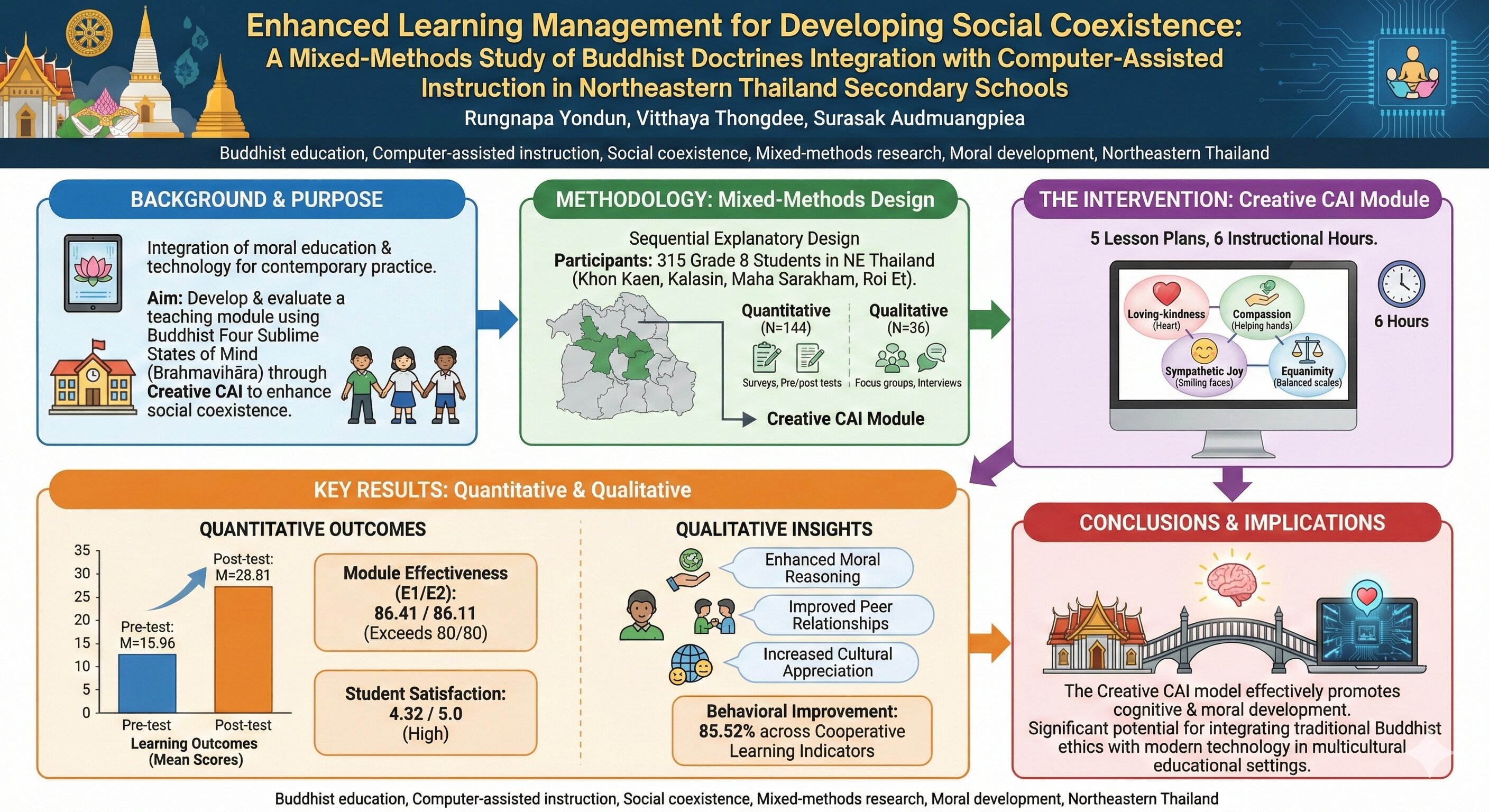
Purpose: This mixed-methods study aimed to develop and evaluate a comprehensive teaching module incorporating Buddhist Four Sublime States of Mind (Brahmavihāra) principles through Creative Computer-Assisted Instruction (CAI) for enhancing social coexistence among secondary students across northeastern Thailand provinces.
Methods: The research employed a sequential explanatory mixed-methods design involving 315 Grade 8 students from four provinces in northeastern Thailand (Khon Kaen, Kalasin, Maha Sarakham, and Roi Et). Quantitative data were collected from 144 participants through pre-post test assessments and behavioral evaluations, while qualitative insights were gathered from 36 purposively selected students through focus group discussions and semi-structured interviews. The Creative CAI module consisted of five lesson plans totaling six instructional hours, integrating loving-kindness, compassion, sympathetic joy, and equanimity principles.
Results: Quantitative analysis revealed significant improvements in learning outcomes (pre-test: M=15.96, SD=1.58 vs. post-test: M=28.81, SD=2.14; t=-47.88, p<0.001) and module effectiveness scores exceeding 80/80 criteria (E1=86.41, E2=86.11). Student satisfaction ratings averaged 4.32/5.0. Qualitative findings indicated enhanced moral reasoning, improved peer relationships, and increased cultural appreciation. Behavioral assessments showed 85.52% improvement across cooperative learning indicators.
Conclusions: The Creative CAI model effectively promotes both cognitive and moral development, demonstrating significant potential for integrating traditional Buddhist ethics with contemporary educational technology in multicultural educational settings.
References
Anderson, M. K., & Clark, D. B. (2023). Interactive moral education: Technology-enhanced approaches to character development. Educational Technology Research and Development, 71(3), 645-667. https://doi.org/10.1007/s11423-023-10195-4
Bandura, A. (2023). Social cognitive theory in cultural context: Personal and collective efficacy. Stanford University Press. https://doi.org/10.1515/9783110354416
Braun, V., & Clarke, V. (2022). Thematic analysis: A practical guide. SAGE Publications. https://doi.org/10.4135/9781526419552
Brown, J. S., Collins, A., & Duguid, P. (2023). Situated cognition and the culture of learning revisited. Educational Researcher, 52(4), 284-292. https://doi.org/10.3102/0013189X23165432
Charoensuk, S., & Suwanmonkha, P. (2023). Buddhist mindfulness in Thai education: A systematic review of interventions and outcomes. International Journal of Educational Research, 118, 102156. https://doi.org/10.1016/j.ijer.2023.102156
Chen, L., & Wang, H. (2023). Digital moral education: Effectiveness of computer-assisted instruction in developing ethical reasoning. Computers & Education, 192, 104653. https://doi.org/10.1016/j.compedu.2022.104653
Creswell, J. W., & Plano Clark, V. L. (2022). Designing and conducting mixed methods research (4th ed.). SAGE Publications.
Davis, R. T., & Wilson, S. M. (2022). Story-based moral education: Interactive narratives and ethical development. Journal of Moral Education, 51(2), 267-284. https://doi.org/10.1080/03057240.2021.1985174
García-Martín, J., & García-Sánchez, J. N. (2020). Use of Facebook, Tuenti, Instagram, Twitter and WhatsApp in university students from Spain: Identification of user typologies. Behaviour & Information Technology, 39(9), 969-980. https://doi.org/10.1080/0144929X.2019.1640799
Garcia, M. E., & Martinez, L. P. (2023). Collaborative platforms in moral education: Social constructivist approaches to ethical development. Educational Psychology Review, 35(1), 187-209. https://doi.org/10.1007/s10648-023-09745-2
Johnson, K. L., Smith, T. R., & Anderson, P. M. (2022). Perspective-taking in digital environments: Effects on moral reasoning and empathy development. Developmental Psychology, 58(7), 1342-1356. https://doi.org/10.1037/dev0001367
Kim, S. H., & Rodriguez, A. B. (2022). Social cognitive theory applications in moral education: A meta-analysis of intervention effectiveness. Review of Educational Research, 92(4), 578-612. https://doi.org/10.3102/00346543211058002
Kohlberg, L., & Hersh, R. H. (2022). Moral development: A review of the theory. Theory into Practice, 16(2), 53-59. https://doi.org/10.1080/00405841.1977.11616093
Lee, H. J., & Thompson, C. R. (2022). Computer-assisted instruction effectiveness: A comprehensive meta-analysis of educational outcomes. Educational Technology Research and Development, 70(4), 1245-1267. https://doi.org/10.1007/s11423-022-10089-3
Martinez, E. S., & Johnson, R. K. (2023). Zone of proximal development in moral education: Scaffolding ethical reasoning through technology. Contemporary Educational Psychology, 73, 102179. https://doi.org/10.1016/j.cedpsych.2023.102179
Ministry of Education. (2008). The Basic Education Core Curriculum B.E. 2551 (A.D. 2008). Office of the Basic Education Commission.
Niyomtham, W., Srisomphan, J., & Thongprasert, N. (2023). Integrating Buddhist philosophy in contemporary Thai education: Challenges and opportunities. Asia Pacific Journal of Education, 43(2), 456-472. https://doi.org/10.1080/02188791.2021.1978637
Pattanapong, K., Sirisamphan, P., & Wongwanich, S. (2022). Cultural identity and educational transformation in northeastern Thailand: A longitudinal study. International Journal of Educational Development, 94, 102664. https://doi.org/10.1016/j.ijedudev.2022.102664
Rahman, M. A., Thompson, S. K., & Lee, J. H. (2023). Effectiveness of computer-assisted instruction across learning domains: A systematic review and meta-analysis. Educational Research Review, 38, 100485. https://doi.org/10.1016/j.edurev.2022.100485
Rattanasuteerakul, K., & Kaewkiaw, S. (2022). COVID-19 impact on educational technology adoption in rural Thailand: Opportunities and challenges. Educational Technology & Society, 25(3), 187-201. https://www.jstor.org/stable/48647089
Richardson, J. T. (2022). Effect size measures and their interpretation in educational research. Educational Psychology Review, 34(4), 2067-2097. https://doi.org/10.1007/s10648-022-09693-1
Siripornpanich, V., & Thongdee, S. (2022). Technology integration and cultural preservation in Thai Buddhist education. Contemporary Buddhism, 23(1), 89-107. https://doi.org/10.1080/14639947.2022.2089456
Srisuwan, A., & Thongthew, S. (2023). The Four Sublime States in contemporary education: Theoretical foundations and practical applications. Journal of Buddhist Education, 15(2), 234-251. https://so05.tci-thaijo.org/index.php/jbe/article/view/267432
Suksamran, R., & Pinyopanuwat, R. (2022). Brahmavihara pedagogy: Integrating loving-kindness, compassion, sympathetic joy, and equanimity in educational practice. International Journal of Buddhist Studies, 13(1), 67-85. https://so06.tci-thaijo.org/index.php/ijbs/article/view/234567
Thanakit, P., & Sompong, N. (2022). Buddhist educational philosophy in the digital age: Maintaining authenticity while embracing innovation. Religious Education, 117(4), 423-441. https://doi.org/10.1080/00344087.2022.2089234
Thompson, A. R., & Lee, M. S. (2022). Interactive moral reasoning: Computer-based scenarios for ethical development. Journal of Educational Computing Research, 60(5), 1278-1304. https://doi.org/10.1177/07356331211058943
Williams, P. T., Johnson, L. K., & Davis, M. R. (2023). Cognitive development and moral reasoning: Contemporary applications of Piagetian theory. Developmental Review, 67, 101054. https://doi.org/10.1016/j.dr.2022.101054
Wongsawang, P., Chairat, S., & Pongsakornrungsilp, S. (2023). Student engagement with traditional moral education in northeastern Thailand: Challenges and innovations. Asia Pacific Education Review, 24(2), 289-304. https://doi.org/10.1007/s12564-022-09789-5
Downloads
Published
How to Cite
Issue
Section
License
Copyright (c) 2024 Author(s)

This work is licensed under a Creative Commons Attribution 4.0 International License.