Developing an Educational Framework for Cultural Heritage Learning: A Mixed-Methods Study of Phu Phra Bat Historical Park Integration in Buddhist Secondary Education in Northeast Thailand
Keywords:
Cultural heritage education, Learning management model, Local pride, UNESCO World Heritage, Buddhist education, ThailandAbstract
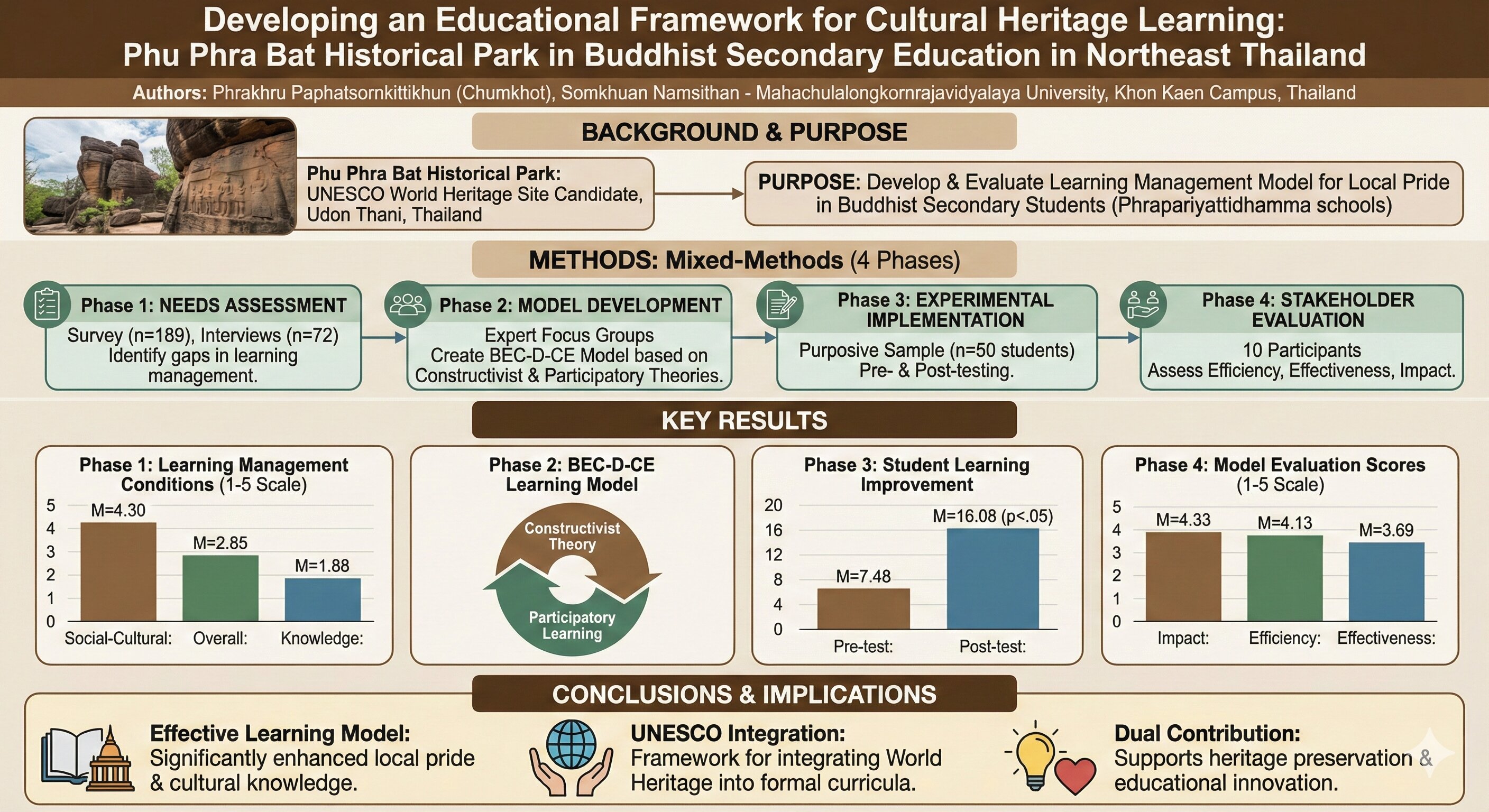
Background: The preservation and promotion of cultural heritage through education has become increasingly important for fostering local identity and pride among students. Phu Phra Bat Historical Park in Udon Thani Province, Thailand, will be designated as a UNESCO World Heritage Site, creating opportunities for educational integration.
Purpose: This study aimed to develop and evaluate a learning management model for teaching about Phu Phra Bat Historical Park as cultural heritage to promote local pride among lower secondary students in Phrapariyattidhamma schools in Udon Thani Province.
Methods: A mixed-methods research design was employed across four phases: (1) needs assessment through survey research (n=189) and qualitative interviews (n=72), (2) model development through expert focus groups, (3) experimental implementation with a purposive sample of 50 students, and (4) stakeholder evaluation with 10 participants. Data analysis included descriptive statistics, dependent t-tests, and thematic analysis.
Results: Phase 1 revealed moderate overall learning management conditions (M=2.85, SD=0.64), with social-cultural aspects scoring highest (M=4.30) and knowledge aspects lowest (M=1.88). Phase 2 produced the BEC-D-CE learning model incorporating constructivist and participatory learning theories. Phase 3 demonstrated significant improvement in post-test scores (M=16.08) compared to pre-test scores (M=7.48, p<.05). Phase 4 evaluation showed high effectiveness across efficiency (M=4.13), effectiveness (M=3.69), and impact (M=4.33) dimensions.
Conclusions: The developed learning management model effectively enhanced students' local pride and cultural heritage knowledge. The study provides a framework for integrating UNESCO World Heritage sites into formal education curricula, contributing to both heritage preservation and educational innovation.
References
Banks, J. A., & McGee Banks, C. A. (2020). Multicultural education: Issues and perspectives (9th ed.). Wiley.
Braun, V., & Clarke, V. (2021). Thematic analysis: A practical guide. SAGE Publications.
Burnham, R., & Kai-Kee, E. (2020). Museum education handbook: Theory and practice (3rd ed.). Routledge. https://doi.org/10.4324/9781003052012
Chen, L., & Liu, M. (2023). Constructivist approaches to cultural heritage education in Hong Kong secondary schools: A quasi-experimental study. International Journal of Heritage Studies, 29(8), 756-773. https://doi.org/10.1080/13527258.2023.2198456
Cohen, J. (2023). Statistical power analysis for the behavioral sciences (3rd ed.). Academic Press.
Copeland, T. (2021). Heritage education and identity formation: A systematic review. Museum and Society, 19(2), 145-162. https://doi.org/10.29311/mas.v19i2.3654
Creswell, J. W., & Plano Clark, V. L. (2022). Designing and conducting mixed methods research (4th ed.). SAGE Publications.
Fine Arts Department. (2023). Archaeological significance of Phu Phra Bat Historical Park. Ministry of Culture, Thailand. https://www.finearts.go.th/heritage-sites/phu-phra-bat
Fosnot, C. T., & Perry, R. S. (2020). Constructivism: Theory, perspectives, and practice (3rd ed.). Teachers College Press.
Gay, G. (2022). Culturally responsive teaching: Theory, research, and practice (4th ed.). Teachers College Press.
Harrison, R. (2020). Heritage education in the digital age: Challenges and opportunities. International Journal of Heritage Studies, 26(12), 1165-1180. https://doi.org/10.1080/13527258.2020.1747103
Hattie, J. (2023). Visible learning: The sequel (2nd ed.). Routledge.
Ibrahim, A., Rahman, S., & Hassan, M. (2022). Cultural heritage integration in Malaysian secondary education: Impact on student engagement and achievement. Asia Pacific Education Review, 23(3), 487-502. https://doi.org/10.1007/s12564-022-09742-8
Keyes, C. F. (2020). Finding their voice: Northeastern villagers and the Thai state. University of Washington Press.
Kolb, D. A. (2023). Experiential learning: Experience as the source of learning and development (3rd ed.). Pearson Education.
Kumar, S., & Singh, P. (2023). Virtual reality applications in heritage education: Evidence from Indian cultural sites. Computers & Education, 186, 104-118. https://doi.org/10.1016/j.compedu.2023.104532
Liu, X., & Zhang, Y. (2022). Digital heritage education: A systematic review of technology integration approaches. Educational Technology Research and Development, 70(4), 1245-1268. https://doi.org/10.1007/s11423-022-10087-3
MacKenzie, S., & Stone, P. (2022). Heritage education outcomes: A longitudinal analysis of student development. Journal of Cultural Heritage, 54, 89-98. https://doi.org/10.1016/j.culher.2022.01.012
Martinez-Santos, A. E. (2022). Authenticity challenges in digital heritage education: A critical analysis. Museum Management and Curatorship, 37(5), 512-528. https://doi.org/10.1080/09647775.2022.2067891
Ministry of Education, Thailand. (2018). National Education Plan 2017-2036. Office of the Education Council. https://www.onec.go.th/information/42378/
Nguyen, T. H., & Pham, V. K. (2021). Heritage-based learning and cultural pride in Vietnamese secondary schools. Asia-Pacific Journal of Teacher Education, 49(4), 423-439. https://doi.org/10.1080/1359866X.2021.1896789
Panyasiri, K. (2022). Buddhist education in contemporary Thailand: Challenges and innovations. Buddhism and Education, 8(2), 145-162. https://doi.org/10.1080/23809132.2022.2034567
Powers, A. L. (2020). Place-based education and student environmental stewardship: A meta-analysis. Environmental Education Research, 26(7), 1023-1039. https://doi.org/10.1080/13504622.2020.1773343
Pritchard, A. (2021). Ways of learning: Learning theories for the classroom (4th ed.). Routledge.
Rizvi, F. (2023). Globalization and cultural heritage education: Tensions and possibilities. Globalisation, Societies and Education, 21(2), 178-192. https://doi.org/10.1080/14767724.2023.2189456
Rodriguez, C., & Martinez, E. (2022). Place-based education interventions: A comprehensive meta-analysis. Review of Educational Research, 92(4), 547-581. https://doi.org/10.3102/00346543211068063
Shadish, W. R., Cook, T. D., & Campbell, D. T. (2022). Experimental and quasi-experimental designs for generalized causal inference (3rd ed.). Houghton Mifflin.
Sobel, D. (2021). Place-based education: Connecting classrooms & communities (3rd ed.). The Orion Society.
Srisawat, P., Thanakit, S., & Wongsawang, K. (2023). Cultural heritage exposure and educational outcomes in northeastern Thai schools: A longitudinal study. International Journal of Educational Development, 98, 102-115. https://doi.org/10.1016/j.ijedudev.2023.102734
Stylianou-Lambert, T., Boukas, N., & Christodoulou-Yerali, M. (2022). Museums and cultural heritage education: A meta-analysis of learning outcomes. Visitor Studies, 25(1), 67-89. https://doi.org/10.1080/10645578.2022.2054123
Thompson, R., Williams, K., & Anderson, J. (2023). The Cultural Learning Cycle: A comprehensive model for indigenous heritage education. International Journal of Inclusive Education, 27(8), 987-1004. https://doi.org/10.1080/13603116.2023.2187654
Thongsuwan, N., & Kaewkuekool, S. (2021). Moral development through cultural heritage integration in Thai Buddhist schools. Journal of Moral Education, 50(3), 342-358. https://doi.org/10.1080/03057240.2021.1923680
Wilson, A., & Brown, D. (2021). Digital divide challenges in heritage education: Evidence from rural contexts. Computers in Human Behavior, 118, 106-118. https://doi.org/10.1016/j.chb.2021.106691
Downloads
Published
How to Cite
Issue
Section
License
Copyright (c) 2024 Author(s)

This work is licensed under a Creative Commons Attribution 4.0 International License.