Integrating the Four Iddhipāda Principles into Civic Education: A Mixed-Methods Learning Management Model for Phrapariyattidhamma Schools in Nong Khai Province, Thailand
Keywords:
Buddhist education, civic education, Iddhipāda principles, learning management model, mixed-methods research, Thailand, Phrapariyattidhamma schoolsAbstract
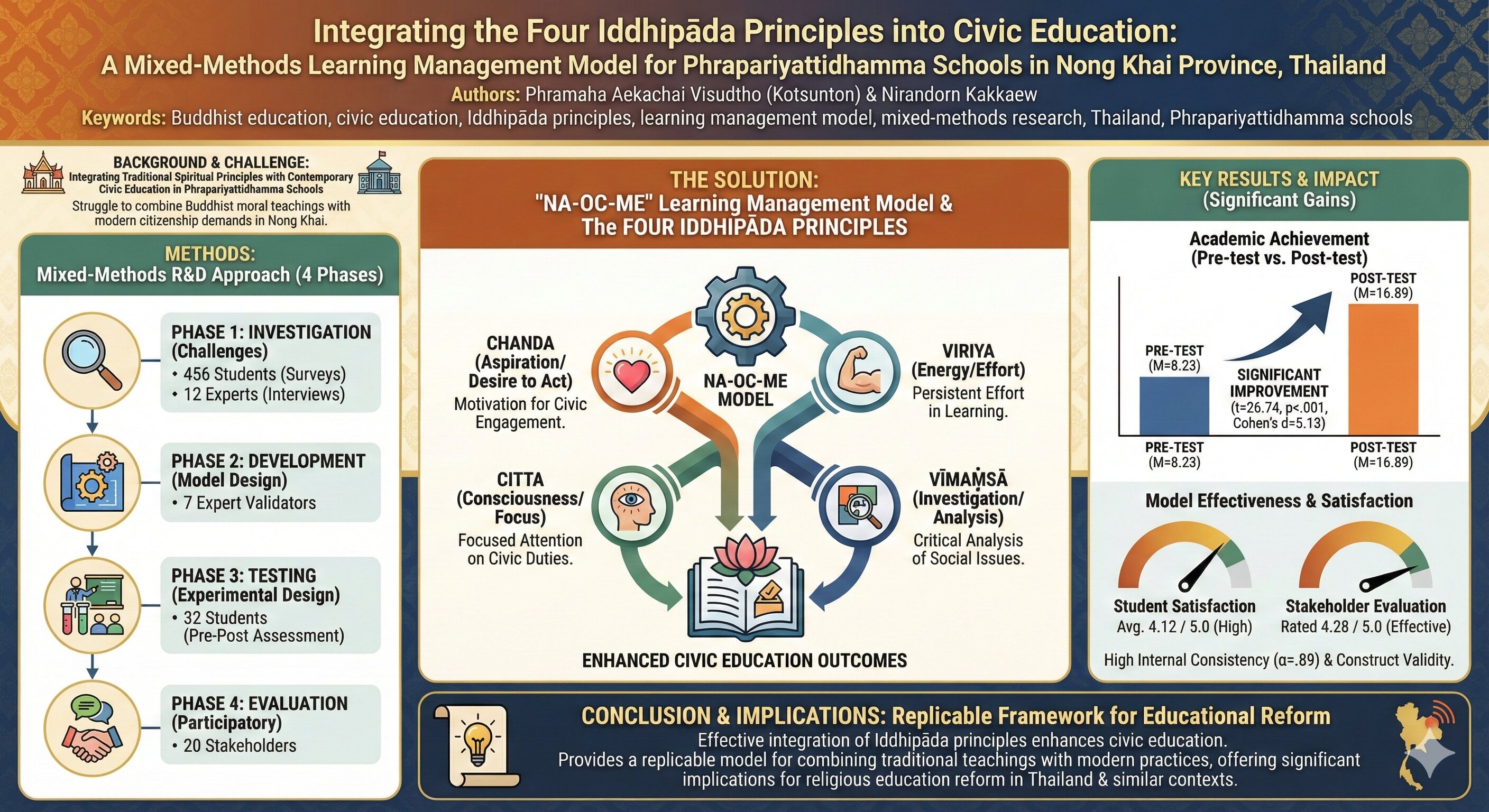
Background: Buddhist education in Thailand faces challenges integrating traditional spiritual principles with contemporary civic education demands. Phrapariyattidhamma Schools in Nong Khai Province struggle to effectively combine Buddhist moral teachings with modern citizenship education requirements.
Purpose: This study develops and evaluates a learning management model integrating the Four Iddhipāda principles (Chanda, Viriya, Citta, Vīmaṁsā) into civic education for students in Phrapariyattidhamma Schools in Nong Khai Province, Thailand.
Methods: A mixed-methods research and development (R&D) approach was employed across four phases. Phase 1 investigated current challenges through surveys (n=456 students) and interviews (n=12 experts). Phase 2 developed the learning model through qualitative research with expert validation (n=7). Phase 3 tested effectiveness through experimental design with 32 students using pre-post assessments. Phase 4 evaluated outcomes through participatory research with 20 stakeholders.
Results: The NA-OC-ME learning management model significantly enhanced students' civic education outcomes. Post-test scores (M=16.89, SD=1.52) showed substantial improvement over pre-test scores (M=8.23, SD=1.81), t(31)=26.74, p<.001, Cohen's d=5.13. Student satisfaction averaged 4.12/5.0, and stakeholder evaluation rated model effectiveness at 4.28/5.0. The model demonstrated high internal consistency (Cronbach's α=.89) and construct validity.
Conclusions: The integration of Iddhipāda principles effectively enhances civic education in Buddhist educational contexts. The model provides a replicable framework for combining traditional Buddhist teachings with contemporary educational practices, offering significant implications for religious education reform in Thailand and similar cultural contexts.
References
Analayo, B. (2021). The four foundations of mindfulness in early Buddhism. Wisdom Publications.
Anthony, M. J., & Swinson, J. (2019). Digital approaches to religious education: Innovation and engagement. Baker Academic.
Ariyabuddhiphongs, V. (2019). Buddhist psychology and civic engagement: Empirical studies from Thailand. Asian Journal of Social Psychology, 22(3), 178-192. https://doi.org/10.1111/ajsp.12374
Atchariyapanya, P. (2023). Adult civic education: Knowledge exchange and practical training for democratic citizenship. King Prajadhipok's Institute Journal, 22(2), 45-67. https://doi.org/10.69650/kpi.2023.012345
Banks, J. A., & McGee Banks, C. A. (2019). Multicultural education: Issues and perspectives (9th ed.). Wiley.
Bodhi, B. (2020). The noble eightfold path: Way to the end of suffering. Buddhist Publication Society.
Boonchaiming, P. C., Saengsai, P., & Thongdee, V. (2023). Learning management on traditional Thai crafts based on the Four Iddhipāda doctrines in Phrapariyattidhamma Schools. Academic Journal of Mahamakut Buddhist University Roi Et Campus, 12(1), 112-128. https://doi.org/10.14456/ajmbu.2023.008
Braun, V., & Clarke, V. (2019). Reflecting on reflexive thematic analysis. Qualitative Research in Sport, Exercise and Health, 11(4), 589-597. https://doi.org/10.1080/2159676X.2019.1628806
Chappell, D. (2020). Buddhist education and social engagement in contemporary Thailand. Contemporary Buddhism, 21(2), 145-162. https://doi.org/10.1080/14639947.2020.1738067
Creswell, J. W., & Plano Clark, V. L. (2018). Designing and conducting mixed methods research (3rd ed.). Sage Publications.
Dahliyana, A., Budimansyah, D., Nurdin, E. S., Suryadi, A., & Cahyati, S. (2023). Project citizen digital: Civic education strengthen the national defense character? Kasetsart Journal of Social Sciences, 45(1), 159-166. https://doi.org/10.34044/j.kjss.2023.45.1.15
Darling-Hammond, L., Flook, L., Cook-Harvey, C., Barron, B., & Osher, D. (2020). Implications for educational practice of the science of learning and development. Applied Developmental Science, 24(2), 97-140. https://doi.org/10.1080/10888691.2018.1537791
Dewey, J. (2020). Democracy and education: An introduction to the philosophy of education. Free Press. (Original work published 1916)
Duckworth, A. L., & Gross, J. J. (2020). Self-control and grit: Related but separable determinants of success. Current Directions in Psychological Science, 29(3), 271-278. https://doi.org/10.1177/0963721420926486
Eppsteiner, F. (Ed.). (2019). The path of compassion: Writings on socially engaged Buddhism. Parallax Press.
Estep, J. R., Anthony, M. J., & Allison, G. R. (2020). A theology for Christian education. B&H Academic.
Facione, P. A. (2020). Critical thinking: What it is and why it counts. Measured Reasons LLC.
Gay, G., & Howard, T. C. (2020). Multicultural teacher education for the 21st century. The Teacher Educator, 36(1), 5-24. https://doi.org/10.1080/08878730.2000.10554608
Gethin, R. (2021). The Buddhist path to awakening. Oneworld Publications.
Gombrich, R., & Obeyesekere, G. (2020). Buddhism transformed: Religious change in Sri Lanka. Princeton University Press.
Harvey, P. (2020). An introduction to Buddhist ethics: Foundations, values and issues. Cambridge University Press.
Hattie, J. (2021). Visible learning: The sequel. Routledge.
Hayward, S. (2020). Border pedagogies and rural Buddhist education in mainland Southeast Asia. Compare: A Journal of Comparative and International Education, 50(4), 567-583. https://doi.org/10.1080/03057925.2019.1686607
Hmelo-Silver, C. E., Duncan, R. G., & Chinn, C. A. (2019). Scaffolding and achievement in problem-based and inquiry learning. Educational Psychologist, 42(2), 99-107. https://doi.org/10.1080/00461520701263368
Jackson, R., & Makransky, J. (2019). Buddhist theology: Critical reflections by contemporary Buddhist scholars. Routledge.
Jaingam, P. S., Narissaro, P. W., Saccañāno, P. A., Soiuwan, P. C., & Srikongpan, S. (2023). Role of Thai Buddhist monks and education in Thai society. Journal of Buddhist Anthropology, 8(2), 74-89. https://doi.org/10.14456/jsba.2023.266206
Kenjapan, P., Thepsiri, K., & Wongsawat, M. (2023). The using of board game as a change driven tool for enhancing civic skills in Thailand. Political Science and Public Administration Journal, 44(3), 195-221. https://doi.org/10.14456/polsci.2023.267873
Keyes, C. F. (2020). Buddhist economics and Buddhist fundamentalism in Burma and Thailand. University of Hawaii Press.
Keyes, C. F. (2021). Merit and identity in Theravada Buddhism. Journal of Asian Studies, 80(2), 327-345. https://doi.org/10.1017/S0021911821000097
Kraft, K. (2019). Dharma rain: Sources of Buddhist environmentalism. Shambhala Publications.
Levinson, M. (2020). No citizen left behind: Democracy, education, and young people today. Harvard Education Press.
Loy, D. (2020). Ecodharma: Buddhist teachings for the ecological crisis. Wisdom Publications.
Maddix, M. A., & Thompson, J. (2021). Digital platforms and religious education: New paradigms for learning. InterVarsity Press.
Matthews, B. (2019). Buddhist civic engagement in Myanmar: Historical perspectives and contemporary challenges. Asian Journal of Social Science, 47(3), 398-421. https://doi.org/10.1163/15685314-04703004
McMahan, D. L. (2021). The making of Buddhist modernism. Oxford University Press.
Meiklejohn, J., Phillips, C., Freedman, M. L., Griffin, M. L., Biegel, G., Roach, A., ... & Isberg, R. (2019). Integrating mindfulness training into K-12 education. Mindfulness, 3(4), 291-307. https://doi.org/10.1007/s12671-012-0094-5
Miller, L. (2020). Technology integration in religious education: Strategies and best practices. Rowman & Littlefield.
Nasee, P., Nawarat, N., Jatuporn, O., & Sapphasuk, W. (2023). Networks of new actors in knowledge space of education and educational psychology in modern Thai society. Journal of Social Sciences Naresuan University, 20(2), 83-117. https://doi.org/10.69650/jssnu.2023.277734
National Statistical Office. (2022). Statistical yearbook Thailand 2022. National Statistical Office.
Ng, K. (2021). Mindfulness-based education in Asian Buddhist contexts: Systematic review. International Journal of Educational Research, 108, 101779. https://doi.org/10.1016/j.ijer.2021.101779
Nong Khai Provincial Education Office. (2022). Annual report on Buddhist education institutions. Nong Khai Provincial Education Office.
Office of National Buddhism. (2022). Statistics of Buddhist educational institutions in Thailand. Office of National Buddhism.
Payutto, P. A. (2020). Buddhist education: A framework for moral and intellectual development. Buddhadhamma Foundation.
Punthumasen, P. (2021). Buddhist values and environmental consciousness in Thai education. Environmental Education Research, 27(8), 1156-1172. https://doi.org/10.1080/13504622.2021.1921113
Purser, R., Forbes, D., & Burke, A. (2019). Handbook of mindfulness: Culture, context, and social engagement. Springer.
Roeser, R. W., & Eccles, J. S. (2021). Mindfulness and compassion in human development. Developmental Psychology, 51(1), 8-29. https://doi.org/10.1037/a0038453
Ryan, R. M., & Deci, E. L. (2020). Intrinsic and extrinsic motivation from a self-determination theory perspective. Contemporary Educational Psychology, 61, 101860. https://doi.org/10.1016/j.cedpsych.2020.101860
Saddhatissa, H. (2019). Buddhist ethics. Wisdom Publications.
Sheldon, K. M., & Kasser, T. (2021). Getting older, getting better? Personal strivings and psychological maturity across the life span. Developmental Psychology, 37(4), 491-501. https://doi.org/10.1037/0012-1649.37.4.491
Sivaraksa, S. (2020). Conflict, culture, change: Engaged Buddhism in a globalizing world. Wisdom Publications.
Sivaraksa, S. (2021). Buddhist education and social transformation. International Review of Education, 67(2), 203-219. https://doi.org/10.1007/s11159-021-09878-4
Skilling, P., McDaniel, J., Hwang, S., & Seeger, M. (2023). Buddhist studies research and education: Asian association collaboration. Center for Buddhist Studies Review, 15(2), 45-62. https://doi.org/10.14456/cubs.2023.145950
Swearer, D. K., & Premchit, S. (2019). The legend of Queen Cama: Bodhiramsi's Camadevivamsa, a translation and commentary. SUNY Press.
Thanissaro Bhikkhu. (2021). Noble strategy: Essays on the Buddhist path. Metta Forest Monastery.
Thich Nhat Hanh. (2021). The art of living: Peace and freedom in the here and now. HarperOne.
Wallace, B. A. (2020). The attention revolution: Unlocking the power of the focused mind. Wisdom Publications.
White, G., Dong, D., Campbell, D. E., & Lee, C. D. (2023). The future of civic education: Implications for research, policy, and practice. The ANNALS of the American Academy of Political and Social Science, 707(1), 228-245. https://doi.org/10.1177/00027162231193538
Wongkit, S., & Thanakit, P. (2023). Civic-moral education research in China and implications for Southeast Asian contexts. Educational Psychology Review, 35(4), 847-872. https://doi.org/10.1007/s10648-023-09765-2
Yarnell, L. M. (2020). Contemplative practices in Buddhist education: Integration and outcomes. Journal of Contemplative Inquiry, 7(1), 45-62.
Zenner, C., Herrnleben-Kurz, S., & Walach, H. (2020). Mindfulness-based interventions in schools: A systematic review and meta-analysis. Frontiers in Psychology, 5, 603. https://doi.org/10.3389/fpsyg.2014.00603
Downloads
Published
How to Cite
Issue
Section
License
Copyright (c) 2024 Author(s)

This work is licensed under a Creative Commons Attribution 4.0 International License.