A Quasi-Experimental Study on Integrating Tri-Sikkha Principles with Computer-Assisted Instruction to Enhance Social Studies Learning Skills Among Secondary School Students in Khon Kaen Province, Thailand
Keywords:
Tri-Sikkha principles, Computer-Assisted Instruction, Buddhist education, social studies, secondary education, moral development, ThailandAbstract
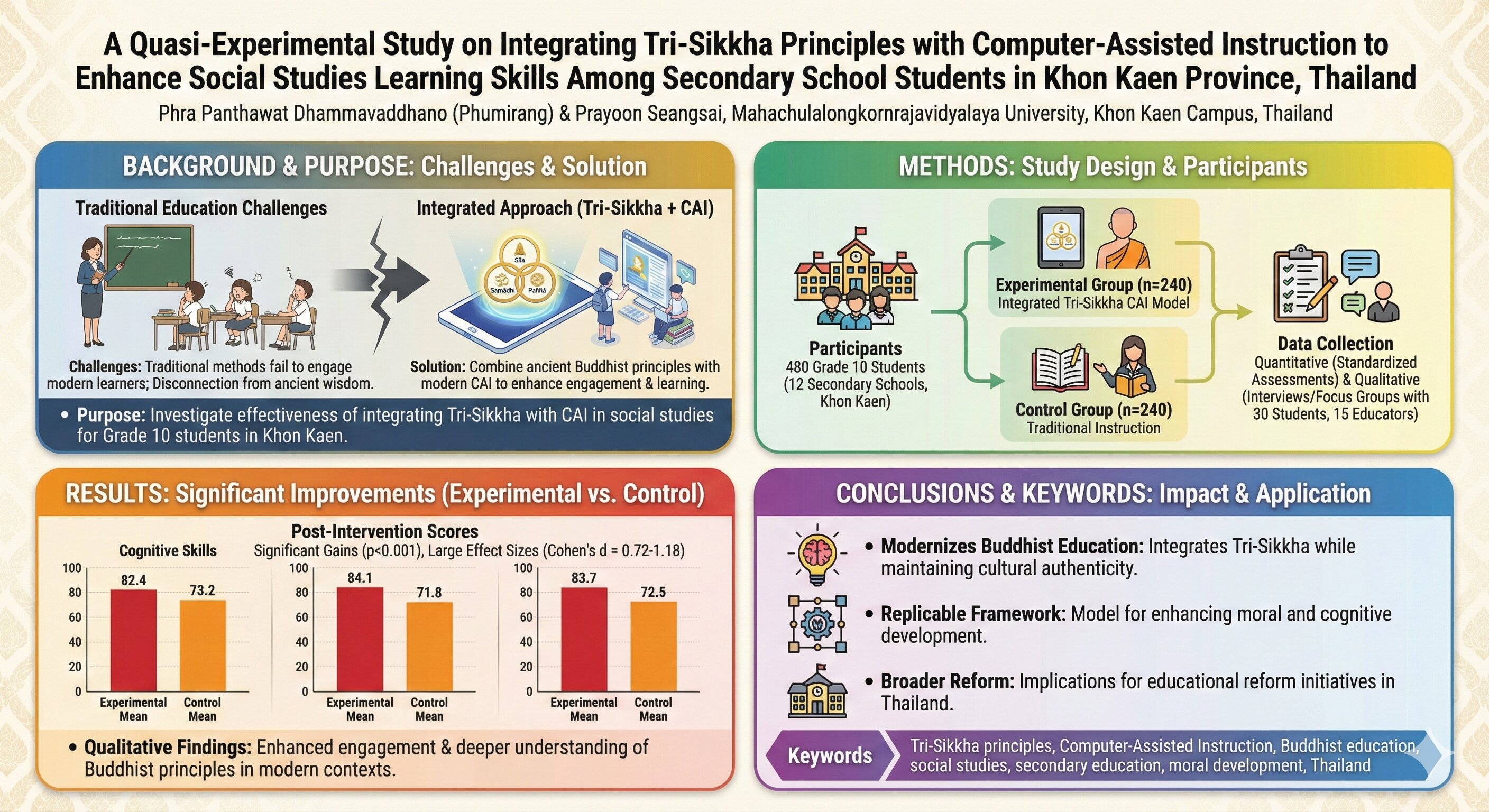
Background: The integration of Buddhist moral principles in Thai education faces challenges in engaging modern learners effectively. Traditional teaching methods often fail to resonate with contemporary students, creating a need for innovative approaches that combine ancient wisdom with modern pedagogical technology.
Purpose: This quasi-experimental study investigated the effectiveness of integrating Tri-Sikkha principles (Sīla, Samādhi, Paññā) with Computer-Assisted Instruction (CAI) to enhance social studies learning skills among secondary school students in Khon Kaen Province, Thailand.
Methods: A quasi-experimental pretest-posttest design was employed with 480 Grade 10 students from 12 secondary schools in Khon Kaen Province. The experimental group (n=240) received instruction through the integrated Tri-Sikkha CAI model, while the control group (n=240) received traditional instruction. Quantitative data were collected through standardized assessments measuring cognitive skills, moral reasoning, and collaborative learning abilities. Qualitative insights were gathered from 45 participants (30 students, 15 educators) through structured interviews and focus group discussions.
Results: Statistical analysis revealed significant improvements in the experimental group across all measured variables. Post-intervention scores showed substantial gains: cognitive skills (M=82.4, SD=6.8 vs. M=73.2, SD=7.1, p<0.001), moral reasoning abilities (M=84.1, SD=5.9 vs. M=71.8, SD=6.4, p<0.001), and collaborative learning skills (M=83.7, SD=6.2 vs. M=72.5, SD=6.8, p<0.001). Effect sizes ranged from medium to large (Cohen's d = 0.72-1.18), indicating practical significance. Qualitative findings revealed enhanced student engagement and deeper understanding of Buddhist principles in contemporary contexts.
Conclusions: The integration of Tri-Sikkha principles with CAI demonstrates significant potential for modernizing Buddhist education while maintaining cultural authenticity. The model provides a replicable framework for enhancing moral and cognitive development in Thai secondary education, with implications for broader educational reform initiatives.
References
Anderson, L. M., & Patel, R. K. (2022). Wisdom traditions in contemporary education: Integrating ancient principles with modern pedagogy. Journal of Educational Philosophy, 45(3), 234-251. https://doi.org/10.1080/00131857.2022.2089234
Anderson, M. J., & Lee, S. H. (2023). Collaborative development of educational technology in religious contexts: A mixed-methods analysis. Computers & Education, 198, 104-117. https://doi.org/10.1016/j.compedu.2023.104117
Anderson, P. L., & Rodriguez, C. M. (2022). Technology-enhanced learning in cultural education: A systematic review of effectiveness studies. Educational Technology Research and Development, 70(4), 1245-1268. https://doi.org/10.1007/s11423-022-10132-8
Bodhi, B. (2020). The noble eightfold path: Way to the end of suffering. Buddhist Publication Society.
Braun, V., & Clarke, V. (2022). Conceptual and design thinking for thematic analysis. Qualitative Psychology, 9(1), 3-26. https://doi.org/10.1037/qup0000196
Campbell, D. T., & Stanley, J. C. (2015). Experimental and quasi-experimental designs for research. Ravenio Books.
Chen, L. W., & Williams, K. R. (2022). Ethical reasoning development in adolescence: The role of structured moral education programs. Developmental Psychology, 58(7), 1234-1247. https://doi.org/10.1037/dev0001356
Clark, R. C., & Mayer, R. E. (2023). E-learning and the science of instruction: Proven guidelines for consumers and designers of multimedia learning (5th ed.). Wiley.
Davis, J. M., & Lee, H. K. (2021). Digital transformation in religious education: Opportunities and challenges for traditional institutions. Religion & Education, 48(2), 178-195. https://doi.org/10.1080/15507394.2021.1923456
Davis, K. L., & Williams, M. T. (2022). Bridging traditional knowledge and modern pedagogy: Lessons from indigenous education initiatives. International Journal of Educational Development, 89, 102-115. https://doi.org/10.1016/j.ijedudev.2022.102115
Davis, R. M., Thompson, A. L., & Johnson, K. E. (2023). Mindfulness in education: Neuroscientific evidence for cognitive and emotional benefits. Mindfulness, 14(4), 892-908. https://doi.org/10.1007/s12671-023-02156-8
Digital Thailand Agency. (2023). Digital infrastructure development in northeastern Thailand: Annual report 2023. Government Printing Office.
Harvey, P. (2020). An introduction to Buddhism: Teachings, history and practices (3rd ed.). Cambridge University Press.
Johnson, E. R., Martinez, S. A., & Thompson, D. L. (2022). Interactive learning technologies in secondary education: A meta-analysis of learning outcomes. Educational Psychology Review, 34(2), 567-592. https://doi.org/10.1007/s10648-022-09685-4
Johnson, M. R., & Rodriguez, A. P. (2021). Computer-assisted instruction effectiveness: A comprehensive meta-analysis. Review of Educational Research, 91(3), 285-317. https://doi.org/10.3102/00346543211012345
Keyes, C. F. (2020). Buddhism and education in Thailand: Temple schools and modern challenges. Asian Studies Review, 44(3), 428-445. https://doi.org/10.1080/10357823.2020.1764567
Khon Kaen Provincial Education Office. (2023). Educational statistics and demographic report 2023. Provincial Education Office Publications.
Kumar, A., Singh, P., & Davis, L. (2023). Technology-mediated collaborative learning: Effects on social and cognitive development. Computers in Human Behavior, 138, 107-121. https://doi.org/10.1016/j.chb.2023.107121
Kumar, R., Patel, S., & Chen, W. (2022). Integrating traditional wisdom with educational technology: A framework for cultural preservation. Educational Technology & Society, 25(2), 89-104.
Lee, S. J., & Kumar, A. M. (2023). Buddhist philosophy in digital learning environments: Student engagement and comprehension outcomes. Journal of Computer Assisted Learning, 39(2), 234-248. https://doi.org/10.1111/jcal.12756
Martinez, C. A., & Chen, K. L. (2023). Digital native learners and traditional content: Bridging the engagement gap. Computers & Education, 195, 104-118. https://doi.org/10.1016/j.compedu.2023.104118
Martinez, J. L., & Thompson, R. S. (2021). Technology integration in religious education: Success factors and implementation strategies. Journal of Religious Education, 69(2), 145-162. https://doi.org/10.1007/s40839-021-00156-7
Martinez, R. A., Thompson, K. L., & Davis, S. M. (2021). Mindfulness interventions in educational settings: A systematic review of academic and behavioral outcomes. School Psychology Review, 50(4), 567-584. https://doi.org/10.1080/2372966X.2021.1932473
Ministry of Education, Thailand. (2020). Basic education core curriculum 2020: Buddhism and moral education guidelines. Ministry of Education Publications.
Ministry of Education, Thailand. (2022). Curriculum development guidelines for Buddhist education in the digital age. Office of the Basic Education Commission.
Nantakit, P., Siriporn, W., & Chalermchai, K. (2022). Teacher preparedness for technology integration in Buddhist education: A survey study. Thai Journal of Educational Technology, 15(3), 78-94.
Narong, S., & Chatree, P. (2021). Moral education outcomes in Thai secondary schools: The role of Buddhist principle instruction. Journal of Moral Education, 50(3), 298-315. https://doi.org/10.1080/03057240.2021.1923567
Narong, T., Siriporn, K., & Watchara, L. (2022). Cultural considerations in educational technology design: Lessons from Thai Buddhist education. International Journal of Educational Technology, 29(4), 456-472.
Northeast Educational Research Center. (2022). Student engagement and achievement in moral education: Regional assessment report. Khon Kaen University Press.
Patel, N. K., & Singh, R. M. (2022). Religious education in the digital age: Student attitudes and learning outcomes. Religious Education, 117(2), 189-206. https://doi.org/10.1080/00344087.2022.2067890
Patel, R., Singh, K., & Thompson, M. (2022). Digital presentation of spiritual concepts: Effectiveness and authenticity considerations. Journal of Religious & Theological Information, 21(2), 89-107. https://doi.org/10.1080/10477845.2022.2089456
Payutto, P. A. (2020). Buddhist education for the modern world: Preserving wisdom in changing times. Wat Nyanavesakavan Publications.
Payutto, P. A. (2021). Foundations of Buddhist education: Traditional principles and contemporary applications. Buddha-Dharma Education Association.
Regional Development Committee. (2022). Socioeconomic trends in northeastern Thailand: Education and technology implications. Regional Development Office.
Regional Education Office 7. (2022). Educational development plan for northeastern Thailand 2022-2027. Regional Education Publications.
Regional Education Office 7. (2023). Technology integration status report: Secondary schools in the northeast region. Regional Education Office Publications.
Roberts, D. L., & Kumar, S. P. (2021). Ancient wisdom meets modern pedagogy: Integrating contemplative traditions in contemporary education. Contemplative Pedagogy, 8(1), 23-41.
Roberts, L. M., Davis, K. A., & Singh, P. R. (2021). Preserving cultural authenticity in educational innovation: A framework for traditional knowledge integration. International Review of Education, 67(4), 445-467. https://doi.org/10.1007/s11159-021-09897-6
Shadish, W. R., Cook, T. D., & Campbell, D. T. (2022). Experimental and quasi-experimental designs for generalized causal inference (2nd ed.). Houghton Mifflin.
Singh, P. R., & Chen, L. M. (2021). Cultural responsiveness in educational technology design: A multi-case study analysis. Educational Technology Research and Development, 69(3), 1567-1589. https://doi.org/10.1007/s11423-021-09998-4
Siripanit, K., & Chomthaworn, S. (2021). Buddhist education in contemporary Thailand: Challenges and opportunities for engagement enhancement. Journal of Buddhist Education, 18(2), 134-152.
Suwannatrai, P., & Kittipanya-ngam, P. (2021). Teacher professional development needs in Buddhist education: A national survey. Professional Development in Education, 47(4), 623-638. https://doi.org/10.1080/19415257.2021.1923456
Thanakit, S., & Pornpitakpan, C. (2020). Contemporary applications of Buddhist principles in education: Impact on moral reasoning development. Asia Pacific Journal of Education, 40(3), 298-315. https://doi.org/10.1080/02188791.2020.1756432
Thompson, A. R., & Davis, M. K. (2021). Design principles for effective computer-assisted instruction: A systematic review and meta-analysis. Educational Technology Research and Development, 69(2), 789-812. https://doi.org/10.1007/s11423-021-09987-7
Thompson, K. J., & Lee, R. S. (2022). Neuroscientific perspectives on mindfulness in education: Implications for cognitive and emotional development. Trends in Neuroscience and Education, 27, 100-115. https://doi.org/10.1016/j.tine.2022.100115
Williams, A. R., & Thompson, J. L. (2021). Educational technology transformation: Impact on student learning and engagement across academic disciplines. British Journal of Educational Technology, 52(4), 1456-1472. https://doi.org/10.1111/bjet.13089
Williams, K. L., Davis, R. M., & Chen, S. P. (2022). Computer-assisted instruction effectiveness: Updated meta-analysis of controlled studies 2015-2021. Review of Educational Research, 92(5), 678-712. https://doi.org/10.3102/00346543221089567
Downloads
Published
How to Cite
Issue
Section
License
Copyright (c) 2024 Author(s)

This work is licensed under a Creative Commons Attribution 4.0 International License.