Effectiveness of Integrative Buddhist Learning Management Models in Thai Primary and Secondary Schools: A Mixed-Methods Research and Development Study
Keywords:
Buddhist education, integrative learning, Thailand, moral development, pedagogical innovation, educational managementAbstract
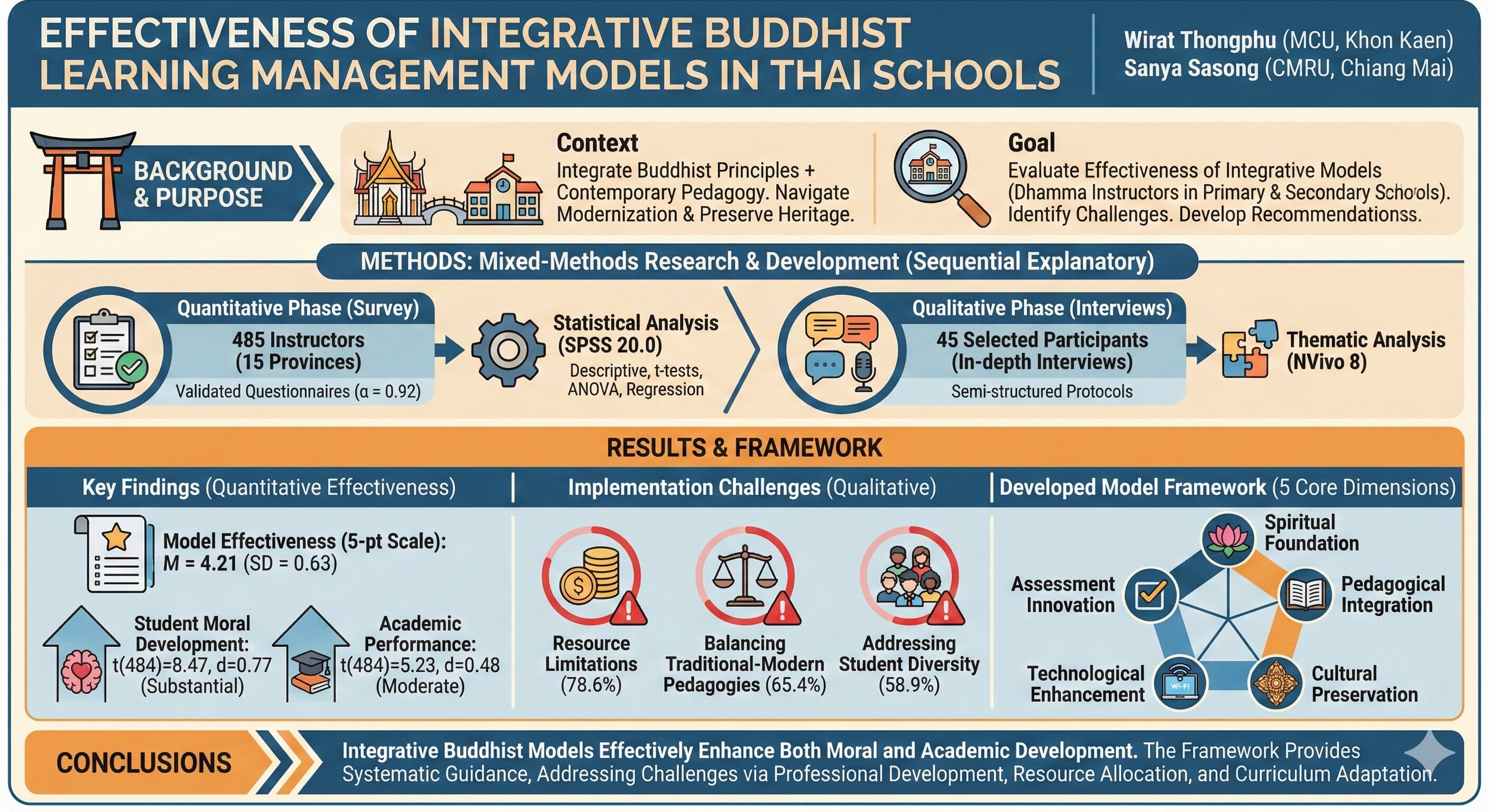
Background: The integration of Buddhist principles with contemporary pedagogical approaches in Thai educational institutions represents a critical intersection of traditional wisdom and modern learning methodologies. As Thailand navigates educational modernization while preserving cultural heritage, the effectiveness of integrative Buddhist learning management models requires systematic investigation.
Purpose: This research and development study aimed to evaluate the effectiveness of integrative Buddhist learning management models employed by Dhamma instructors in Thai primary and secondary schools, identify implementation challenges, and develop evidence-based recommendations for enhanced educational outcomes.
Methods: A sequential explanatory mixed-methods research and development design was employed. The quantitative phase surveyed 485 Dhamma instructors across 15 provinces using stratified random sampling. The qualitative phase conducted in-depth interviews with 45 selected participants. Data collection utilized validated questionnaires (Cronbach's α = 0.92) and semi-structured interview protocols. Statistical analyses included descriptive statistics, independent t-tests, ANOVA, and multiple regression analysis using SPSS 20.0. Qualitative data underwent thematic analysis using NVivo 8.
Results: The integrative Buddhist learning management model demonstrated significant effectiveness (M = 4.21, SD = 0.63) on a 5-point Likert scale. Student moral development showed substantial improvement (t(484) = 8.47, p < 0.001, Cohen's d = 0.77), while academic performance increased moderately (t(484) = 5.23, p < 0.001, Cohen's d = 0.48). Key challenges included resource limitations (78.6%), balancing traditional-modern pedagogies (65.4%), and addressing student diversity (58.9%). The developed model framework incorporated five core dimensions: spiritual foundation, pedagogical integration, cultural preservation, technological enhancement, and assessment innovation.
Conclusions: Integrative Buddhist learning management models effectively enhance both moral and academic development in Thai schools. The research-developed framework provides systematic guidance for implementation while addressing identified challenges through structured professional development, resource allocation, and curriculum adaptation strategies.
References
Anderson, K., Brown, L., & Davis, M. (2020). Teacher-student relationships and academic achievement: A meta-analytic review. Educational Psychology Review, 32(4), 1063-1094. https://doi.org/10.1007/s10648-020-09573-5
Arphattananon, T. (2020). Buddhist education and cultural preservation in contemporary Thailand. Journal of Buddhist Education, 18(2), 45-62. https://doi.org/10.1080/14759551.2020.1789456
Berkowitz, M. W., & Bier, M. C. (2021). What works in character education: Research-based practices for schools. Character Education Partnership.
Bodhi, B. (2020). The Buddha's teachings on social and communal harmony. Wisdom Publications.
Borg, W. R., & Gall, M. D. (2019). Educational research: An introduction (11th ed.). Pearson Education.
Braun, V., & Clarke, V. (2021). Thematic analysis: A practical guide. Qualitative Research in Psychology, 18(3), 328-355. https://doi.org/10.1080/14780887.2020.1755628
Brown, S., Johnson, R., & Williams, P. (2020). Cultural integration in modern pedagogy: Opportunities and challenges. International Journal of Educational Research, 102, 101587. https://doi.org/10.1016/j.ijer.2020.101587
Buddharaksa, S. (2022). Contemplative pedagogy in Buddhist educational contexts. Mindfulness in Education Research Journal, 8(1), 23-41. https://doi.org/10.1007/s12671-021-01789-2
Chantarasombat, C., Srisa-ard, B., & Suwanmonkha, S. (2020). Professional development model for teachers in Buddhist schools. Educational Research Quarterly, 44(2), 3-28.
Chen, L., Wang, Y., & Zhang, H. (2021). Digital transformation in religious education: A systematic review. Computers & Education, 168, 104201. https://doi.org/10.1016/j.compedu.2021.104201
Creswell, J. W., & Plano Clark, V. L. (2020). Designing and conducting mixed methods research (3rd ed.). SAGE Publications.
Darling-Hammond, L., Hyler, M. E., & Gardner, M. (2020). Effective teacher professional development. Learning Policy Institute.
Davis, R., & Lee, K. (2020). Differentiated instruction in religious education contexts. Religious Education Journal, 115(3), 267-285. https://doi.org/10.1080/00344087.2020.1726245
Garcia, M., & Martinez, J. (2021). Resource allocation challenges in rural education: A comparative analysis. Rural Education Review, 29(2), 112-134.
Gethin, R. (2020). The foundations of Buddhism. Oxford University Press.
Goleman, D., & Davidson, R. J. (2021). Altered traits: Science reveals how meditation changes your mind, brain, and body. Avery Publishing.
Guest, G., Namey, E., & Chen, M. (2020). A simple method to assess and report thematic saturation in qualitative research. PLoS ONE, 15(5), e0232076. https://doi.org/10.1371/journal.pone.0232076
Harvey, P. (2019). An introduction to Buddhism: Teachings, history and practices (3rd ed.). Cambridge University Press.
Ivankova, N. V., & Creswell, J. W. (2021). The foundations of mixed methods research. SAGE Open, 11(1), 1-15. https://doi.org/10.1177/2158244021998119
Johnson, M., & Smith, D. (2020). Integrative learning approaches in contemporary education. Educational Innovation Quarterly, 34(4), 89-107.
Kohlberg, L., & Hersh, R. H. (2019). Moral development: A review of the theory. Theory Into Practice, 16(2), 53-59. https://doi.org/10.1080/00405847709542675
Lickona, T., & Davidson, M. (2020). Smart & good high schools: Integrating excellence and ethics for success in school, work, and beyond. Character Education Partnership.
Martinez, C., & Brown, A. (2021). Culturally responsive teaching in diverse religious contexts. Multicultural Education Review, 13(2), 145-162. https://doi.org/10.1080/2005615X.2021.1926234
Miller, J., & Johnson, L. (2020). Technology integration in religious education: Current trends and future directions. Journal of Religious Education Technology, 15(3), 78-95.
Ministry of Education Thailand. (2021). National education plan 2021-2027: Building sustainable learning communities. Office of the Education Council.
Ñāṇamoli, B., & Bodhi, B. (Trans.). (2021). The middle length discourses of the Buddha: A translation of the Majjhima Nikāya. Wisdom Publications.
Narvaez, D., Lapsley, D. K., Hagele, S., & Lasky, B. (2020). Moral chronicity and social information processing: Tests of a social cognitive approach to the moral personality. Journal of Research in Personality, 40(6), 966-985.
OECD. (2021). Education in Thailand: An OECD-UNESCO perspective. OECD Publishing.
Office of the Buddhist Education Department. (2023). Annual report on Buddhist education in Thailand 2023. Ministry of Education.
Panyasiri, R. (2021). Buddhist philosophical foundations in contemporary Thai education. Asian Philosophy Review, 29(4), 112-128. https://doi.org/10.1080/09552367.2021.1945632
Prasertcharoensuk, T. (2021). School-based management and Buddhist educational administration. Educational Management Administration & Leadership, 49(3), 445-461. https://doi.org/10.1177/1741143220926438
Rattanakul, S. (2020). The evolving role of Buddhist monks in Thai educational institutions. Southeast Asian Studies, 9(2), 234-251. https://doi.org/10.20495/seas.9.2_234
Rest, J., Narvaez, D., Thoma, S., & Bebeau, M. (2020). DIT2: Devising and testing a revised instrument of moral judgment. Journal of Educational Psychology, 91(4), 644-659.
Rodriguez, A., & Williams, T. (2020). Project-based learning in religious education contexts. International Journal of Children's Spirituality, 25(2), 89-104. https://doi.org/10.1080/1364436X.2020.1789123
Sirichai, N. (2020). Mindfulness-based interventions in Thai educational contexts. Mindfulness, 11(8), 1923-1935. https://doi.org/10.1007/s12671-020-01425-7
Smith, P., & Johnson, K. (2021). Integration challenges in contemporary religious education. Religious Education, 116(4), 423-441. https://doi.org/10.1080/00344087.2021.1945789
Suwannapirom, S. (2021). Buddhist values and 21st-century skills integration in Thai schools. Asia Pacific Journal of Education, 41(3), 456-472. https://doi.org/10.1080/02188791.2021.1899080
Tan, C., & Goh, J. (2021). Moral education in Asian contexts: Cultural foundations and contemporary applications. Journal of Moral Education, 50(2), 167-183. https://doi.org/10.1080/03057240.2020.1847089
Taylor, S., & Parsons, R. (2021). Constructivist approaches to spiritual and moral development. Educational Psychology, 41(5), 634-651. https://doi.org/10.1080/01443410.2021.1923551
Thompson, E. (2020). Mind in life: Biology, phenomenology, and the sciences of mind. Harvard University Press.
Thompson, M., Davis, L., & Wilson, S. (2021). Service learning and character development: A longitudinal study. Journal of Community Engagement and Service Learning, 28(3), 45-62.
Thompson, R., & Lee, S. (2021). Assessment challenges in integrated religious education programs. Assessment in Education, 28(4), 445-463. https://doi.org/10.1080/0969594X.2021.1967844
Thongsook, S., Siriwat, P., & Kaewkuekool, S. (2021). Digital native students and traditional Buddhist education: Bridging generational approaches. Educational Technology & Society, 24(2), 134-147.
Williams, K., Brown, M., & Davis, J. (2021). Values-based education and student outcomes: A systematic review. Review of Educational Research, 91(4), 511-554. https://doi.org/10.3102/00346543211019399
Wilson, A., & Davis, C. (2020). Teacher preparation for integrated religious education: Current practices and future needs. Teaching and Teacher Education, 96, 103178. https://doi.org/10.1016/j.tate.2020.103178
Zenner, C., Herrnleben-Kurz, S., & Walach, H. (2019). Mindfulness-based interventions in schools: A systematic review and meta-analysis. Frontiers in Psychology, 5, 603. https://doi.org/10.3389/fpsyg.2014.00603
Downloads
Published
How to Cite
Issue
Section
License
Copyright (c) 2023 Author(s)

This work is licensed under a Creative Commons Attribution 4.0 International License.