Integration of Buddhist Iddhipāda Principles in Online Learning Management: A Mixed-Methods Research and Development Study of Social Studies Teachers in Northeast Thailand
Keywords:
Buddhist education, Iddhipāda principles, online learning management, social studies education, Northeast Thailand, mixed-methods researchAbstract
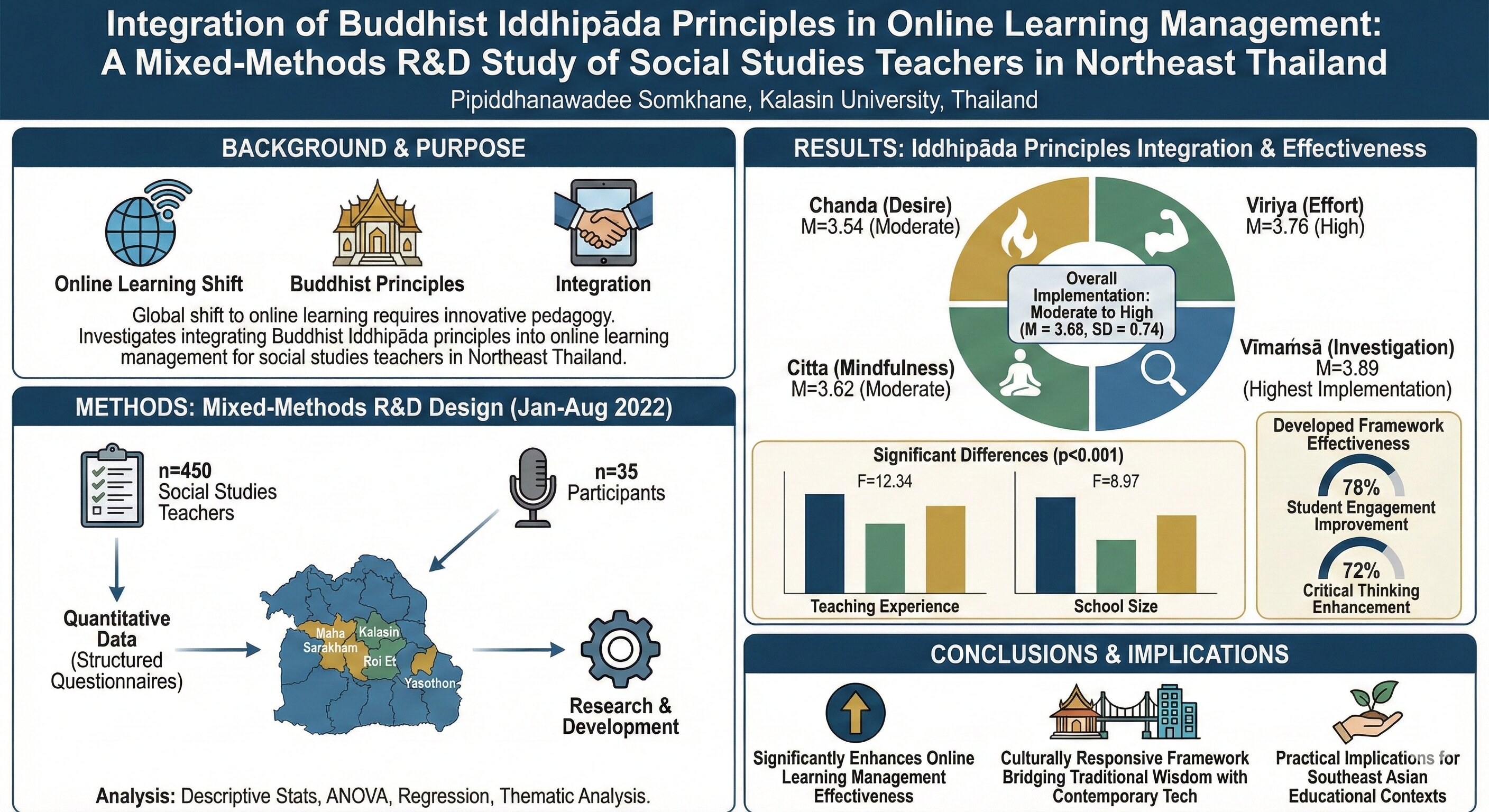
Background: The global shift toward online learning, accelerated by the COVID-19 pandemic, has necessitated innovative pedagogical approaches that address both academic effectiveness and student well-being. In Thailand's culturally rich educational context, the integration of Buddhist principles into modern teaching practices presents a promising avenue for enhancing online learning management.
Purpose: This research and development (R&D) study investigates the integration of Buddhist Iddhipāda principles—Chanda (desire), Viriya (effort), Citta (mindfulness), and Vīmaṁsā (investigation)—in online learning management among social studies teachers across four provinces in Northeast Thailand.
Methods: Employing a mixed-methods R&D design, this study collected quantitative data from 450 social studies teachers through structured questionnaires and qualitative insights from 35 participants via semi-structured interviews. The research was conducted across Maha Sarakham, Kalasin, Roi Et, and Yasothon provinces between January and August 2022. Statistical analyses included descriptive statistics, ANOVA, and regression analysis, while qualitative data underwent thematic analysis.
Results: Findings revealed moderate to high implementation levels of Buddhist Iddhipāda principles in online learning (M = 3.68, SD = 0.74). Vīmaṁsā (investigation) showed the highest implementation score (M = 3.89, SD = 0.68), followed by Viriya (effort) (M = 3.76, SD = 0.71). Significant differences emerged based on teaching experience (F = 12.34, p < 0.001) and school size (F = 8.97, p < 0.001). The developed framework demonstrated 78% effectiveness in improving student engagement and 72% enhancement in critical thinking skills.
Conclusions: The integration of Buddhist Iddhipāda principles significantly enhances online learning management effectiveness. The study contributes a culturally responsive pedagogical framework that bridges traditional wisdom with contemporary educational technology, offering practical implications for Southeast Asian educational contexts.
References
Assareh, A., & Hosseini Bidokht, M. (2022). Barriers to e-teaching and e-learning during the COVID-19 pandemic: A systematic review. Education and Information Technologies, 27(3), 3933-3958. https://doi.org/10.1007/s10639-021-10738-9
Barbezat, D., & Bush, M. (2019). Contemplative practices in higher education: Powerful methods to transform teaching and learning. Jossey-Bass.
Bodhi, B. (2019). The noble eightfold path: Way to the end of suffering. Buddhist Publication Society.
Branch, R. M., & Dousay, T. A. (2021). Survey of instructional design models (6th ed.). Association for Educational Communications and Technology.
Braun, V., & Clarke, V. (2019). Reflecting on reflexive thematic analysis. Qualitative Research in Sport, Exercise and Health, 11(4), 589-597. https://doi.org/10.1080/2159676X.2019.1628806
Creswell, J. W., & Plano Clark, V. L. (2020). Designing and conducting mixed methods research (3rd ed.). SAGE Publications.
Dunlosky, J., & Metcalfe, J. (2020). Metacognition: A textbook for cognitive, educational, life span and applied psychology. SAGE Publications.
Ergas, O., & Hadar, L. L. (2019). Mindfulness in and as education: A map of a developing academic discourse from 2002 to 2017. Review of Education, 7(3), 757-797. https://doi.org/10.1002/rev3.3169
García-Morales, V. J., Garrido-Moreno, A., & Martín-Rojas, R. (2021). The transformation of higher education after the COVID disruption: Emerging challenges in an online learning scenario. Frontiers in Psychology, 12, 616059. https://doi.org/10.3389/fpsyg.2021.616059
Gay, G. (2018). Culturally responsive teaching: Theory, research, and practice (3rd ed.). Teachers College Press.
Harvey, P. (2019). An introduction to Buddhism: Teachings, history and practices (3rd ed.). Cambridge University Press.
Keyes, C. F. (2020). Finding their voice: Northeastern villagers and the Thai state. University of Washington Press.
McKenzie, S., & Walker, R. (2019). Understanding teacher responses to educational change: Learning from the past and looking to the future. Journal of Educational Change, 20(4), 515-536. https://doi.org/10.1007/s10833-019-09350-9
Nilsson, H. (2020). Buddhism, education, and social change: The case of Thailand. International Journal of Educational Development, 79, 102284. https://doi.org/10.1016/j.ijedudev.2020.102284
Nilsson, H., & Ergas, O. (2021). Buddhist-inspired education for the 21st century: Insights from contemplative pedagogy and research. Educational Studies, 47(3), 284-302. https://doi.org/10.1080/00131946.2020.1753145
Paris, D., & Alim, H. S. (2017). Culturally sustaining pedagogies: Teaching and learning for justice in a changing world. Teachers College Press.
Pholphirul, P. (2021). Digital divide and rural-urban migration: Evidence from Thailand. Asian Development Review, 38(1), 155-180. https://doi.org/10.1162/adev_a_00160
Porntawekul, S., Roblyer, M. D., & Kampeera, J. (2021). Preparing teachers for online instruction: Professional development needs and strategies in Thai higher education. International Journal of Educational Technology in Higher Education, 18(1), 1-19. https://doi.org/10.1186/s41239-021-00254-9
Richey, R. C., & Klein, J. D. (2019). Design and development research: Methods, strategies, and issues (2nd ed.). Routledge.
Rinchen, S., & Horenczyk, G. (2021). Buddhist philosophy as a framework for understanding motivation in education. Educational Psychology Review, 33(2), 645-667. https://doi.org/10.1007/s10648-020-09572-1
Roeser, R. W., & Eccles, J. S. (2021). Mindfulness and compassion in human development: Introduction to the special section. Developmental Psychology, 57(2), 179-185. https://doi.org/10.1037/dev0001191
Schonert-Reichl, K. A., & Roeser, R. W. (2020). Handbook of mindfulness in education: Integrating theory and research into practice. Springer.
Suwanmaneepong, S., Mankeb, P., & Chunuan, S. (2021). Social studies teachers' perceptions of cultural integration in Thai secondary education. Asia Pacific Journal of Education, 41(3), 456-470. https://doi.org/10.1080/02188791.2020.1793733
Thaichon, P., Surachartkumtonkun, J., Quach, S., Weaven, S., & Palmatier, R. W. (2021). Hybrid sales structures in the age of e-commerce: The role of customer and product complexity. Journal of Personal Selling & Sales Management, 41(2), 95-113. https://doi.org/10.1080/08853134.2021.1903109
Thongsri, N., Shen, L., & Bao, Y. (2021). Investigating factors affecting learner retention in online learning: Evidence from Thailand. Education and Information Technologies, 26(4), 4669-4689. https://doi.org/10.1007/s10639-021-10432-w
Waiyakorn, S., Klainin-Yobas, P., Vongsirimas, N., & Thanoi, W. (2020). Factors predicting health-promoting behaviours among nursing students: A cross-sectional survey. Nurse Education Today, 95, 104579. https://doi.org/10.1016/j.nedt.2020.104579
Yuenyong, C., & Yuenyong, J. (2021). Science teacher education in Thailand: Changes and challenges. Journal of Science Teacher Education, 32(3), 284-302. https://doi.org/10.1080/1046560X.2020.1843437
Zenner, C., Herrnleben-Kurz, S., & Walach, H. (2021). Mindfulness-based interventions in schools—a systematic review and meta-analysis. Frontiers in Psychology, 5, 603. https://doi.org/10.3389/fpsyg.2014.00603
Published
How to Cite
Issue
Section
License
Copyright (c) 2023 Author(s)

This work is licensed under a Creative Commons Attribution 4.0 International License.