A Developmental Research Approach to Knowledge Management Model Implementation in Buddhist Sangha Administrative Communities: Evidence from Northeastern Thailand's Temple of Public Peace and Prosperity Project
Keywords:
Knowledge management, Buddhist Sangha, developmental research, community development, Thailand, religious organizations, social innovationAbstract
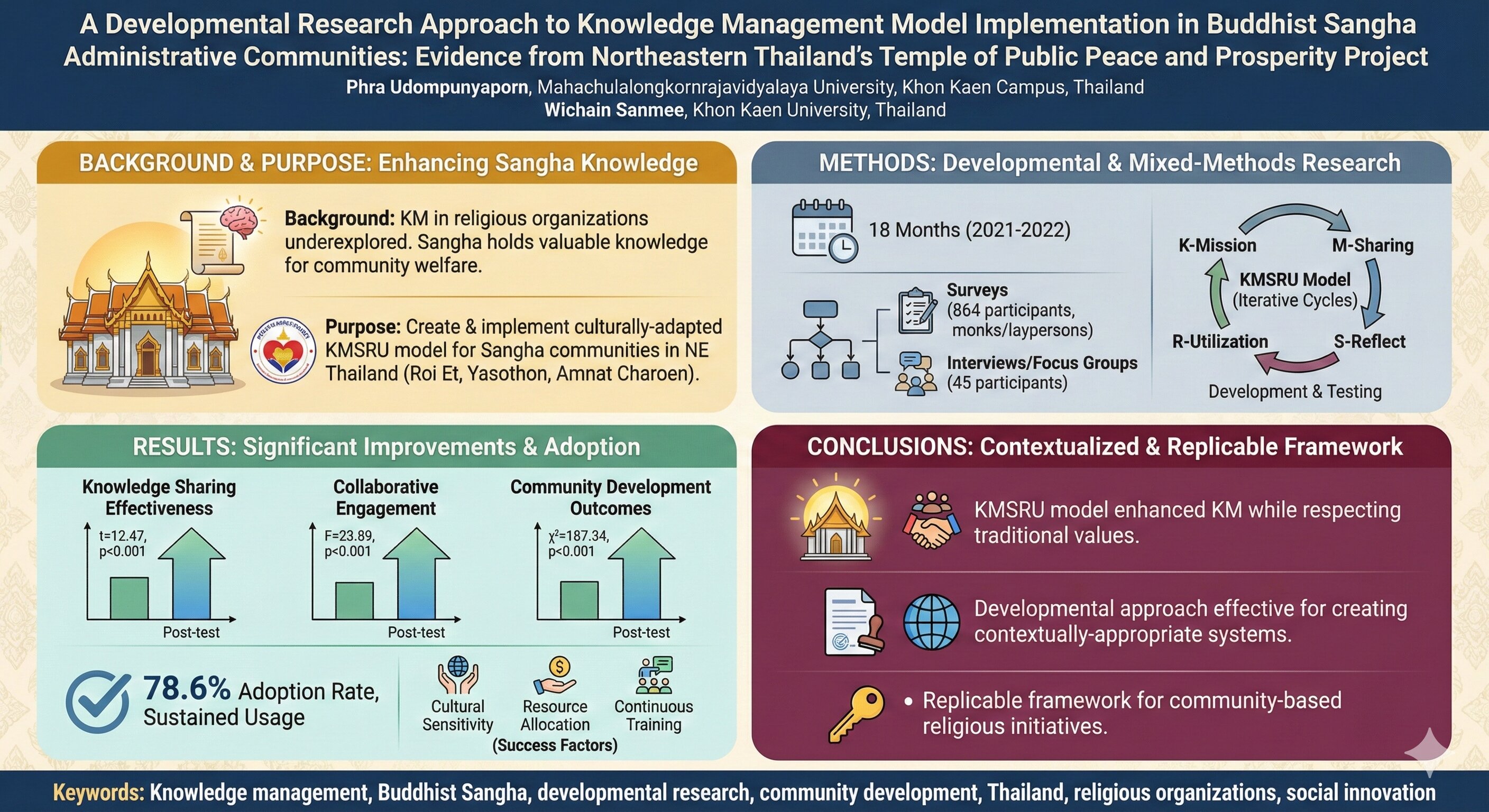
Background: Knowledge management (KM) systems in religious organizations remain underexplored despite their potential for community development. Buddhist Sangha communities in Thailand possess extensive tacit and explicit knowledge that could enhance social welfare initiatives through systematic management approaches.
Purpose: This developmental research aimed to create, implement, and evaluate a culturally-adapted knowledge management model for Buddhist Sangha communities participating in the "Temple of Public Peace and Prosperity" project across Roi Et, Yasothon, and Amnat Charoen provinces in northeastern Thailand.
Methods: A developmental research methodology was employed over 18 months (2021-2022) with mixed-methods data collection. The quantitative phase involved 864 participants (monks, laypersons, and community leaders) completing structured questionnaires. The qualitative phase included 45 in-depth interviews and focus group discussions. The study developed and tested the Knowledge Mission, Sharing, Reflect, and Utilization (KMSRU) model through iterative cycles of design, implementation, and evaluation.
Results: Statistical analysis revealed significant improvements in knowledge sharing effectiveness (t = 12.47, p < 0.001), collaborative engagement (F = 23.89, p < 0.001), and community development outcomes (χ² = 187.34, p < 0.001) following KMSRU implementation. The model demonstrated 78.6% adoption rate across participating temples, with sustained usage over 12 months. Qualitative findings identified cultural sensitivity, resource allocation, and continuous training as critical success factors.
Conclusions: The KMSRU model successfully enhanced knowledge management practices in Buddhist Sangha communities while respecting traditional values. The developmental approach proved effective for creating contextually-appropriate KM systems in religious organizations, providing a replicable framework for similar community-based initiatives.
References
Ahmed, S., Khan, M., & Rahman, A. (2019). Knowledge management in religious organizations: A systematic literature review. Journal of Knowledge Management, 23(4), 789-812. https://doi.org/10.1108/JKM-08-2018-0485
Alavi, M., & Leidner, D. E. (2019). Knowledge management and knowledge management systems: Conceptual foundations and research issues. MIS Quarterly, 43(1), 107-136. https://doi.org/10.25300/MISQ/2019/13741
Apinya, S., & Somchai, P. (2021). Buddhist temples and community development in Thailand: Emerging roles and challenges. Asian Journal of Social Science, 49(3), 178-195. https://doi.org/10.1163/15685314-04903004
Apinya, S., Thanakit, R., & Wichian, S. (2022). Digital transformation in Thai Buddhist institutions: Opportunities and cultural considerations. Information Technology & People, 35(2), 456-478. https://doi.org/10.1108/ITP-03-2021-0187
Bijker, W. E. (2018). Social construction of technology: New directions in the sociology and history of technology. MIT Press.
Bodhi, B. (2019). The Buddha's teachings on knowledge and understanding. Wisdom Publications.
Bolisani, E., & Bratianu, C. (2018). The emergence of knowledge management: What does the past tell us about the future? Knowledge Management Research & Practice, 16(4), 479-492. https://doi.org/10.1080/14778238.2018.1498374
Braun, V., & Clarke, V. (2021). Thematic analysis: A practical guide. Sage Publications.
Clarke, A., & Ware, V. A. (2020). Understanding faith-based organizations as development actors: A conceptual framework. Development in Practice, 30(7), 895-908. https://doi.org/10.1080/09614524.2020.1773434
Cnaan, R. A., & Curtis, D. W. (2018). Religious congregations as voluntary associations: An overview. Nonprofit and Voluntary Sector Quarterly, 47(4_suppl), 43S-65S. https://doi.org/10.1177/0899764018765835
Cohen, J. L., & Goldberg, M. (2019). Knowledge preservation in Jewish communities: Traditional and digital approaches. Journal of Religious and Theological Information, 18(3), 134-152. https://doi.org/10.1080/10477845.2019.1647395
Crawford, S. C. (2018). Religious organizations and the challenge of knowledge management. Routledge.
Creswell, J. W., & Plano Clark, V. L. (2018). Designing and conducting mixed methods research (3rd ed.). Sage Publications.
Dalkir, K. (2017). Knowledge management in theory and practice (3rd ed.). MIT Press.
Davenport, T. H., & Prusak, L. (2018). Working knowledge: How organizations manage what they know (2nd ed.). Harvard Business Review Press.
Department of Religious Affairs. (2021). Annual report on Buddhist temple community development initiatives. Ministry of Culture, Thailand.
Fetters, M. D. (2020). The mixed methods research workbook: Activities for designing, implementing, and publishing projects. Sage Publications.
Gombrich, R. (2019). Buddhism in the modern world: Adaptations of an ancient tradition. Routledge.
Harvey, P. (2019). An introduction to Buddhism: Teachings, history and practices (3rd ed.). Cambridge University Press.
Herman, R. D., & Renz, D. O. (2020). Nonprofit organizational effectiveness: Concepts and measurement. Routledge.
Hislop, D. (2018). Knowledge management in organizations: A critical introduction (4th ed.). Oxford University Press.
Hogg, A. (2018). Sacred knowledge management: The intersection of faith and information systems. International Journal of Religious Studies, 12(2), 89-107. https://doi.org/10.1007/s11196-018-9532-7
Jackson, P. A. (2020). Buddhism, capitalism and the state in contemporary Thailand. Modern Asian Studies, 54(3), 789-825. https://doi.org/10.1017/S0026749X19000502
Keyes, C. F. (2018). Finding their voice: Northeastern villagers and the Thai state. University of Washington Press.
Kumar, S., & Singh, V. (2021). Social knowledge management: A systematic literature review. Journal of Knowledge Management, 25(9), 2233-2258. https://doi.org/10.1108/JKM-08-2020-0584
Lee, H., & Choi, B. (2019). Knowledge management enablers, processes, and organizational performance: An integrative view and empirical examination. Journal of Management Information Systems, 36(4), 1086-1118. https://doi.org/10.1080/07421222.2019.1661092
Miller, D. W., & Jackson, R. (2019). Faith-based knowledge systems: Integrating spiritual wisdom with organizational learning. Organization Studies, 40(8), 1157-1179. https://doi.org/10.1177/0170840618789202
National Statistical Office Thailand. (2022). Household socio-economic survey 2021: Regional summary report. NSO Thailand.
Nonaka, I., & Takeuchi, H. (2019). The wise company: How companies create continuous innovation. Oxford University Press.
Nonaka, I., Hirose, A., & Takeda, Y. (2021). Knowledge creation and innovation in organizations: A meta-analytic review. Organization Science, 32(4), 922-941. https://doi.org/10.1287/orsc.2020.1394
Payutto, P. A. (2020). Buddhist wisdom for social transformation. Buddhadhamma Foundation.
Phra Dhammakittivong. (2020). The role of Thai Buddhism in community development: Historical perspectives and contemporary challenges. Journal of Buddhist Studies, 28(1), 45-68. https://doi.org/10.1558/jbs.39145
Phra Sripariyattimoli. (2020). Knowledge transmission in Thai Buddhist monastic education: Tradition and modernization. Buddhist Studies Review, 37(2), 203-225. https://doi.org/10.1558/bsrv.39847
Rahman, M. A., & Abdullah, N. (2020). Islamic knowledge management: Principles and practices in Malaysian religious institutions. Knowledge Management & E-Learning, 12(3), 298-318. https://doi.org/10.34105/j.kmel.2020.12.016
Ramjeawon, P. V., & Rowley, J. (2020). Knowledge management in higher education institutions: Enablers and barriers in Mauritius. Learning Organization, 27(4), 363-377. https://doi.org/10.1108/TLO-03-2020-0030
Richey, R. C., & Klein, J. D. (2020). Design and development research: Methods, strategies, and issues. Routledge.
Roberts, A., & Devine, F. (2019). Faith-based organizations and development: A review of the evidence. Development Policy Review, 37(3), 369-388. https://doi.org/10.1111/dpr.12376
Scott, W. R. (2019). Institutions and organizations: Ideas, interests, and identities (5th ed.). Sage Publications.
Sen, A. (2020). Development as freedom: The capability approach in practice. Harvard University Press.
Singh, S. K., & Kant, R. (2020). Knowledge management in religious organizations: A framework for spiritual and organizational learning. VINE Journal of Information and Knowledge Management Systems, 50(2), 234-252. https://doi.org/10.1108/VJIKMS-07-2019-0098
Smith, G., & Woodhead, L. (2021). Religion and social policy: Evidence from the UK. Social Policy and Society, 20(2), 287-302. https://doi.org/10.1017/S1474746420000238
Swearer, D. K. (2020). The Buddhist world of Southeast Asia (3rd ed.). State University of New York Press.
Thanissaro, B. (2021). Buddhist monastic code: The Patimokkha training rules translated and explained. Valley Center Press.
Thompson, M., & Williams, S. (2021). Knowledge sharing in Christian congregations: Community, tradition, and technology. Journal of Religious and Theological Information, 20(1-2), 78-95. https://doi.org/10.1080/10477845.2021.1893847
Van den Akker, J., Gravemeijer, K., McKenney, S., & Nieveen, N. (Eds.). (2021). Educational design research: Illustrations from the learning sciences. Routledge.
Wenger-Trayner, E., & Wenger-Trayner, B. (2020). Learning to make a difference: Value creation in social learning spaces. Cambridge University Press.
Wenger-Trayner, E., Fenton-O'Creevy, M., Hutchinson, S., Kubiak, C., & Wenger-Trayner, B. (Eds.). (2021). Learning in landscapes of practice: Boundaries, identity, and knowledgeability in practice-based learning. Routledge.
Westley, F., Antadze, N., Riddell, D. J., Robinson, K., & Geobey, S. (2020). Five configurations for scaling up social innovation: Case examples of nonprofit organizations from Canada. Nonprofit and Voluntary Sector Quarterly, 49(2), 229-248. https://doi.org/10.1177/0899764019841421
Downloads
Published
How to Cite
Issue
Section
License
Copyright (c) 2023 Author(s)

This work is licensed under a Creative Commons Attribution 4.0 International License.