The Effectiveness of SIM-AE Learning Management Model on Academic Achievement and Cultural Preservation in Thai History Education: A Correlational Study in Nakhon Phanom Province
Keywords:
SIM-AE model, Thai history education, cultural preservation, academic achievement, correlational study, Nakhon Phanom, multimedia learning, student engagementAbstract
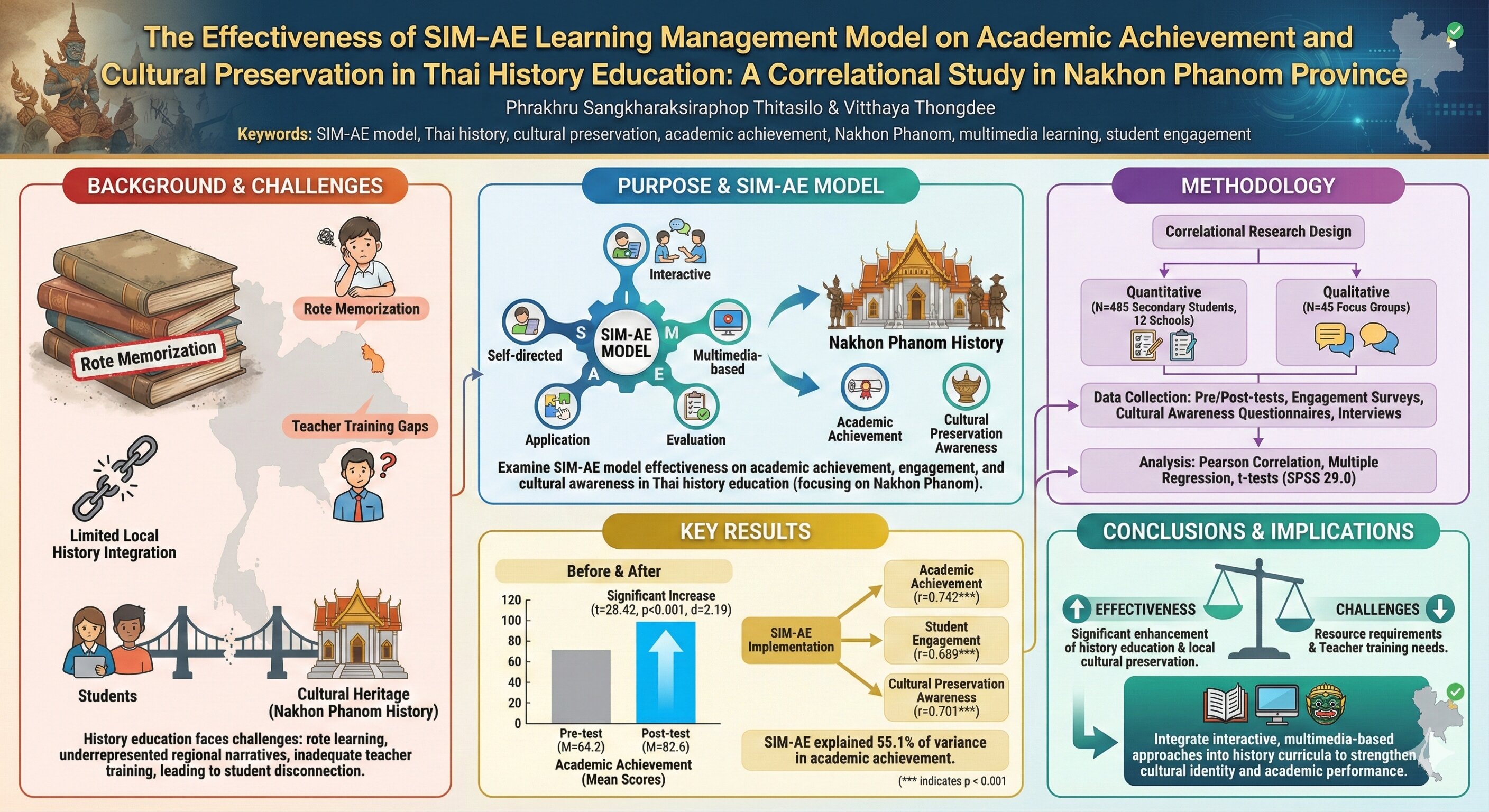
Background: History education in Thailand faces significant challenges including rote memorization approaches, limited integration of local histories, and inadequate teacher training in modern pedagogical methods. The underrepresentation of regional narratives, particularly in northeastern Thailand, creates disconnection between students and their cultural heritage.
Purpose: This correlational study examined the effectiveness of the SIM-AE (Self-directed, Interactive, Multimedia-based, Application, and Evaluation) learning management model on secondary students' academic achievement, engagement levels, and cultural preservation awareness in Thai history education, specifically focusing on Nakhon Phanom History in Nakhon Phanom Province.
Methods: Using a correlational research design, this study involved 485 secondary school students from 12 schools in Nakhon Phanom Province for quantitative analysis, with 45 students participating in qualitative focus groups. Data collection employed pre/post-test assessments, engagement surveys, cultural awareness questionnaires, and semi-structured interviews. Statistical analyses included Pearson correlation, multiple regression, and t-tests using SPSS 29.0.
Results: Strong positive correlations were found between SIM-AE model implementation and academic achievement (r = 0.742, p < 0.001), student engagement (r = 0.689, p < 0.001), and cultural preservation awareness (r = 0.701, p < 0.001). Post-test scores increased significantly from M = 64.2 (SD = 8.7) to M = 82.6 (SD = 7.3), t(484) = 28.42, p < 0.001, d = 2.19. The model explained 55.1% of variance in academic achievement outcomes.
Conclusions: The SIM-AE model demonstrates significant effectiveness in enhancing Thai history education outcomes while promoting local cultural preservation. Implementation challenges include resource requirements and teacher training needs. Findings support integration of interactive, multimedia-based approaches in history curricula to strengthen cultural identity and academic performance.
References
Braun, V., & Clarke, V. (2021). Thematic analysis: A practical guide. SAGE Publications.
Chanprasert, C., & Wongwanich, S. (2021). Development of cultural learning model to enhance local wisdom preservation among secondary school students in northeastern Thailand. Kasetsart Journal of Social Sciences, 42(2), 341-348. https://doi.org/10.34044/j.kjss.2021.42.2.14
Charoenwongse, P., & Wongwanich, S. (2020). The effectiveness of multimedia instruction on historical thinking skills development among Thai secondary students. Educational Technology Research and Development, 68(4), 1923-1945. https://doi.org/10.1007/s11423-020-09798-4
Chen, L., & Wang, M. (2021). Interactive multimedia learning environments in history education: A systematic review of effectiveness and implementation factors. Computers & Education, 169, 104201. https://doi.org/10.1016/j.compedu.2021.104201
Creswell, J. W., & Creswell, J. D. (2022). Research design: Qualitative, quantitative, and mixed methods approaches (6th ed.). SAGE Publications.
Creswell, J. W., & Plano Clark, V. L. (2021). Designing and conducting mixed methods research (3rd ed.). SAGE Publications.
Fredricks, J. A., Reschly, A. L., & Christenson, S. L. (2019). Handbook of student engagement interventions. Academic Press.
Johnson, R. B., & Christensen, L. (2020). Educational research: Quantitative, qualitative, and mixed approaches (7th ed.). SAGE Publications.
Kasemsap, B., & Hatthakitt, S. (2021). Technology integration in Thai history education: Challenges and opportunities for cultural preservation. Asia Pacific Education Review, 22(3), 487-503. https://doi.org/10.1007/s12564-021-09698-2
Krejcie, R. V., & Morgan, D. W. (1970). Determining sample size for research activities. Educational and Psychological Measurement, 30(3), 607-610. https://doi.org/10.1177/001316447003000308
Pimthong, B., & Wannapiroon, P. (2022). Digital storytelling model for enhancing cultural identity among secondary school students in rural Thailand. Educational Technology & Society, 25(1), 142-156. https://www.jstor.org/stable/48647018
Pornpimon, C., Wallapha, A., & Prayuth, C. (2022). Constructivist learning management system for developing higher-order thinking skills in history education. International Journal of Instruction, 15(2), 525-542. https://doi.org/10.29333/iji.2022.15229a
Rattanawicha, P., & Seechaliao, T. (2020). Development of a web-based learning environment for promoting cultural awareness in northeastern Thai communities. Contemporary Educational Technology, 12(2), ep275. https://doi.org/10.30935/cedtech/8583
Siriporn, A., & Prachayapruit, N. (2021). Effects of local history integration on cultural identity and academic achievement among secondary students in Isan region. Journal of Education and Learning, 10(3), 81-94. https://doi.org/10.5539/jel.v10n3p81
Siriporn, A., Wannapiroon, P., & Nilsook, P. (2021). The learning process of scientific imagineering through AR for fostering creative thinking and innovation skills. TEM Journal, 10(1), 121-131. https://doi.org/10.18421/TEM101-15
Suwannatthachote, P., & Tantrarungroj, P. (2020). Constructivist learning environments and student engagement in Thai secondary education: A multilevel analysis. Learning Environments Research, 23(2), 285-304. https://doi.org/10.1007/s10984-019-09304-1
Tashakkori, A., & Teddlie, C. (2021). SAGE handbook of mixed methods in social & behavioral research (3rd ed.). SAGE Publications.
Thanakit, P., & Nilsook, P. (2020). A framework for developing virtual reality learning environments for historical site preservation. International Journal of Online and Biomedical Engineering, 16(7), 107-119. https://doi.org/10.3991/ijoe.v16i07.13639
Thongthew, S., & Wannapiroon, P. (2020). Development of a collaborative learning model using virtual reality for enhancing historical empathy among secondary school students. Educational Technology Research and Development, 68(5), 2357-2379. https://doi.org/10.1007/s11423-020-09771-1
Wannapiroon, P., & Nilsook, P. (2021). Collaborative learning model using mobile technology for developing digital literacy skills in the 21st century. International Journal of Interactive Mobile Technologies, 15(11), 146-159. https://doi.org/10.3991/ijim.v15i11.20225
Downloads
Published
How to Cite
Issue
Section
License
Copyright (c) 2023 Author(s)

This work is licensed under a Creative Commons Attribution 4.0 International License.