The Impact of Cutting-Edge Information Technology Integration on Student Academic Performance: A Causal-Comparative Study in Central Thailand's Educational Institutions
Abstract
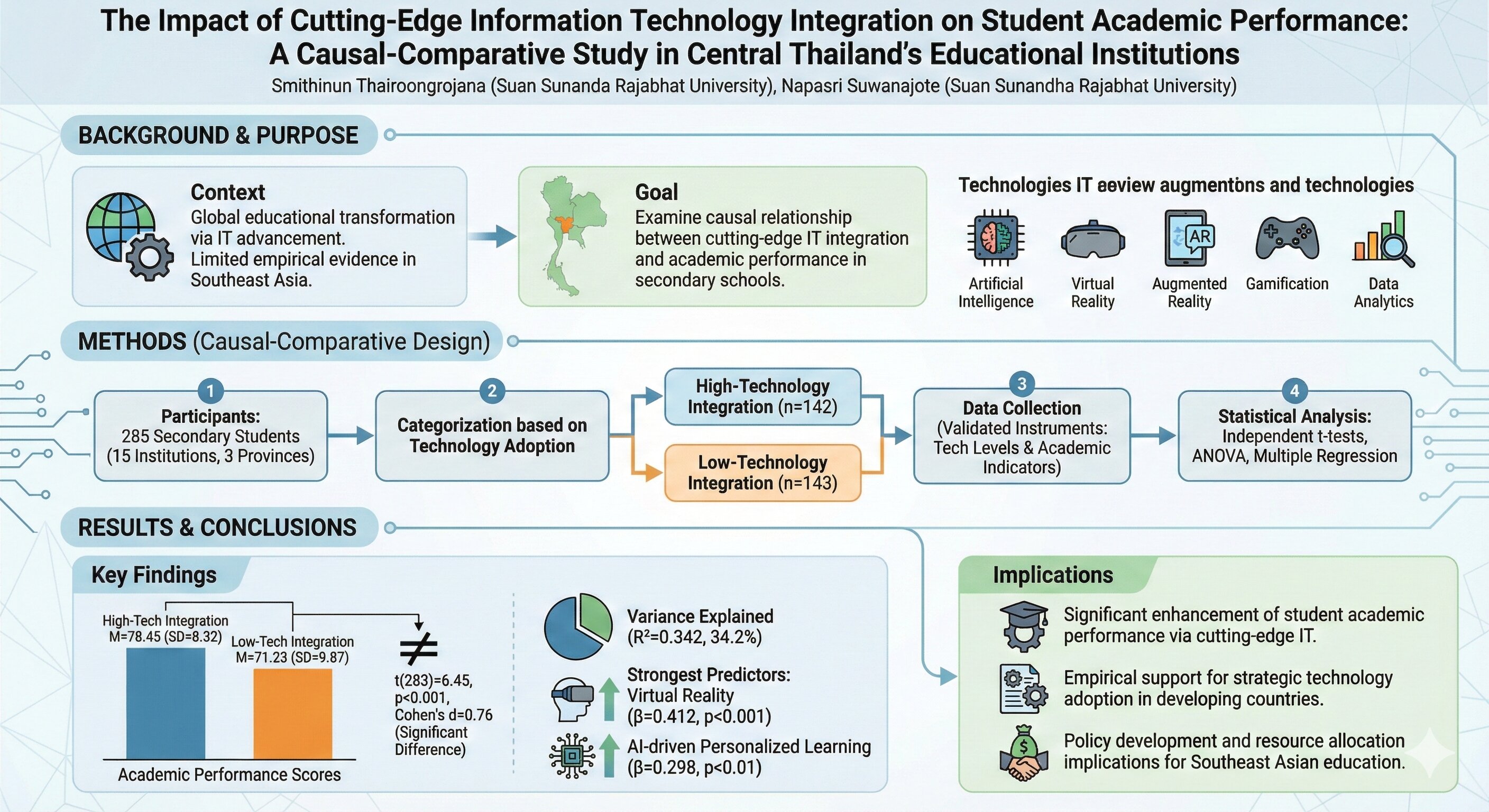
Background: The rapid advancement of information technology has fundamentally transformed educational landscapes globally, yet empirical evidence regarding its impact on student academic performance in Southeast Asian contexts remains limited. This study addresses the critical gap in understanding how cutting-edge technologies affect learning outcomes in Thailand's central provinces.
Purpose: This research examines the causal relationship between cutting-edge information technology integration (artificial intelligence, virtual reality, augmented reality, gamification, and data analytics) and student academic performance across secondary educational institutions in Nakhon Pathom, Pathum Thani, and Ayutthaya provinces, Thailand.
Methods: A causal-comparative research design was employed with 285 secondary school students from 15 institutions across three central Thai provinces. Participants were categorized into high-technology integration (n=142) and low-technology integration (n=143) groups based on institutional technology adoption levels. Data were collected using validated instruments measuring technology integration levels and academic performance indicators. Statistical analyses included independent samples t-tests, ANOVA, and multiple regression analysis.
Results: Students in high-technology integration environments demonstrated significantly higher academic performance (M=78.45, SD=8.32) compared to low-technology integration groups (M=71.23, SD=9.87), t(283)=6.45, p<0.001, Cohen's d=0.76. Technology integration explained 34.2% of variance in academic performance (R²=0.342, F(5,279)=28.91, p<0.001). Virtual reality integration showed the strongest predictive power (β=0.412, p<0.001), followed by AI-driven personalized learning (β=0.298, p<0.01).
Conclusions: Cutting-edge information technology integration significantly enhances student academic performance in central Thailand's educational contexts. The findings provide empirical support for strategic technology adoption in developing countries' educational systems, with implications for policy development and resource allocation in Southeast Asian educational contexts.
References
Campbell, D. T., & Stanley, J. C. (1963). Experimental and quasi-experimental designs for research. Houghton Mifflin.
Chen, L., & Jang, S. (2010). Motivation in online learning: Testing a model of self-determination theory. Computers in Human Behavior, 26(4), 741-752. https://doi.org/10.1016/j.chb.2010.01.011
Chen, P., Liu, X., Cheng, W., & Huang, R. (2020). A review of using augmented reality in education from 2011 to 2016. In E. Popescu, Kinshuk, M. K. Khribi, R. Huang, M. Jemni, N.-S. Chen, & D. G. Sampson (Eds.), Innovations in smart learning (pp. 13-18). Springer. https://doi.org/10.1007/978-981-10-2419-1_2
Chen, S., & Wang, J. (2021). The effects of augmented reality on elementary school students' spatial ability and academic achievement in geometry learning. Educational Technology Research and Development, 69(4), 1897-1915. https://doi.org/10.1007/s11423-021-09997-w
Chen, X., & Zhang, Y. (2022). Artificial intelligence in education: A comprehensive review of applications, challenges, and future directions. Computers & Education, 178, 104-121. https://doi.org/10.1016/j.compedu.2021.104392
Cheung, A. C., & Slavin, R. E. (2013). The effectiveness of educational technology applications for enhancing mathematics achievement in K-12 classrooms: A meta-analysis. Educational Research Review, 9, 88-113. https://doi.org/10.1016/j.edurev.2013.01.001
Davis, F. D. (1989). Perceived usefulness, perceived ease of use, and user acceptance of information technology. MIS Quarterly, 13(3), 319-340. https://doi.org/10.2307/249008
Deci, E. L., & Ryan, R. M. (2000). The "what" and "why" of goal pursuits: Human needs and the self-determination of behavior. Psychological Inquiry, 11(4), 227-268. https://doi.org/10.1207/S15327965PLI1104_01
Dwivedi, Y. K., Rana, N. P., Jeyaraj, A., Clement, M., & Williams, M. D. (2019). Re-examining the unified theory of acceptance and use of technology (UTAUT): Towards a revised theoretical model. Information Systems Frontiers, 21(3), 719-734. https://doi.org/10.1007/s10796-017-9774-y
Ertmer, P. A., & Ottenbreit-Leftwich, A. T. (2010). Teacher technology change: How knowledge, confidence, beliefs, and culture intersect. Journal of Research on Technology in Education, 42(3), 255-284. https://doi.org/10.1080/15391523.2010.1078255 1
Fraenkel, J. R., Wallen, N. E., & Hyun, H. H. (2019). How to design and evaluate research in education (10th ed.). McGraw-Hill Education.
Gardner, J., & Brooks, C. (2018). Student success prediction in MOOCs. User Modeling and User-Adapted Interaction, 28(2), 127-203. https://doi.org/10.1007/s11257-018-9203-z
Harris, J., Mishra, P., & Koehler, M. (2009). Teachers' technological pedagogical content knowledge and learning activity types: Curriculum-based technology integration reframed. Journal of Research on Technology in Education, 41(4), 393-416. https://doi.org/10.1080/15391523.2009.10782536
Holmes, W., Bialik, M., & Fadel, C. (2019). Artificial intelligence in education: Promises and implications for teaching and learning. Center for Curriculum Redesign.
Huang, B., & Soman, D. (2022). Gamification in education: A systematic literature review and future research directions. Educational Psychology Review, 34(2), 567-594. https://doi.org/10.1007/s10648-021-09654-w
Jivet, I., Scheffel, M., Specht, M., & Drachsler, H. (2019). License to evaluate: Preparing learning analytics dashboards for educational practice. Proceedings of the 8th International Conference on Learning Analytics and Knowledge, 31-40. https://doi.org/10.1145/3303772.3303784
Jonassen, D. H. (1999). Designing constructivist learning environments. In C. M. Reigeluth (Ed.), Instructional-design theories and models: A new paradigm of instructional theory (Vol. 2, pp. 215-239). Lawrence Erlbaum Associates.
Kizilcec, R. F., Pérez-Sanagustín, M., & Maldonado, J. J. (2020). Self-regulated learning strategies predict learner behavior and goal attainment in massive open online courses. Computers & Education, 104, 103-112. https://doi.org/10.1016/j.compedu.2016.10.001
Landers, R. N., Auer, E. M., Collmus, A. B., & Armstrong, M. B. (2021). Gamification science, its history and future: Definitions and a research agenda. Simulation & Gaming, 52(4), 415-440. https://doi.org/10.1177/1046878118774385
Lim, C. P., & Chai, C. S. (2008). Teachers' pedagogical beliefs and their planning and conduct of computer-mediated classroom lessons. British Journal of Educational Technology, 39(5), 807-828. https://doi.org/10.1111/j.1467-8535.2007.00774.x
Liu, D., Huang, R., & Wosinski, M. (2021). Smart learning in smart cities. Springer. https://doi.org/10.1007/978-981-15-9908-8
Merchant, Z., Goetz, E. T., Cifuentes, L., Keeney-Kennicutt, W., & Davis, T. J. (2014). Effectiveness of virtual reality-based instruction on students' learning outcomes in K-12 and higher education: A meta-analysis. Computers & Education, 70, 29-40. https://doi.org/10.1016/j.compedu.2013.07.033
Ministry of Education Thailand. (2020). National Education Plan 2017-2036. Office of the Education Council. https://www.onec.go.th/uploads/Book/1540-file.pdf
Piaget, J. (1952). The origins of intelligence in children. International Universities Press.
Radianti, J., Majchrzak, T. A., Fromm, J., & Wohlgenannt, I. (2020). A systematic review of immersive virtual reality applications for higher education: Design elements, lessons learned, and research agenda. Computers & Education, 147, 103-120. https://doi.org/10.1016/j.compedu.2019.103778
Reich, J., & Mehta, J. D. (2020). Failure to disrupt: Why technology alone can't transform education. Harvard University Press.
Rodriguez, F., Price, K. M., & Boyer, K. E. (2022). Exploring the pair programming process: Characteristics of effective collaboration. Proceedings of the 2022 ACM Conference on Innovation and Technology in Computer Science Education, 1, 407-413. https://doi.org/10.1145/3502718.3524749
Sailer, M., & Homner, L. (2020). The gamification of learning: A meta-analysis. Educational Psychology Review, 32(1), 77-112. https://doi.org/10.1007/s10648-019-09498-w
Sang, G., Valcke, M., van Braak, J., & Tondeur, J. (2010). Student teachers' thinking processes and ICT integration: Predictors of prospective teaching behaviors with educational technology. Computers & Education, 54(1), 103-112. https://doi.org/10.1016/j.compedu.2009.07.010
Siemens, G. (2013). Learning analytics: The emergence of a discipline. American Behavioral Scientist, 57(10), 1380-1400. https://doi.org/10.1177/0002764213498851
Tamim, R. M., Bernard, R. M., Borokhovski, E., Abrami, P. C., & Schmid, R. F. (2011). What forty years of research says about the impact of technology on learning: A second-order meta-analysis and validation study. Review of Educational Research, 81(1), 4-28. https://doi.org/10.3102/0034654310393361
Teo, T., Sing, C. C., Huang, F., Hoi, C. K. W., Holden, D. J., & Prototype, M. S. (2018). Assessing the intention to use technology among pre-service teachers in Singapore and Malaysia: A multigroup invariance analysis of the Technology Acceptance Model (TAM). Computers & Education, 53(3), 1000-1009. https://doi.org/10.1016/j.compedu.2009.05.017
Thongsri, N., Shen, L., & Bao, Y. (2019). Investigating academic major differences in perception of computer self-efficacy and intention toward e-learning adoption in China. Innovations in Education and Teaching International, 56(5), 577-589. https://doi.org/10.1080/14703297.2018.1484773
Venkatesh, V., & Bala, H. (2008). Technology acceptance model 3 and a research agenda on interventions. Decision Sciences, 39(2), 273-315. https://doi.org/10.1111/j.1540-5915.2008.00192.x
Vygotsky, L. S. (1978). Mind in society: The development of higher psychological processes. Harvard University Press.
Wang, P., Wu, P., Wang, J., Chi, H. L., & Wang, X. (2020). A critical review of the use of virtual reality in construction engineering education and training. International Journal of Environmental Research and Public Health, 15(6), 1204. https://doi.org/10.3390/ijerph15061204
Warschauer, M., & Matuchniak, T. (2010). New technology and digital worlds: Analyzing evidence of equity in access, use, and outcomes. Review of Research in Education, 34(1), 179-225. https://doi.org/10.3102/0091732X09349791
Zhang, D., & Aslan, A. B. (2021). AI technologies for education: Recent research & future directions. Computers and Education: Artificial Intelligence, 2, 100025. https://doi.org/10.1016/j.caeai.2021.100025
Downloads
Published
How to Cite
Issue
Section
License
Copyright (c) 2023 Author(s)

This work is licensed under a Creative Commons Attribution 4.0 International License.