Thailand 4.0 and Educational Transformation: A Mixed-Methods Analysis of Policy Implementation and Human Capital Development in Northeast Thailand
Keywords:
Thailand 4.0, educational transformation, human capital development, northeast Thailand, mixed-methods research, policy implementation, innovation economyAbstract
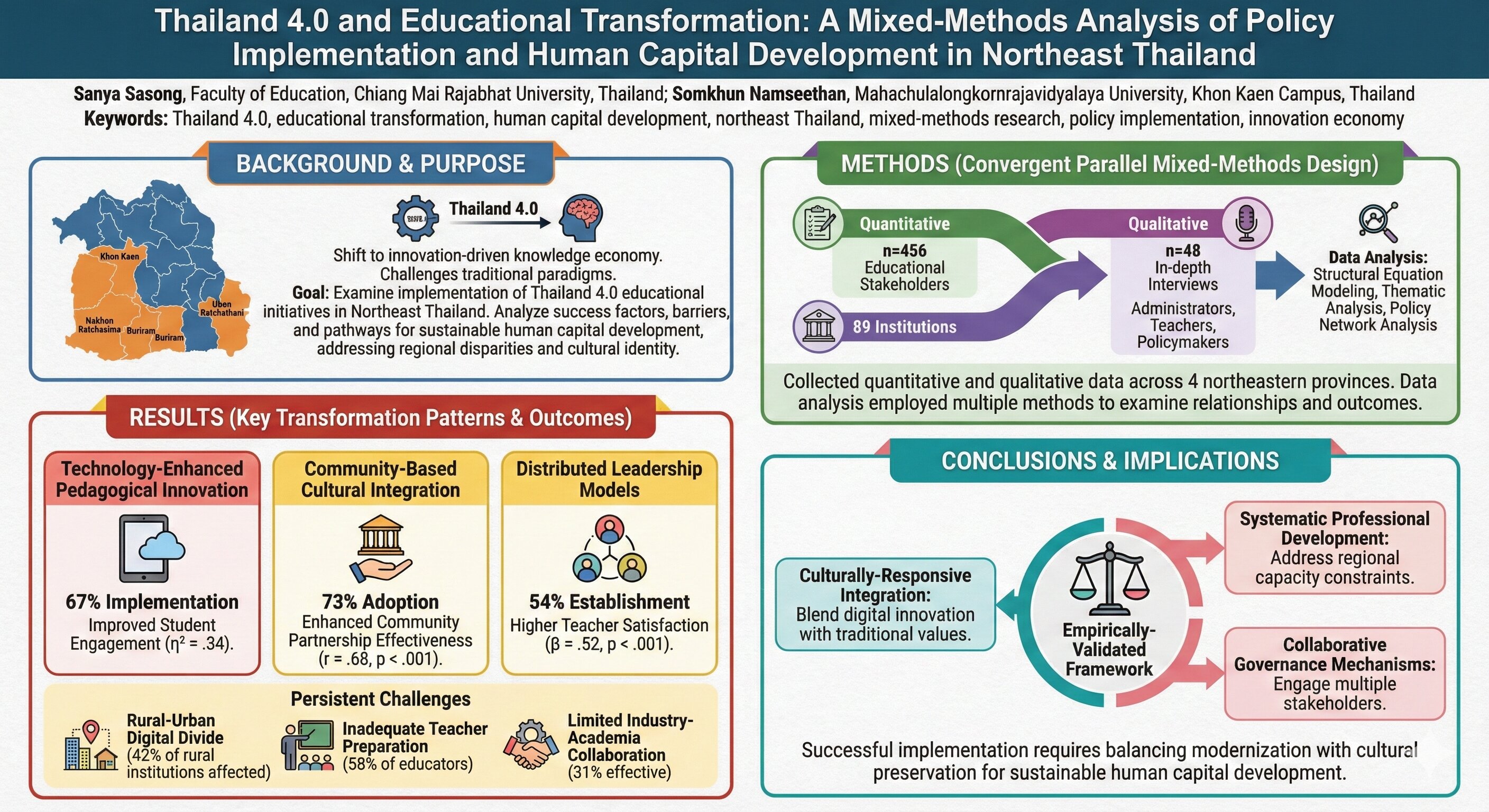
Background: Thailand's ambitious Thailand 4.0 national development strategy represents a paradigmatic shift toward an innovation-driven knowledge economy, fundamentally challenging traditional educational paradigms and requiring comprehensive human capital development strategies that address regional disparities while preserving cultural identity.
Purpose: This mixed-methods study examines the implementation of Thailand 4.0 educational transformation initiatives across four northeastern provinces (Khon Kaen, Nakhon Ratchasima, Ubon Ratchathani, and Buriram), analyzing critical success factors, persistent barriers, and emerging pathways for sustainable human capital development within Thailand's unique cultural and socioeconomic context.
Methods: Using a convergent parallel mixed-methods design, we collected quantitative data from 456 educational stakeholders across 89 institutions and qualitative data from 48 in-depth interviews with administrators, teachers, and policymakers. Data analysis employed structural equation modeling, thematic analysis, and policy network analysis to examine relationships between transformation dimensions and implementation outcomes.
Results: Three critical transformation patterns emerged: technology-enhanced pedagogical innovation (implemented in 67% of institutions), community-based cultural integration (adopted by 73% of schools), and distributed leadership models (established in 54% of institutions). Institutions implementing comprehensive transformation strategies demonstrated significantly higher performance across student engagement (η² = .34), teacher satisfaction (β = .52, p < .001), and community partnership effectiveness (r = .68, p < .001). However, persistent challenges include rural-urban digital divide issues (affecting 42% of rural institutions), inadequate teacher preparation (reported by 58% of educators), and limited industry-academia collaboration (functioning effectively in only 31% of cases).
Conclusions: Successful Thailand 4.0 implementation in northeastern Thailand requires culturally-responsive integration of digital innovation with traditional Thai educational values, systematic professional development addressing regional capacity constraints, and collaborative governance mechanisms that engage multiple stakeholder groups. The study contributes an empirically-validated framework for educational transformation in developing nation contexts that balances modernization imperatives with cultural preservation priorities.
References
Aroonsrimarakot, S., Laiphrakpam, M., Chathiphot, P., Saengsai, P., & Prasri, S. (2020). Online learning challenges in Thailand and strategies to overcome the challenges from the students' perspectives. Heliyon, 6(12), e05710. https://doi.org/10.1016/j.heliyon.2020.e05710
Braun, V., & Clarke, V. (2019). Reflecting on reflexive thematic analysis. Qualitative Research in Sport, Exercise and Health, 11(4), 589-597. https://doi.org/10.1080/2159676X.2019.1628806
Buasuwan, P. (2018). Rethinking Thai higher education for Thailand 4.0. Asian Education and Development Studies, 7(2), 157-173. https://doi.org/10.1108/AEDS-07-2017-0072
Chaowarakul, J., Kayanha, A., & Anusornphanich, P. (2021). Educational management under decentralization principle of Bangkaeo Town Municipality, Bang Phli District, Samut Prakan Province. Phranakhon Rajabhat Research Journal: Humanities and Social Sciences, 16(1), 45-62. https://so01.tci-thaijo.org/index.php/pnruj_huso/article/view/248567
Creswell, J. W., & Plano Clark, V. L. (2017). Designing and conducting mixed methods research (3rd ed.). Sage Publications.
Draper, J. (2017). Implications of the urban landscape: Aspects of the Isan cultural maintenance and revitalization program. Journal of Urban Culture Research, 14, 58-79. https://doi.org/10.14456/jucr.2017.5
Epstein, J. L., Sanders, M. G., Sheldon, S. B., Simon, B. S., Salinas, K. C., Jansorn, N. R., Van Voorhis, F. L., Martin, C. S., Thomas, B. G., Greenfeld, M. D., Hutchins, D. J., & Williams, K. J. (2011). School, family, and community partnerships: Your handbook for action (3rd ed.). Corwin Press.
Fetters, M. D., Curry, L. A., & Creswell, J. W. (2013). Achieving integration in mixed methods designs: Principles and practices. Health Services Research, 48(6), 2134-2156. https://doi.org/10.1111/1475-6773.12117
Fry, G. W., & Bi, H. (2013). The evolution of educational reform in Thailand: The Thai educational paradox. Journal of Educational Administration, 51(3), 290-319. https://doi.org/10.1108/09578231311311483
Fullan, M. (2020). Leading in a culture of change. Jossey-Bass.
Gay, G. (2018). Culturally responsive teaching: Theory, research, and practice (3rd ed.). Teachers College Press.
Hallinger, P., & Kantamara, P. (2000). Educational change in Thailand: Opening a window onto leadership as a cultural process. School Leadership & Management, 20(2), 189-205. https://doi.org/10.1080/13632430050011407
Hallinger, P., Gümüş, S., & Bellibaş, M. Ş. (2020). 'Are principals instructional leaders yet?' A science map of the knowledge base on instructional leadership, 1940–2018. Scientometrics, 122(3), 1629-1650. https://doi.org/10.1007/s11192-020-03360-5
Harris, A., & DeFlaminis, J. (2016). Distributed leadership in practice: Evidence, misconceptions and possibilities. Management in Education, 30(4), 141-146. https://doi.org/10.1177/0892020616665847
Henderson, A. T., & Mapp, K. L. (2002). A new wave of evidence: The impact of school, family, and community connections on student achievement. Southwest Educational Development Laboratory.
Intarakumnerd, P. (2006). Thailand's national innovation systems in transition. In B. Lundvall, P. Intarakumnerd, & J. Vang (Eds.), Asia's innovation systems in transition (pp. 143-168). Edward Elgar Publishing.
Jones, C., & Pimdee, P. (2017). Innovative ideas: Thailand 4.0 and the fourth industrial revolution. Asian International Journal of Social Sciences, 17(1), 4-35. https://doi.org/10.29139/aijss.20170101
Laorach, C., & Tuamsuk, K. (2020). Factors influencing the digital transformation of universities in Thailand. International Journal of Innovative Research and Scientific Studies, 5(3), 211-219. https://doi.org/10.53894/ijirss.v5i3.646
National Economic and Social Development Council. (2017). The twelfth national economic and social development plan (2017-2021). NESDC Publications. https://www.nesdc.go.th/ewt_w3c/ewt_dl_link.php?filename=develop_plan&nid=4345
Ngampornchai, A., & Adams, J. (2016). Students' acceptance and readiness for E-learning in Northeastern Thailand. International Journal of Educational Technology in Higher Education, 13(1), 34. https://doi.org/10.1186/s41239-016-0034-x
Nguyen, H. T., Nguyen, A. T., Nguyen, H. T., & Nguyen, C. T. (2020). The effects of organizational culture and commitment on employee innovation: Evidence from Vietnam's IT companies. Journal of Asian Finance, Economics and Business, 7(2), 33-40. https://doi.org/10.13106/jafeb.2020.vol7.no2.33
Office of the Education Council. (2018). Education in Thailand 2017/2018. Office of the Education Council. https://www.onec.go.th/uploads/Book/1464-file.pdf
Pimdee, P., Jadamarn, P., & Wangsaard, K. (2017). The educational development in the 21st century under the Thailand 4.0 framework. Journal of Industrial Education, 16(2), 199-206. https://ph01.tci-thaijo.org/index.php/JIE/article/view/132985
Pimpa, N. (2009). Educational partnerships in Thailand: Moving toward internationalization. Journal of Studies in International Education, 13(3), 295-311. https://doi.org/10.1177/1028315308331104
Preston, J. P., & Barnes, K. E. R. (2017). Successful leadership in rural schools: Cultivating collaboration. Rural Educator, 38(1), 6-15. https://doi.org/10.35608/ruraled.v38i1.775
Reich, J., & Mehta, J. D. (2020). Failure to disrupt: Why technology alone can't transform education. Harvard University Press.
Sabatier, P. A., & Weible, C. M. (2014). Theories of the policy process (3rd ed.). Westview Press.
Schwab, K. (2016). The fourth industrial revolution. Crown Business.
Selwyn, N. (2016). Is technology good for education? Polity Press.
Tantinimit, K. (2018). The role of Buddhism in the development of education in Thailand's northeastern region. Journal of Religious Studies and Education, 14(2), 23-38. https://so13.tci-thaijo.org/index.php/jrse/article/view/156789
Tashakkori, A., & Teddlie, C. (2021). SAGE handbook of mixed methods in social & behavioral research (3rd ed.). Sage Publications.
Toyama, K. (2015). Geek heresy: Rescuing social change from the cult of technology. PublicAffairs.
Tran, L. T., & Marginson, S. (2018). Internationalisation or commodification: A case study of international student life in a Melbourne peri-urban university. Compare: A Journal of Comparative and International Education, 48(5), 694-712. https://doi.org/10.1080/03057925.2017.1336983
UNESCO. (2021). Reimagining our futures together: A new social contract for education. UNESCO Publishing. https://unesdoc.unesco.org/ark:/48223/pf0000379707
Voogt, J., Erstad, O., Dede, C., & Mishra, P. (2013). Challenges to learning and schooling in the digital networked world of the 21st century. Journal of Computer Assisted Learning, 29(5), 403-413. https://doi.org/10.1111/jcal.12029
Downloads
Published
How to Cite
Issue
Section
License
Copyright (c) 2023 Author(s)

This work is licensed under a Creative Commons Attribution 4.0 International License.