The Evolution of Project-Based Learning: Historical Foundations, Theoretical Perspectives, and Modern Applications
Keywords:
Project-Based Learning, Constructivist Education, Experiential Learning, Digital Learning Tools, Interdisciplinary EducationAbstract
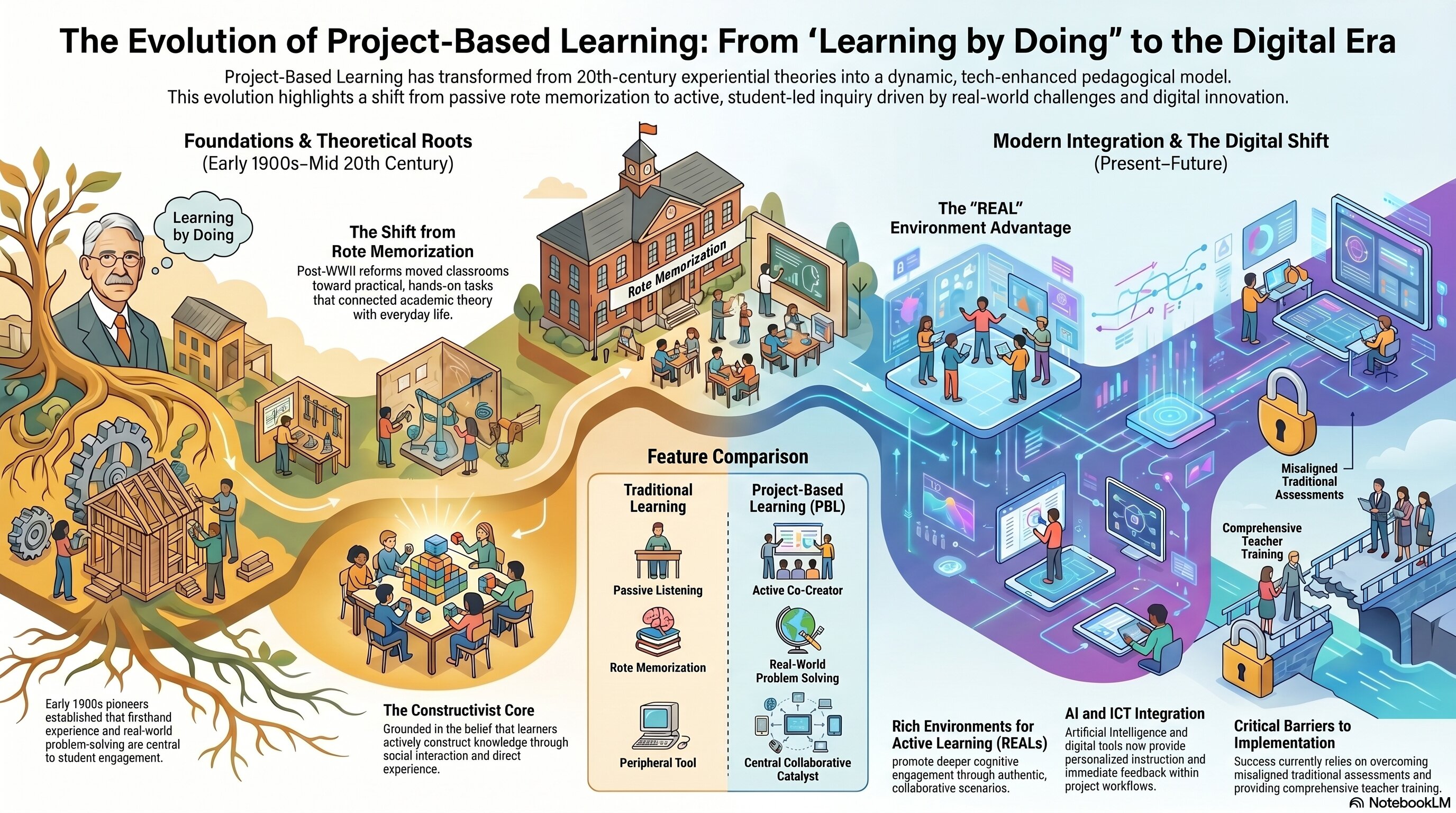
Background: Project-Based Learning (PBL) has developed over more than a century as a student-centered pedagogical approach grounded in constructivist and experiential learning theories. From John Dewey's foundational call for learning through doing to contemporary applications integrating artificial intelligence and digital learning environments, PBL has continuously evolved in response to shifting educational demands, technological advancements, and broader socio-economic forces. Despite its growing adoption across educational levels, a comprehensive account of its historical trajectory, theoretical underpinnings, and modern applications remains needed.
Purpose: This study provides an integrated historical and theoretical analysis of PBL, tracing its development from early 20th-century experiential foundations through contemporary technology-enhanced implementations, examining the theoretical frameworks that support it, identifying challenges to its effective implementation, and evaluating its application across K-12, higher education, and cross-disciplinary learning contexts.
Methods: The study employs systematic literature analysis drawing on historical review of PBL's development, theoretical examination of constructivism, social learning theory, cognitive development theory, and motivation theory, alongside comparative analysis of case studies from diverse educational settings and evaluation of technology integration including digital tools, artificial intelligence, and virtual learning environments.
Results: Findings demonstrate that PBL evolved from Dewey's experiential philosophy through Kilpatrick's project method into contemporary constructivist frameworks such as Rich Environments for Active Learning (REALs), with social constructivism and Vygotskian principles providing its strongest theoretical foundations. Technology integration - particularly AI-assisted personalized learning, IoT platforms, and computer-supported collaboration - has substantially expanded PBL's reach and effectiveness across K-12, higher education, and adult learning contexts. PBL consistently demonstrates positive outcomes for critical thinking, problem-solving, collaboration, and student motivation. However, significant barriers persist, including inadequate teacher preparation, misalignment between PBL assessment strategies and standardized evaluation systems, inequitable access to digital resources, and institutional resistance rooted in traditional curricula.
Conclusions: PBL remains a highly relevant and adaptable pedagogical model for preparing learners to navigate complex, real-world challenges. Its sustained effectiveness depends on comprehensive professional development for educators, reform of assessment practices to capture higher-order learning outcomes, and equity-centered approaches ensuring all learners have access to meaningful project experiences. Future research should address PBL's intersection with emerging technologies, cross-disciplinary and global applications, and culturally responsive implementation in underrepresented educational contexts.
References
Abel, T., Acosta-Michlik, L., Adger, W. N., Allen, K., Amundsen, H., Anguelovski, I., et al. (2014). Reconceptualising adaptation to climate change as part of pathways of change and response. Retrieved from https://core.ac.uk/download/30662975.pdf
Akyeampong, A. K. (2002). Reconceptualising teacher education in the sub-Saharan African context. Retrieved from https://core.ac.uk/download/2708300.pdf
Allahverdiyeva, A. F. (2024). Azərbaycanda müəllimlərin sertifikatlaşdırılmasının onların motivasiyasının artırılmasına təsiri. Retrieved from https://core.ac.uk/download/621474372.pdf
Aruldoss, V. (2011). Construction of early childhood and ECCD service provisioning in India. Retrieved from https://core.ac.uk/download/30608472.pdf
Asrifan, A., & Arqam. (2024). Integrating AI in project-based learning for differentiated English language instruction: A scoping review. Retrieved from https://core.ac.uk/download/616615507.pdf
Beardon, C., Kuksa, I., Marton, F., & Read, J. C. (2009). Virtual reality in theatre education and design practice—New developments and applications. Retrieved from https://core.ac.uk/download/30646920.pdf
Belknap, G., & LaBelle, J. (2017). A rationale for requiring philosophy of education in preservice teacher programs. Retrieved from https://core.ac.uk/download/213087741.pdf
Brown, M., Quay, J., & Seaman, J. O. (2017). The evolution of experiential learning: Tracing lines of research in the JEE. Retrieved from https://core.ac.uk/download/84124186.pdf
Buffalo State College. (2013). College catalog, 2013-2014, graduate. Retrieved from https://core.ac.uk/download/322568737.pdf
Caeiro, S., Galli, A., Givliotti, M., Malandrakis, et al. (2021). Guidelines for setting-up transdisciplinary sustainability courses. Retrieved from https://core.ac.uk/download/552760403.pdf
Cheers, C. (2017). Higher education curriculum ecosystem design. Retrieved from https://core.ac.uk/download/211503546.pdf
Ciobanescu Husanu, I. N., & Chiou, R. (2017). Internet of Things: Remote integrated laboratory activities in green energy manufacturing and energy management learning modules: Heat exchangers efficiency, the design perspective. Retrieved from https://www.semanticscholar.org/paper/4435d38550072e28c924bc41f4488a7bbd78b303
Clark, A. (2013). Whatever next? Predictive brains, situated agents, and the future of cognitive science. Behavioral and Brain Sciences, 36, 181–204. https://doi.org/10.1017/s0140525x12000477
Columbia College Chicago. (2022). 2022-2023 Course Catalog. Retrieved from https://core.ac.uk/download/599241543.pdf
Columbia College Chicago. (2023). 2023-2024 Course Catalog. Retrieved from https://core.ac.uk/download/599241542.pdf
Compton, A., Craft, A., Cremin, T., & Glauert, et al. (2018). Fostering inquiry and creativity in early years STEM education: Policy recommendations from the Creative Little Scientists project. Retrieved from https://core.ac.uk/download/161526377.pdf
D’Ignazio, C., & Klein, L. (2020). Data feminism. The MIT Press eBooks. https://doi.org/10.7551/mitpress/11805.001.0001
Davis, K., Ekboir, J., Mekasha, W., Ochieng, et al. (2025). Strengthening agricultural education and training in sub-Saharan Africa from an innovation systems perspective: Case studies of Ethiopia and Mozambique. Retrieved from https://core.ac.uk/download/pdf/6337674.pdf
Dunjko, V., & Briegel, H. J. (2018). Machine learning & artificial intelligence in the quantum domain: A review of recent progress. Reports on Progress in Physics, 81(7), 074001-074001. https://doi.org/10.1088/1361-6633/aab406
Dunlap, J. C., & Grabinger, R. S. (1995). Rich environments for active learning: A definition. Retrieved from https://core.ac.uk/download/7253.pdf
Dwivedi, Y. K., Hughes, L., Kar, A. K., Baabdullah, A. M., Grover, P., Abbas, R., Andreini, D., et al. (2021). Climate change and COP26: Are digital technologies and information management part of the problem or the solution? An editorial reflection and call to action. International Journal of Information Management, 63, 102456-102456. https://doi.org/10.1016/j.ijinfomgt.2021.102456
Ellsworth, M., Ellsworth, P., Hutson, J., Ntungirimana, et al. (2023). Digitizing the cultural capital: Harnessing digital humanities for heritage preservation in Bujumbura, Burundi. Retrieved from https://core.ac.uk/download/599684971.pdf
Fosbrook, B. (2018). How scenarios became corporate strategies: Alternative futures and uncertainty in strategic management. Retrieved from https://core.ac.uk/download/158457725.pdf
Gelonch Bosch, A. J., Gómez Miguelez, I., & Marojevic, V. (2017). Teaching telecommunication standards: Bridging the gap between theory and practice. Retrieved from https://core.ac.uk/download/157811069.pdf
Getz, D., & Page, S. J. (2015). Progress and prospects for event tourism research. Tourism Management, 52, 593–631. https://doi.org/10.1016/j.tourman.2015.03.007
Gidley, J. (2011). Evolution of education: From weak signals to rich imaginaries of educational futures. Retrieved from https://core.ac.uk/download/pdf/15623015.pdf
Grand Valley State University. (2022). GVSU Undergraduate and Graduate Catalog, 2022-2023. Retrieved from https://core.ac.uk/download/621105915.pdf
Gretzel, U., Fuchs, M., Baggio, R., Höepken, W., Law, R., Neidhardt, J., Pesonen, J., et al. (2020). e-Tourism beyond COVID-19: A call for transformative research. Information Technology & Tourism, 22, 187-203. https://doi.org/10.1007/s40558-020-00181-3
Griffiths, T., & Guile, D. (2001). Learning through work experience. Retrieved from https://core.ac.uk/download/pdf/83205.pdf
Handbook of research on educational communications and technology. (2013). Routledge eBooks. https://doi.org/10.4324/9781410609519
Hanney, R. (2018). Doing, being, becoming: A historical appraisal of the modalities of project-based learning. Retrieved from https://core.ac.uk/download/161933618.pdf
Hickey, A. (2009). When the street becomes a pedagogue. Retrieved from https://core.ac.uk/download/11040020.pdf
Horvath, K. Z., Kou, X., Mohseni, A., Osili, U., et al. (2019). An annotated bibliography of recent literature on current developments in philanthropy. Retrieved from https://core.ac.uk/download/227054275.pdf
Huang, T. (2023). Methods and means of developing academic talent of students in universities of the PRC. Professional Education: Methodology, Theory and Technologies. Retrieved from https://www.semanticscholar.org/paper/57c5ceb63a0b144934fc77dcf3d476c593c8c242
Hubert, B., Ison, R. L., Jiggins, J., & Roggero, et al. (2004). The SLIM (Social learning for the integrated management and sustainable use of water at catchment scale) final report. Retrieved from https://core.ac.uk/download/248441.pdf
Hunaepi, H., & Suharta, I. G. P. (2024). Transforming education in Indonesia: The impact and challenges of the Merdeka Belajar Curriculum. Retrieved from https://core.ac.uk/download/613996511.pdf
Isah, H., Leung, T., & Zulkernine, F. (2018). The use of virtual reality in enhancing interdisciplinary research and education. Retrieved from https://core.ac.uk/download/615461029.pdf
Jessup-Anger, J. E. (2015). Theoretical foundations of learning communities. Retrieved from https://core.ac.uk/download/213078876.pdf
Jones, A., & Moreland, J. (2001). The enhancement of technology education classroom practice in New Zealand. Retrieved from https://core.ac.uk/download/29200798.pdf
Ndlovu‐Gatsheni, S. J. (2018). Epistemic freedom in Africa. Routledge eBooks. https://doi.org/10.4324/9780429492204
Northeastern Illinois University. (2022). Northeastern Illinois University, academic catalog 2022-2023. Retrieved from https://core.ac.uk/download/588298146.pdf
Oreshchuk, H. (2023). Методика та паттерн комунікації сервісів в хмарних системах. Retrieved from https://core.ac.uk/download/603960164.pdf
Osman, M. (2015). Consciousness complexity. Retrieved from https://core.ac.uk/download/30698083.pdf
Rodríguez, J. C. (2006). Weaving technology in the design of learning experiences in world language teacher education: The development of a cognitive tool, an instructional device, and an exploration. Retrieved from https://core.ac.uk/download/38897812.pdf
Salmi, A., & Scott-Kennel, J. (2012). Just another BRIC in the wall? The rise of BRICs and educating tomorrow's global managers. Retrieved from https://core.ac.uk/download/29200651.pdf
Santos, R. P. dos, & Villan, F. (2023). ChatGPT as co-advisor in scientific initiation: Action research with project-based learning in elementary education. Retrieved from https://core.ac.uk/download/599446620.pdf
Schot, J., & Steinmueller, W. E. (2018). Three frames for innovation policy: R&D, systems of innovation and transformative change. Research Policy, 47(8), 1554-1567. https://doi.org/10.1016/j.respol.2018.08.011
Seaman, J. O. (2008). Experience, reflect, critique: The end of the "learning cycles" era. Retrieved from https://core.ac.uk/download/84124190.pdf
Stepanechko, O. (2022). Modern and traditional teaching methods of English from the perspective of own teacher’s experience. Naukovì zapiski Nacìonalʹnogo unìversitetu «Ostrozʹka akademìâ». Serìâ «Fìlologìâ». Retrieved from https://www.semanticscholar.org/paper/50b1e57830d769d9af761be243910b2ebaca4adc
Teece, D. J. (2014). A dynamic capabilities-based entrepreneurial theory of the multinational enterprise. Journal of International Business Studies, 45, 8–37. https://doi.org/10.1057/jibs.2013.54
University of Missouri-St. Louis. (2015). UMSL Bulletin 2015-2016. Retrieved from https://core.ac.uk/download/217317534.pdf
University of Missouri-St. Louis. (2020). UMSL Bulletin 2020-2021. Retrieved from https://core.ac.uk/download/346534267.pdf
University of Sydney, Education. (2002). Education handbook. Retrieved from https://core.ac.uk/download/41230289.pdf
Valparaiso University. (1992). Graduate catalog, 1992-1993. Retrieved from https://core.ac.uk/download/144553217.pdf
Valparaiso University. (2002). Graduate catalog, 2002-2003. Retrieved from https://core.ac.uk/download/144553210.pdf
Valparaiso University. (2003). Graduate catalog, 2003-2004. Retrieved from https://core.ac.uk/download/144553304.pdf
Valparaiso University. (2004). Graduate catalog, 2004-2005. Retrieved from https://core.ac.uk/download/144553209.pdf
Valparaiso University. (2005). Graduate catalog, 2005-2006. Retrieved from https://core.ac.uk/download/144553208.pdf
Western Oregon University. (2018). Western Oregon University 2018-2019 course catalog. Retrieved from https://core.ac.uk/download/228829820.pdf
Western Oregon University. (2019). Western Oregon University 2019-2020 course catalog. Retrieved from https://core.ac.uk/download/228832830.pdf
Wieczorek, A. J., Hekkert, M. P., & Smits, R. E. H. M. (2025). Contemporary innovation policy and instruments: Challenges and implications. Retrieved from https://core.ac.uk/download/pdf/6601738.pdf
Yousefpour, A., Fung, C., Nguyen, T. N., Kadiyala, K., Jalali, F., Niakanlahiji, A., Kong, J., et al. (2019). All one needs to know about fog computing and related edge computing paradigms: A complete survey. Journal of Systems Architecture, 98, 289–330. https://doi.org/10.1016/j.sysarc.2019.02.009
Zamfir, G. (2025). Theoretical and factual meaning in assisted instruction. Retrieved from https://core.ac.uk/download/pdf/6673278.pdf
Published
How to Cite
Issue
Section
License
Copyright (c) 2025 Insights into Modern Education (i-ME)

This work is licensed under a Creative Commons Attribution 4.0 International License.