The Mechanism and Coupling Measurement of Intelligent Digital Technology Empowering the Green and Low-Carbon Transition of the Energy Industry
Keywords:
Intelligent Digital Technology; Green Energy Transition; Coupling Coordination Degree; Dual Carbon Targets; Green Total Factor ProductivityAbstract
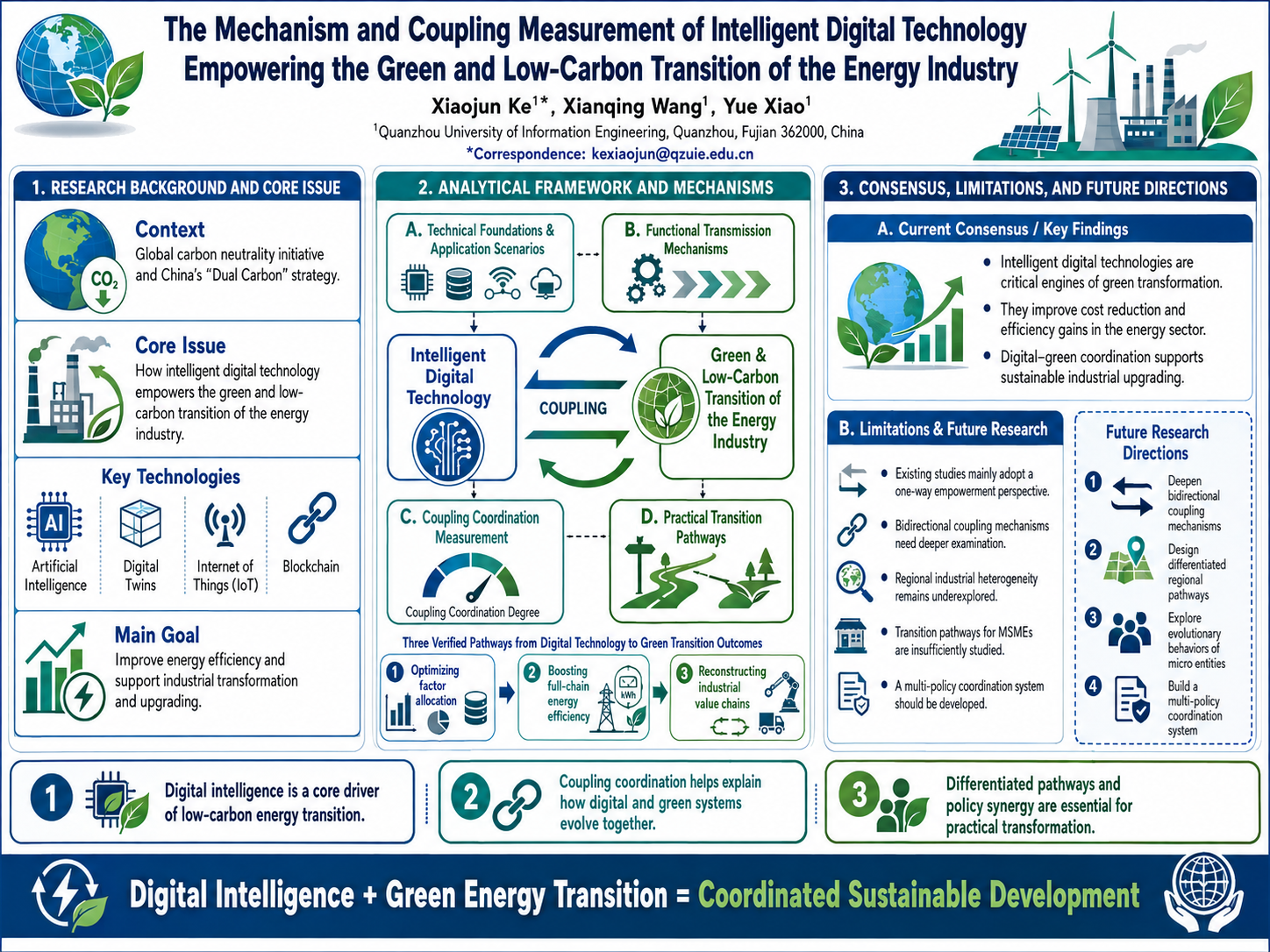
Against the backdrop of the global carbon neutrality initiative and China’s “Dual Carbon” strategy, the green and low-carbon transition of the energy industry serves as the core lever for realizing sustainable economic and social development. Intelligent digital technologies represented by artificial intelligence, digital twins, the Internet of Things (IoT), and blockchain have become critical engines driving improvements in energy efficiency and industrial transformation and upgrading. This paper systematically reviews core research outcomes over the past decade worldwide regarding intelligent digital technologies and green energy transition, and constructs an analytical framework spanning four dimensions: technical foundations and application scenarios, functional transmission mechanisms, coupling coordination measurement, and practical transition pathways. It comprehensively interprets the internal logic and research progress of intelligent digital technologies enabling the green transition of the energy industry. The study finds that existing literature has verified three pathways through which intelligent digital technologies advance cost reduction and efficiency gains in the energy sector: optimizing factor allocation, boosting full-chain energy efficiency, and reconstructing industrial value chains. Nevertheless, prevailing research is dominated by a unidirectional empowerment perspective, lacks thorough elaboration on bidirectional coupling mechanisms, insufficiently explores regional industrial heterogeneity, and neglects transition pathways for micro, small, and medium-sized enterprises (MSMEs). Accordingly, this paper further discusses consensus and limitations within current scholarship, and proposes future research directions covering four dimensions: deepening bidirectional coupling mechanisms, designing differentiated regional pathways, exploring the evolutionary behaviors of micro entities, and building a multi-policy coordination system. It provides systematic references for theoretical research and practical advancement of the coordinated digital and green development of the energy industry.
References
Ahl, A., Goto, M., Yarime, M., Tanaka, K., & Sagawa, D. (2022). Challenges and opportunities of blockchain energy applications: Interrelatedness among technological, economic, social, environmental, and institutional dimensions. Renewable and Sustainable Energy Reviews, 166, 112623.https://doi.org/10.1016/j.rser.2022.112623
Ahl, A., Yarime, M., Tanaka, K., & Sagawa, D. (2019). Review of blockchain-based distributed energy: Implications for institutional development. Renewable and Sustainable Energy Reviews, 107, 200–211. https://doi.org/10.1016/j.rser.2019.03.002
Ahmed, S., Ali, A., & D’Angola, A. (2024). A review of renewable energy communities: concepts, scope, progress, challenges, and recommendations. Sustainability, 16(5), 1749. https://doi.org/10.3390/su16051749
Aldoseri, A., Al-Khalifa, K. N., & Hamouda, A. M. (2024). AI-powered innovation in digital transformation: Key pillars and industry impact. Sustainability, 16(5), 1790. https://doi.org/10.3390/su16051790
Alotaibi, I., Abido, M. A., Khalid, M., & Savkin, A. V. (2020). A comprehensive review of recent advances in smart grids: A sustainable future with renewable energy resources. Energies, 13(23), 6269. https://doi.org/10.3390/en13236269
Amici, J., Asinari, P., Ayerbe, E., Barboux, P., Bayle‐Guillemaud, P., Behm, R. J., … & Edström, K. (2022). A roadmap for transforming research to invent the batteries of the future designed within the European large scale research initiative BATTERY 2030+. Advanced Energy Materials, 12(17), 2102785.https://doi.org/10.1002/aenm.202102785
Bibri, S. E., & Krogstie, J. (2020). Environmentally data-driven smart sustainable cities: Applied innovative solutions for energy efficiency, pollution reduction, and urban metabolism. Energy Informatics, 3(1), 29. https://doi.org/10.1186/s42162-020-00130-8
Blaabjerg, F., Yang, Y., Kim, K. A., & Rodriguez, J. (2023). Power electronics technology for large-scale renewable energy generation. Proceedings of the IEEE, 111(4), 335–355. https://doi.org/10.1109/JPROC.2023.3253165
Brauns, J., & Turek, T. (2020). Alkaline water electrolysis powered by renewable energy: A review. Processes, 8(2), 248. https://doi.org/10.3390/pr8020248
Breyer, C., Khalili, S., Bogdanov, D., Ram, M., Oyewo, A. S., Aghahosseini, A., … & Sovacool, B. K. (2022). On the history and future of 100% renewable energy systems research. IEEE Access, 10, 78176–78218. https://doi.org/10.1109/ACCESS.2022.3193391
Caineng, Z., Feng, M., Songqi, P., Minjie, L., Ying, W., & Zhi, Y. (2022). Earth energy evolution, human development and carbon neutral strategy. Petroleum Exploration and Development, 49(2), 468–488. https://doi.org/10.1016/S1876-3804(22)60040-5
Casini, M. (2018). Active dynamic windows for buildings: A review. Renewable Energy, 119, 923–934.https://doi.org/10.1016/j.renene.2017.12.021
Chen, C., Hu, Y., Karuppiah, M., & Kumar, P. M. (2021). Artificial intelligence on economic evaluation of energy efficiency and renewable energy technologies. Sustainable Energy Technologies and Assessments, 47, 101358. https://doi.org/10.1016/j.seta.2021.101358
Chen, Y., Visnjic, I., Parida, V., & Zhang, Z. (2021). On the road to digital servitization–The (dis) continuous interplay between business model and digital technology. International Journal of Operations & Production Management, 41(5), 694–722. https://doi.org/10.1108/IJOPM-08-2020-0544
Chu, S., Cui, Y., & Liu, N. (2017). The path towards sustainable energy. Nature Materials, 16(1), 16–22. https://doi.org/10.1038/nmat4834
Dong, T., Yin, S., & Zhang, N. (2023). The interaction mechanism and dynamic evolution of digital green innovation in the integrated green building supply chain. Systems, 11(3), 122. https://doi.org/10.3390/systems11030122
Dou, S., Tao, L., Wang, R., El Hankari, S., Chen, R., & Wang, S. (2018). Plasma‐assisted synthesis and surface modification of electrode materials for renewable energy. Advanced Materials, 30(21), 1705850. https://doi.org/10.1002/adma.201705850
Etim, U. J., Song, Y., & Zhong, Z. (2020). Improving the Cu/ZnO-based catalysts for carbon dioxide hydrogenation to methanol, and the use of methanol as a renewable energy storage media. Frontiers in Energy Research, 8, 545431. https://doi.org/10.3389/fenrg.2020.545431
Fan, Z., Yan, Z., & Wen, S. (2023). Deep learning and artificial intelligence in sustainability: a review of SDGs, renewable energy, and environmental health. Sustainability, 15(18), 13493. https://doi.org/10.3390/su151813493
Feng, H., Wang, F., Song, G., & Liu, L. (2022). Digital transformation on enterprise green innovation: Effect and transmission mechanism. International Journal of Environmental Research and Public Health, 19(17), 10614. https://doi.org/10.3390/ijerph191710614
Fridgen, G., Keller, R., Körner, M. F., & Schöpf, M. (2020). A holistic view on sector coupling. Energy Policy, 147, 111913. https://doi.org/10.1016/j.enpol.2020.111913
Gao, X., Chen, Y., Wang, Y., Zhao, L., Zhao, X., Du, J., … & Chen, A. (2024). Next-generation green hydrogen: progress and perspective from electricity, catalyst to electrolyte in electrocatalytic water splitting. Nano-Micro Letters, 16(1), 237. https://doi.org/10.1007/s40820-024-01424-2
Gao, Z., Hua, M., Jia, Z., Li, L., & Hao, Y. (2025). Intelligent Pathway: Artificial Intelligence and the Path to Energy Sustainability. Growth and Change, 56(4), e70050. https://doi.org/10.1111/grow.70050
Gielen, D., Boshell, F., Saygin, D., Bazilian, M. D., Wagner, N., & Gorini, R. (2019). The role of renewable energy in the global energy transformation. Energy Strategy Reviews, 24, 38–50. https://doi.org/10.1016/j.esr.2019.01.006
Gong, L., Zhang, D., Lin, C. Y., Zhu, Y., Shen, Y., Zhang, J., … & Xia, Z. (2019). Catalytic mechanisms and design principles for single‐atom catalysts in highly efficient CO₂ conversion. Advanced Energy Materials, 9(44), 1902625. https://doi.org/10.1002/aenm.201902625
Hamdan, A., Ibekwe, K. I., Ilojianya, V. I., Sonko, S., & Etukudoh, E. A. (2024). AI in renewable energy: A review of predictive maintenance and energy optimization. International Journal of Science and Research Archive, 11(1), 718–729. https://doi.org/10.30574/ijsra.2024.11.1.0278
Hao, X., Wang, X., Wu, H., & Hao, Y. (2023). Path to sustainable development: Does digital economy matter in manufacturing green total factor productivity? Sustainable Development, 31(1), 360–378. https://doi.org/10.1002/sd.2405
Heffron, R., Körner, M. F., Wagner, J., Weibelzahl, M., & Fridgen, G. (2020). Industrial demand-side flexibility: A key element of a just energy transition and industrial development. Applied Energy, 269, 115026. https://doi.org/10.1016/j.apenergy.2020.115026
Hou, R., Li, S., Chen, H., Ren, G., Gao, W., & Liu, L. (2021). Coupling mechanism and development prospect of innovative ecosystem of clean energy in smart agriculture based on blockchain. Journal of Cleaner Production, 319, 128466. https://doi.org/10.1016/j.jclepro.2021.128466
Huang, A. Q. (2019). Power semiconductor devices for smart grid and renewable energy systems. Power electronics in renewable energy systems and smart grid: Technology and applications, 85-152. https://doi.org/10.1002/9781119515661.ch2
Inderwildi, O., Zhang, C., Wang, X., & Kraft, M. (2020). The impact of intelligent cyber-physical systems on the decarbonization of energy. Energy & Environmental Science, 13(3), 744–771. https://doi.org/10.1039/c9ee01919g
Jing, P., Li, S., & Wang, M. (2025). Digital empowerment, industry chain integration and corporate energy efficiency. Energy Economics, 145, 108446. https://doi.org/10.1016/j.eneco.2025.108446
Kabeyi, M. J. B., & Olanrewaju, O. A. (2023). Smart grid technologies and application in the sustainable energy transition: a review. International Journal of Sustainable Energy, 42(1), 685–758. https://doi.org/10.1080/14786451.2023.2222298
Kiasari, M., Ghaffari, M., & Aly, H. H. (2024). A comprehensive review of the current status of smart grid technologies for renewable energies integration and future trends: The role of machine learning and energy storage systems. Energies, 17(16), 4128. https://doi.org/10.3390/en17164128
Khan, K., Su, C. W., Rehman, A. U., & Ullah, R. (2022). Is technological innovation a driver of renewable energy? Technology in Society, 70, 102044. https://doi.org/10.1016/j.techsoc.2022.102044
Khan, K., Tareen, A. K., Aslam, M., Zhang, Y., Wang, R., Ouyang, Z., … & Zhang, H. (2019). Recent advances in two-dimensional materials and their nanocomposites in sustainable energy conversion applications. Nanoscale, 11(45), 21622–21678. https://doi.org/10.1039/c9nr05916d
Kober, T., Schiffer, H. W., Densing, M., & Panos, E. (2020). Global energy perspectives to 2060–WEC's World Energy Scenarios 2019. Energy Strategy Reviews, 31, 100523. https://doi.org/10.1016/j.esr.2020.100523
Lezama, F., Soares, J., Hernandez-Leal, P., Kaisers, M., Pinto, T., & Vale, Z. (2018). Local energy markets: Paving the path toward fully transactive energy systems. IEEE Transactions on Power Systems, 34(5), 4081–4088. https://doi.org/10.1109/TPWRS.2018.2833959
Li, H., Yang, Z., Jin, C., & Wang, J. (2023). How an industrial internet platform empowers the digital transformation of SMEs: theoretical mechanism and business model. Journal of Knowledge Management, 27(1), 105–120. https://doi.org/10.1108/JKM-04-2022-0325
Li, L., Li, X., Sun, Y., & Xie, Y. (2022). Rational design of electrocatalytic carbon dioxide reduction for a zero-carbon network. Chemical Society Reviews, 51(4), 1234–1252. https://doi.org/10.1039/d1cs00893e
Li, X., Cao, J., Liu, Z., & Luo, X. (2020). Sustainable business model based on digital twin platform network: The inspiration from Haier’s case study in China. Sustainability, 12(3), 936. https://doi.org/10.3390/su12030936
Li, X., Liu, F., & Ren, X. (2023). Firms' digitalization in manufacturing and the structure and direction of green innovation. Journal of Environmental Management, 335, 117525. https://doi.org/10.1016/j.jenvman.2023.117525
Li, Z., Zhang, W., Zhang, R., & Sun, H. (2020). Development of renewable energy multi-energy complementary hydrogen energy system (A Case Study in China): A review. Energy Exploration & Exploitation, 38(6), 2099–2127. https://doi.org/10.1177/0144598720953512
Lin, L., Sherrell, P., Liu, Y., Lei, W., Zhang, S., Zhang, H., & Chen, J. (2020). Engineered 2D transition metal dichalcogenides—a vision of viable hydrogen evolution reaction catalysis. Advanced Energy Materials, 10(16), 1903870.https://doi.org/10.1002/aenm.201903870
Litvinenko, V. S. (2020). Digital economy as a factor in the technological development of the mineral sector. Natural Resources Research, 29(3), 1521–1541. https://doi.org/10.1007/s11053-019-09568-4
Liu, M., Xu, X., Chu, H., Huang, S., & Li, W. (2023). Research on the pathway of digital technology to drive China’s energy sector to achieve its carbon neutrality goal. Environmental Science and Pollution Research, 30(58), 122663–122676. https://doi.org/10.1007/s11356-023-30408-9
Liu, J., Zhang, P., & Wang, X. (2025). Exploring the mechanisms and pathways through which the digital transformation of manufacturing enterprises enhances green and low-carbon performance under the “Dual Carbon” goals. Sustainability, 17(3), 1162. https://doi.org/10.3390/su17031162
Liu, T., & Yao, Z. (2026). The impact of digital-intelligent policy synergy on corporate green transformation: A perspective based on new-quality productive forces. Journal of Cleaner Production, 538, 147205. https://doi.org/10.1016/j.jclepro.2025.147205
Liu, X., Liu, Y., Liu, J., Xiang, Y., & Yuan, X. (2019). Optimal planning of AC-DC hybrid transmission and distributed energy resource system: Review and prospects. CSEE Journal of Power and Energy Systems, 5(3), 409.https://doi.org/10.17775/CSEEJPES.2019.00540
Liu, Y., & He, Z. (2024). Synergistic industrial agglomeration, new quality productive forces and high-quality development of the manufacturing industry. International Review of Economics & Finance, 94, 103373.https://doi.org/10.1016/j.iref.2024.103373
Liu, Y., Shen, L., & Ullah, F. (2025). Linking manufacturing smart transformation to regional economic development in China: The Crucial mediation of regional innovation capacity. Systems, 13(5), 389. https://doi.org/10.3390/systems13050389
Lu, Y., Khan, Z. A., Alvarez-Alvarado, M. S., Zhang, Y., Huang, Z., & Imran, M. (2020). A critical review of sustainable energy policies for the promotion of renewable energy sources. Sustainability, 12(12), 5078. https://doi.org/10.3390/su12125078
Lv, Y. (2023). Transitioning to sustainable energy: opportunities, challenges, and the potential of blockchain technology. Frontiers in Energy Research, 11, 1258044. https://doi.org/10.3389/fenrg.2023.1258044
Ma, J., Li, Y., Grundish, N. S., Goodenough, J. B., Chen, Y., Guo, L., … & Wan, L. J. (2021). The 2021 battery technology roadmap. Journal of Physics D: Applied Physics, 54(18), 183001. https://doi.org/10.1088/1361-6463/abd353
Metallidou, C. K., Psannis, K. E., & Egyptiadou, E. A. (2020). Energy efficiency in smart buildings: IoT approaches. IEEE Access, 8, 63679–63699. https://doi.org/10.1109/ACCESS.2020.2984461
Mishra, P., & Singh, G. (2023). Energy management systems in sustainable smart cities based on the internet of energy: A technical review. Energies, 16(19), 6903. https://doi.org/10.3390/en16196903
Ning, J., Li, X., & Gao, Y. (2025). Dynamic analysis and influence mechanism of digital technology diffusion in the energy industry based on the evolutionary game model of complex networks. Energy & Environment, 36(7), 3355–3375. https://doi.org/10.1177/0958305X231217653
Njema, G. G., Ouma, R. B. O., & Kibet, J. K. (2024). A review on the recent advances in battery development and energy storage technologies. Journal of Renewable Energy, 2024, 2329261.https://doi.org/10.1155/2024/2329261
Ourahou, M., Ayrir, W., Hassouni, B. E., & Haddi, A. (2020). Review on smart grid control and reliability in presence of renewable energies: Challenges and prospects. Mathematics and Computers in Simulation, 167, 19–31. https://doi.org/10.1016/j.matcom.2019.07.013
Pang, M., Gao, W., Xia, Y., & Cao, S. (2025). Exploring Pathways for Digital Technologies to Advance Sichuan Province's Modern Energy System Towards Achieving Dual Carbon Goals. Frontiers in Economics and Management, 6(12), 121–133. https://doi.org/10.6981/FEM.202512_6(12).0010
Qian, Q., He, X., Li, Z., Chen, Y., Feng, Y., Cheng, M., … & Xie, Y. (2023). Electrochemical biomass upgrading coupled with hydrogen production under industrial‐level current density. Advanced Materials, 35(25), 2300935.https://doi.org/10.1002/adma.202300935
Qin, T., Wang, L., Zhou, Y., Guo, L., Jiang, G., & Zhang, L. (2022). Digital technology-and-services-driven sustainable transformation of agriculture: Cases of China and the EU. Agriculture, 12(2), 297.https://doi.org/10.3390/agriculture12020297
Qu, F., Tang, Q., Li, C. M., & Liu, J. (2025). Exploring the impact of digital transformation on productivity: the role of artificial intelligence technology, green technology, and energy technology. Technological and Economic Development of Economy, 31(5), 1499–1530. https://doi.org/10.3846/tede.2025.23009
Rabbi, M. F., Popp, J., Máté, D., & Kovács, S. (2022). Energy security and energy transition to achieve carbon neutrality. Energies, 15(21), 8126. https://doi.org/10.3390/en15218126
Rajagopalan, A., Swaminathan, D., Bajaj, M., Damaj, I., Rathore, R. S., Singh, A. R., … & Prokop, L. (2024). Empowering power distribution: Unleashing the synergy of IoT and cloud computing for sustainable and efficient energy systems. Results in Engineering, 21, 101949. https://doi.org/10.1016/j.rineng.2024.101949
Rehmani, M. H., Reisslein, M., Rachedi, A., Erol-Kantarci, M., & Radenkovic, M. (2018). Integrating renewable energy resources into the smart grid: Recent developments in information and communication technologies. IEEE Transactions on Industrial Informatics, 14(7), 2814–2825. https://doi.org/10.1109/TII.2018.2819169
Salkuti, S. R. (2022). Emerging and advanced green energy technologies for sustainable and resilient future grid. Energies, 15(18), 6667. https://doi.org/10.3390/en15186667
Seif, R., Salem, F. Z., & Allam, N. K. (2024). E-waste recycled materials as efficient catalysts for renewable energy technologies and better environmental sustainability. Environment, Development and Sustainability, 26(3), 5473–5508. https://doi.org/10.1007/s10668-023-02925-7
Shi, J., Zhu, Y., Feng, Y., Yang, J., & Xia, C. (2023). A prompt decarbonization pathway for shipping: green hydrogen, ammonia, and methanol production and utilization in marine engines. Atmosphere, 14(3), 584. https://doi.org/10.3390/atmos14030584
Steindl, G., Stagl, M., Kasper, L., Kastner, W., & Hofmann, R. (2020). Generic digital twin architecture for industrial energy systems. Applied Sciences, 10(24), 8903. https://doi.org/10.3390/app10248903
Sun, Y., Wang, J., Qi, Y., Li, W., & Wang, C. (2022). Efficient electrooxidation of 5‐hydroxymethylfurfural using Co‐doped Ni₃S₂ catalyst: promising for H₂ production under industrial‐level current density. Advanced Science, 9(17), 2200957.https://doi.org/10.1002/advs.202200957
Tabor, D. P., Roch, L. M., Saikin, S. K., Kreisbeck, C., Sheberla, D., Montoya, J. H., … & Aspuru-Guzik, A. (2018). Accelerating the discovery of materials for clean energy in the era of smart automation. Nature Reviews Materials, 3(5), 5–20. https://doi.org/10.1038/s41578-018-0005-z
Tan, S., Guo, S., Wu, Y., Zhang, T., Tang, J., & Ji, G. (2025). Achieving broadband microwave shielding, thermal management, and smart window in energy‐efficient buildings. Advanced Functional Materials, 35(8), 2415921. https://doi.org/10.1002/adfm.202415921
Tang, Z., Yang, Y., & Blaabjerg, F. (2021). Power electronics: The enabling technology for renewable energy integration. CSEE Journal of Power and Energy Systems, 8(1), 39–52. https://doi.org/10.17775/CSEEJPES.2020.04970
Teufel, B., Sentic, A., & Barmet, M. (2019). Blockchain energy: Blockchain in future energy systems. Journal of Electronic Science and Technology, 17(4), 100011. https://doi.org/10.1016/j.jnlest.2020.100011
Teng, X., Wu, Z., & Yang, F. (2022). Research on the relationship between digital transformation and performance of SMEs. Sustainability, 14(10), 6012. https://doi.org/10.3390/su14106012
Tian, X., Wu, L., Gu, D., Yuan, S., Zhao, Y., Li, X., … & Li, D. (2022). Roadmap for additive manufacturing: toward intellectualization and industrialization. Chinese Journal of Mechanical Engineering: Additive Manufacturing Frontiers, 1(1), 100014. https://doi.org/10.1016/j.cjmeam.2022.100014
Ukoba, K., Olatunji, K. O., Adeoye, E., Jen, T. C., & Madyira, D. M. (2024). Optimizing renewable energy systems through artificial intelligence: Review and future prospects. Energy & Environment, 35(7), 3833–3879. https://doi.org/10.1177/0958305X241256293
Victoria, M., Zeyen, E., & Brown, T. (2022). Speed of technological transformations required in Europe to achieve different climate goals. Joule, 6(5), 1066–1086.https://doi.org/10.1016/j.joule.2022.03.008
Wang, D., Liu, L., Jia, H., Wang, W., Zhi, Y., Meng, Z., & Zhou, B. (2018). Review of key problems related to integrated energy distribution systems. CSEE Journal of Power and Energy Systems, 4(2), 130–145. https://doi.org/10.17775/CSEEJPES.2017.00650
Wang, X., & Ma, D. (2024). Smart city landscape architecture for sustainable urbanization in digital twin: Practical sustainable and reliable renewable based smart cities energy hub development. Sustainable Energy Technologies and Assessments, 65, 103785. https://doi.org/10.1016/j.seta.2024.103785
Wu, J., & Tran, N. K. (2018). Application of blockchain technology in sustainable energy systems: An overview. Sustainability, 10(9), 3067. https://doi.org/10.3390/su10093067
Wu, Y., Wu, Y., Guerrero, J. M., & Vasquez, J. C. (2021). Digitalization and decentralization driving transactive energy Internet: Key technologies and infrastructures. International Journal of Electrical Power & Energy Systems, 126, 106593. https://doi.org/10.1016/j.ijepes.2020.106593
Wu, Y., Wu, Y., Cimen, H., Vasquez, J. C., & Guerrero, J. M. (2022). Towards collective energy Community: Potential roles of microgrid and blockchain to go beyond P2P energy trading. Applied Energy, 314, 119003. https://doi.org/10.1016/j.apenergy.2022.119003
Yao, Z., Lum, Y., Johnston, A., Mejia-Mendoza, L. M., Zhou, X., Wen, Y., … & Seh, Z. W. (2023). Machine learning for a sustainable energy future. Nature Reviews Materials, 8(3), 202–215.https://doi.org/10.1038/s41578-022-00490-5
Yang, B., Lv, Z., & Wang, F. (2022). Digital twins for intelligent green buildings. Buildings, 12(6), 856. https://doi.org/10.3390/buildings12060856
Yin, S., Zhang, N., Ullah, K., & Gao, S. (2022). Enhancing digital innovation for the sustainable transformation of manufacturing industry: a pressure-state-response system framework to perceptions of digital green innovation and its performance for green and intelligent manufacturing. Systems, 10(3), 72.https://doi.org/10.3390/systems10030072
Zhai, P., Wang, C., Zhao, Y., Zhang, Y., Gao, J., Sun, L., & Hou, J. (2023). Regulating electronic states of nitride/hydroxide to accelerate kinetics for oxygen evolution at large current density. Nature Communications, 14(1), 1873.https://doi.org/10.1038/s41467-023-37091-x
Zhang, P., Liu, J., Guo, L., & Wang, X. (2025). Research on the measurement and enhancement pathways of the coupled and coordinated development of digitalization and greening in the energy industry. Sustainability, 17(13), 6104. https://doi.org/10.3390/su17136104
Zhang, Z., Pang, H., Georgiadis, A., & Cecati, C. (2018). Wireless power transfer—An overview. IEEE Transactions on Industrial Electronics, 66(2), 1044–1058. https://doi.org/10.1109/TIE.2018.2838077
Zhao, L. C., Zou, H. X., Wei, K. X., Zhou, S. X., Meng, G., & Zhang, W. M. (2023). Mechanical intelligent energy harvesting: from methodology to applications. Advanced Energy Materials, 13(29), 2300557. https://doi.org/10.1002/aenm.202300557
Zheng, T., Jiang, K., & Wang, H. (2018). Recent advances in electrochemical CO₂‐to‐CO conversion on heterogeneous catalysts. Advanced Materials, 30(48), 1802066. https://doi.org/10.1002/adma.201802066
Zheng, Y., & Zhang, Q. (2023). Digital transformation, corporate social responsibility and green technology innovation-based on empirical evidence of listed companies in China. Journal of Cleaner Production, 424, 138805.https://doi.org/10.1016/j.jclepro.2023.138805