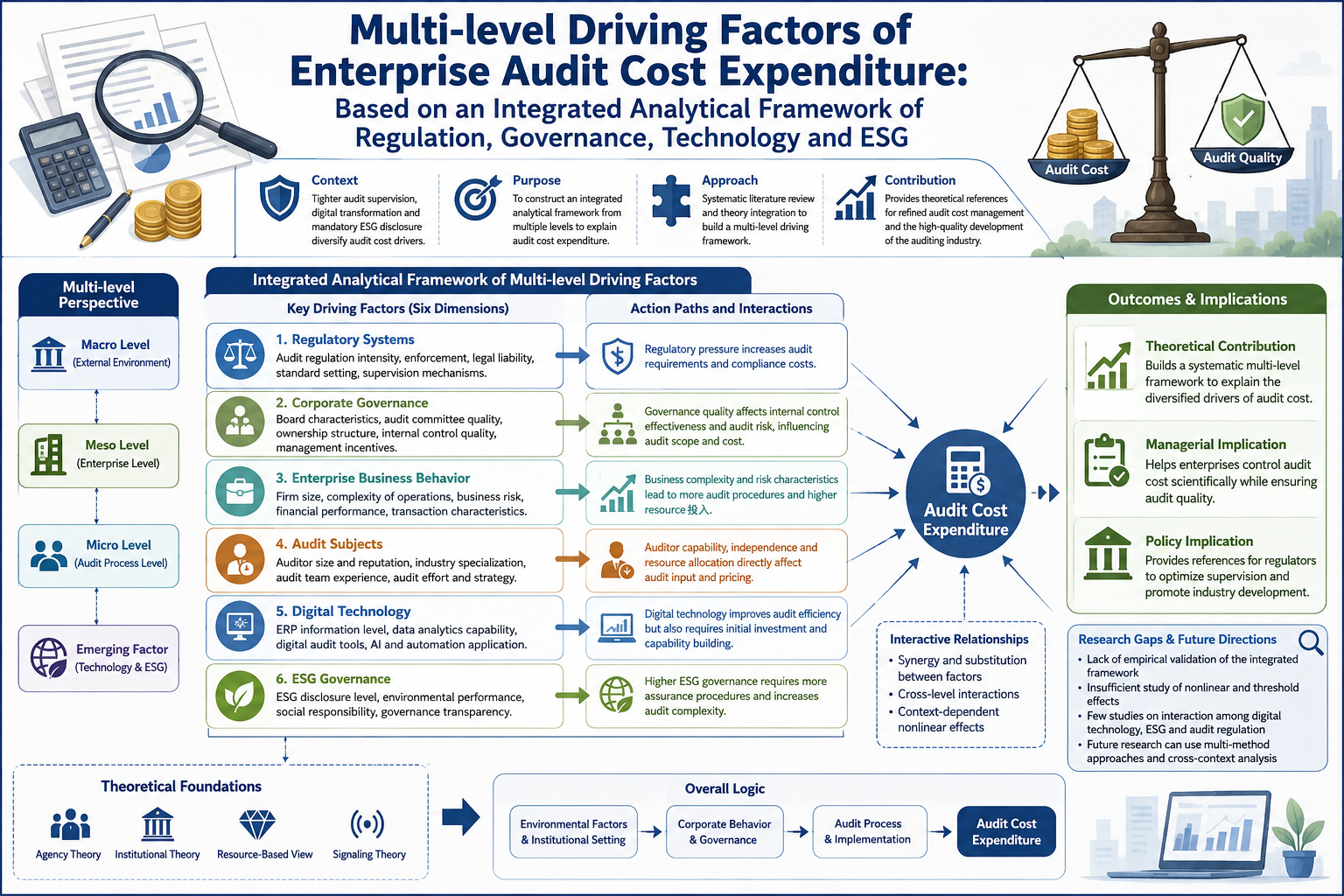
Multi-level Driving Factors of Enterprise Audit Cost Expenditure: Based on an Integrated Analytical Framework of Regulation, Governance, Technology and ESG
Keywords:
Audit Cost Expenditure; Corporate Governance; Digital Auditing; Regulatory System; Influencing FactorsAbstract
Audit cost is a core economic indicator of corporate financial governance, and balancing audit cost and audit quality is a key focus for both enterprises and the auditing profession. With the tightening of audit supervision, the digital transformation of enterprises and the implementation of mandatory ESG disclosure, the driving factors of audit cost have become increasingly diversified. This paper systematically sorts out influencing factors across six dimensions: regulatory systems, corporate governance, enterprise business behavior, audit subjects, digital technology and ESG governance, defines relevant concepts and theoretical foundations, constructs an integrated framework of influencing factors, analyzes the action paths and interactive relationships of each variable, sorts out the shortcomings of existing research, and finally proposes future research directions. This study can provide theoretical references for the refined management and control of enterprise audit costs and the high-quality development of the auditing industry.
References
Ahn, J., Hoitash, R., & Hoitash, U. (2020). Auditor task-specific expertise: The case of fair value accounting. The Accounting Review, 95(3), 1-32.https://doi.org/10.2308/accr-52599
Al-Ateeq, B. A., Sawan, N., Al-Hajaya, K., Altarawneh, M., & Al-Makhadmeh, A. (2022). Big data analytics in auditing and the consequences for audit quality: A study using the technology acceptance model (TAM). Corporate Governance and Organizational Behavior Review, 6(1), 64-78. https://doi.org/10.22495/cgobrv6i1p6
Al‐Shaer, H. (2020). Sustainability reporting quality and post‐audit financial reporting quality: Empirical evidence from the UK. Business Strategy and the Environment, 29(6), 2355-2373. https://doi.org/10.1002/bse.2509
Andiola, L. M., Downey, D. H., & Westermann, K. D. (2020). Examining climate and culture in audit firms: Insights, practice implications, and future research directions. Auditing: A Journal of Practice & Theory, 39(4), 1-29. https://doi.org/10.2308/AJPT-19-107
Bacha, S., Ajina, A., & Ben Saad, S. (2021). CSR performance and the cost of debt: Does audit quality matter?. Corporate Governance: The International Journal of Business in Society, 21(1), 137-158. https://doi.org/10.1108/CG-11-2019-0335
Bergolo, M., Ceni, R., Cruces, G., Giaccobasso, M., & Perez-Truglia, R. (2023). Tax audits as scarecrows: Evidence from a large-scale field experiment. American Economic Journal: Economic Policy, 15(1), 110-153. https://doi.org/10.1257/pol.20200321
Breuer, M. (2021). How does financial‐reporting regulation affect industry‐wide resource allocation?. Journal of Accounting Research, 59(1), 59-110. https://doi.org/10.1111/1475-679X.12348
Brown, N. C., Smith, J. D., White, R. M., & Zutter, C. J. (2021). Political corruption and firm value in the US: Do rents and monitoring matter? Journal of Business Ethics, 168(2), 335-351. https://doi.org/10.2139/ssrn.3147385
Carcello, J. V., Eulerich, M., Masli, A., & Wood, D. A. (2020). Are internal audits associated with reductions in perceived risk?. Auditing: A Journal of Practice & Theory, 39(3), 55-73. https://doi.org/10.2308/ajpt-19-036
Celestin, M. (2020). The effect of regulatory changes on auditing standards: How global compliance rules are reshaping the audit profession. Brainae Journal of Business, Sciences and Technology, 4(1), 34-43. https://doi.org/10.5281/zenodo.3876529
Celestin, M. (2020). The role of data analytics in enhancing the effectiveness of audit procedures and financial statement reviews. Brainae Journal of Business, Sciences and Technology, 4(8), 835-845. https://doi.org/10.5281/zenodo.15056688
Chen, Y., Lin, B., Lu, L., & Zhou, G. (2020). Can internal audit functions improve firm operational efficiency? Evidence from China. Managerial Auditing Journal, 35(8), 1167-1188. https://doi.org/10.1108/MAJ-01-2019-2136
Christ, M. H., Eulerich, M., Krane, R., & Wood, D. A. (2021). New frontiers for internal audit research. Accounting Perspectives, 20(4), 449-475. https://doi.org/10.1111/1911-3838.12278
Dang, V. C., & Nguyen, Q. K. (2022). Audit committee characteristics and tax avoidance: Evidence from an emerging economy. Cogent Economics & Finance, 10(1), 2023263. https://doi.org/10.1080/23322039.2021.2023263
Darshan, A., Girdhar, N., Bhojwani, R., Rastogi, K., Angalaeswari, S., Natrayan, L., & Paramasivam, P. (2022). Energy audit of a residential building to reduce energy cost and carbon footprint for sustainable development with renewable energy sources. Advances in Civil Engineering, 2022(1), 4400874. https://doi.org/10.1155/2022/4400874
Eilifsen, A., Kinserdal, F., Messier Jr., W. F., & McKee, T. E. (2020). An exploratory study into the use of audit data analytics on audit engagements. Accounting Horizons, 34(4), 75-103. https://doi.org/10.2308/HORIZONS-19-121
Endenich, C., & Trapp, R. (2020). Ethical implications of management accounting and control: A systematic review of the contributions from the Journal of Business Ethics. Journal of Business Ethics, 163(2), 309-328. https://doi.org/10.1007/s10551-018-4034-8
Fekriaval, F., & Nahandi, Y. B. (2026). The relationship between corporate governance mechanisms and disclosure of key audit matters considering the role of agency costs. Journal of Accounting Knowledge, 17(1), 103. https://doi.org/10.22103/jak.2025.24035.4094
Friske, W., Hoelscher, S. A., & Nikolov, A. N. (2023). The impact of voluntary sustainability reporting on firm value: Insights from signaling theory. Journal of the Academy of Marketing Science, 51(2), 372-392.https://doi.org/10.1007/s11747-022-00879-2
Gauthier, M. P., & Brender, N. (2021). How do the current auditing standards fit the emergent use of blockchain?. Managerial Auditing Journal, 36(3), 365-385.https://doi.org/10.1108/MAJ-12-2019-2513
Hrazdil, K., Novak, J., Rogo, R., Wiedman, C., & Zhang, R. (2020). Measuring executive personality using machine‐learning algorithms: A new approach and audit fee‐based validation tests. Journal of Business Finance & Accounting, 47(3-4), 519-544. https://doi.org/10.1111/jbfa.12428
Juwita, R., Sutrisno, T., & Hariadi, B. (2020). Influence of audit committee and internal audit on audit report lag: Size of public accounting firm as a moderating variable. International Journal of Research in Business and Social Science, 9(1), 137-142. https://doi.org/10.20525/IJRBS.V9I1.593
Kend, M., & Nguyen, L. A. (2020). Big data analytics and other emerging technologies: The impact on the Australian audit and assurance profession. Australian Accounting Review, 30(4), 269-282. https://doi.org/10.1111/auar.12318
Knechel, W. R., Thomas, E., & Driskill, M. (2020). Understanding financial auditing from a service perspective. Accounting, Organizations and Society, 81, 101080. https://doi.org/10.1016/j.aos.2019.101080
Lari Dashtbayaz, M., Rezazadeh, Z., & Safdel, T. (2025). Abnormal audit profits or costs and factors affecting audit fees. Journal of Business, Communication & Technology, 4(1), 1-17. https://doi.org/10.56632/bct.2025.4101
Leng, A., & Zhang, Y. (2024). The effect of enterprise digital transformation on audit efficiency—Evidence from China. Technological Forecasting and Social Change, 201, 123215. https://doi.org/10.1016/j.techfore.2024.123215
Lois, P., Drogalas, G., Karagiorgos, A., & Tsikalakis, K. (2020). Internal audits in the digital era: Opportunities risks and challenges. EuroMed Journal of Business, 15(2), 205-217. https://doi.org/10.1108/EMJB-07-2019-0097
Lutfi, A., Alqudah, H., Alrawad, M., Alshira’h, A. F., Alshirah, M. H., Almaiah, M. A., & Hassan, M. F. (2023). Green environmental management system to support environmental performance: What factors influence SMEs to adopt green innovations?. Sustainability, 15(13), 10645. https://doi.org/10.3390/su151310645
Manita, R., Elommal, N., Baudier, P., & Hikkerova, L. (2020). The digital transformation of external audit and its impact on corporate governance. Technological Forecasting and Social Change, 150, 119751. https://doi.org/10.1016/j.techfore.2019.119751
Mardessi, S. (2022). Audit committee and financial reporting quality: The moderating effect of audit quality. Journal of Financial Crime, 29(1), 368-388. https://doi.org/10.1108/JFC-01-2021-0010
Metaxa, D., Park, J. S., Robertson, R. E., Karahalios, K., Wilson, C., Hancock, J., & Sandvig, C. (2021). Auditing algorithms: Understanding algorithmic systems from the outside in. Foundations and Trends® in Human–Computer Interaction, 14(4), 272-344. https://doi.org/10.1561/1100000067
Minutti-Meza, M. (2021). The art of conversation: The expanded audit report. Accounting and Business Research, 51(5), 548-581. https://doi.org/10.1080/00014788.2021.1932264
Salehi, M., Tarighi, H., & Shahri, T. A. (2020). The effect of auditor characteristics on tax avoidance of Iranian companies. Journal of Asian Business and Economic Studies, 27(2), 119-134. https://doi.org/10.1108/JABES-11-2018-0100
Seethamraju, R., & Hecimovic, A. (2023). Adoption of artificial intelligence in auditing: An exploratory study. Australian Journal of Management, 48(4), 780-800. https://doi.org/10.1177/03128962221108440
Sekicki, V., & Šuvakov, P. (2025). Emerging Paradigms in Global Accounting and Auditing: Challenges and Innovations. Journal of Agronomy, Technology and Engineering Management (JATEM), 8(2), 1459-1468. https://doi.org/10.55817/LKII3657
Sharma, M., Al Khalil, A., & Daim, T. (2022). Blockchain technology adoption: Multinational analysis of the agriculture supply chain. IEEE Transactions on Engineering Management, 71, 12400-12417. https://doi.org/10.1109/TEM.2022.3193688
Soeparjono, P. I. H., & Senjani, Y. P. (2024). The impact of tax avoidance on audit report lag with audit fee as a moderating variable. Journal of Accounting Inquiry, 3(1), 041-051. https://doi.org/10.5281/zenodo.10532847
Sun, X., Yao, Y., & Han, J. (2025). Does ESG Washing Increase Abnormal Audit Fees? Research Based on the Chain Mediating Effects. Sustainability, 17(21), 9668. https://doi.org/10.3390/su17219668
Wang, W., Yu, Y., & Li, X. (2022). ESG performance, auditing quality, and investment efficiency: Empirical evidence from China. Frontiers in Psychology, 13, 948674. https://doi.org/10.3389/fpsyg.2022.948674
Widmann, M., Follert, F., & Wolz, M. (2021). What is it going to cost? Empirical evidence from a systematic literature review of audit fee determinants. Management Review Quarterly, 71(2), 455-489.https://doi.org/10.1007/s11301-020-00190-w
Wohlfarth, K., Worrell, E., & Eichhammer, W. (2020). Energy efficiency and demand response–two sides of the same coin?. Energy Policy, 137, 111070. https://doi.org/10.1016/j.enpol.2019.111070
Wu, D., & Ye, Q. (2020). Public attention and auditor behavior: The case of Hurun Rich List in China. Journal of Accounting Research, 58(3), 777-825. https://doi.org/10.1111/1475-679X.12309
Xiao, T., Geng, C., & Yuan, C. (2020). How audit effort affects audit quality: An audit process and audit output perspective. China Journal of Accounting Research, 13(1), 109-127. https://doi.org/10.1016/j.cjar.2020.02.002
Xu, Y., Zhang, C., Wang, G., Qin, Z., & Zeng, Q. (2020). A blockchain-enabled deduplicatable data auditing mechanism for network storage services. IEEE Transactions on Emerging Topics in Computing, 9(3), 1421-1432. https://doi.org/10.1109/TETC.2020.3005610
Yuan, H., Chen, X., Wang, J., Yuan, J., Yan, H., & Susilo, W. (2020). Blockchain-based public auditing and secure deduplication with fair arbitration. Information Sciences, 541, 409-425. https://doi.org/10.1016/j.ins.2020.06.051
Zahid, R. A., Khan, M. K., Anwar, W., & Maqsood, U. S. (2022). The role of audit quality in the ESG-corporate financial performance nexus: Empirical evidence from Western European companies. Borsa Istanbul Review, 22, S200-S212. https://doi.org/10.1016/j.bir.2022.09.011
Zhang, C., Xu, Y., Hu, Y., Wu, J., Ren, J., & Zhang, Y. (2021). A blockchain-based multi-cloud storage data auditing scheme to locate faults. IEEE Transactions on Cloud Computing, 10(4), 2252-2263. https://doi.org/10.1109/TCC.2021.3057771