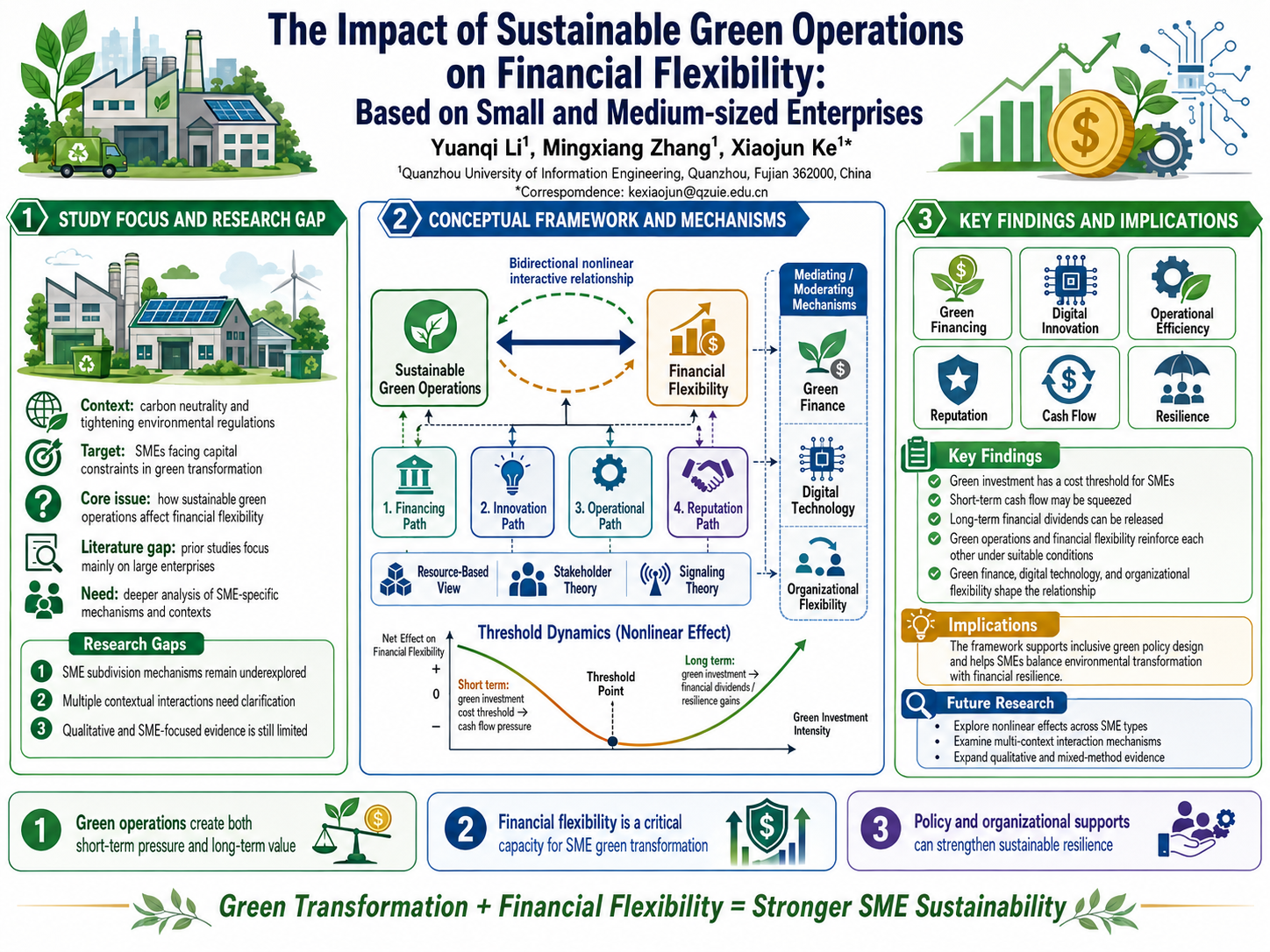
The Impact of Sustainable Green Operations on Financial Flexibility: Based on Small and Medium-sized Enterprises
Keywords:
Sustainable Green Operations; Financial Flexibility; Green Transformation; Organizational Resilience; Sustainable DevelopmentAbstract
Against the backdrop of carbon neutrality and tightening global environmental regulations, the capital constraint of green transformation among small and medium-sized enterprises (SMEs) has become prominent, and financial flexibility determines their capacity for low-carbon sustainable operations. Grounded in the Resource-Based View, Stakeholder Theory, and Signaling Theory, this paper systematically clarifies the bidirectional nonlinear interactive relationship between sustainable green operations and financial flexibility, summarizes four transmission paths of financing, innovation, operation, and reputation, and sorts out mediating and moderating mechanisms such as green finance, digital technology, and organizational flexibility. The study finds that green investment by SMEs has a cost threshold, which squeezes cash flow in the short term and releases financial dividends in the long run. However, existing literature mostly focuses on large enterprises, leaving obvious gaps in the subdivision mechanisms, multiple context interactions, and qualitative research targeting SMEs. This paper constructs a conceptual analytical framework for the research, provides theoretical support for the green transformation of SMEs and the formulation of inclusive green policies, and proposes future research directions.
References
Aboalsamh, H. M., Khrais, L. T., & Albahussain, S. A. (2023). Pioneering perception of green fintech in promoting sustainable digital services application within smart cities. Sustainability, 15(14), 11440. https://doi.org/10.3390/su151411440
Afum, E., Agyabeng-Mensah, Y., Sun, Z., Frimpong, B., Kusi, L. Y., & Acquah, I. S. K. (2020). Exploring the link between green manufacturing, operational competitiveness, firm reputation and sustainable performance dimensions: a mediated approach. Journal of Manufacturing Technology Management, 31(7), 1417–1438. https://doi.org/10.1108/JMTM-02-2020-0036
Akomea-Frimpong, I., Adeabah, D., Ofosu, D., & Tenakwah, E. J. (2022). A review of studies on green finance of banks, research gaps and future directions. Journal of Sustainable Finance & Investment, 12(4), 1241–1264. https://doi.org/10.1080/20430795.2021.1908802
Alkaraan, F., Elmarzouky, M., Hussainey, K., Venkatesh, V. G., Shi, Y., & Gulko, N. (2024). Reinforcing green business strategies with Industry 4.0 and governance towards sustainability:Natural‐resource‐based view and dynamic capability. Business Strategy and the Environment, 33(4), 3588–3606.https://doi.org/10.1002/bse.3665
Alraja, M. N., Imran, R., Khashab, B. M., & Shah, M. (2022). Technological innovation, sustainable green practices and SMEs sustainable performance in times of crisis (COVID-19 pandemic). Information Systems Frontiers, 24(4), 1081–1105. https://doi.org/10.1007/s10796-022-10266-0
Bag, S., & Rahman, M. S. (2023). The role of capabilities in shaping sustainable supply chain flexibility and enhancing circular economy-target performance: an empirical study. Supply Chain Management: An International Journal, 28(1), 162–178. https://doi.org/10.1108/SCM-03-2022-0134
Bai, C., Sarkis, J., Yin, F., & Dou, Y. (2020). Sustainable supply chain flexibility and its relationship to circular economy-target performance. International Journal of Production Research, 58(19), 5893–5910. https://doi.org/10.1080/00207543.2020.1737543
Boakye, D. J., Tingbani, I., Ahinful, G., Damoah, I., & Tauringana, V. (2020). Sustainable environmental practices and financial performance: Evidence from listed small and medium‐sized enterprise in the United Kingdom. Business Strategy and the Environment, 29(6), 2583–2602. https://doi.org/10.1002/bse.2543
Chen, Z., Mirza, N., Huang, L., & Umar, M. (2022). Green banking—can financial institutions support green recovery?. Economic Analysis and Policy, 75, 389–395.https://doi.org/10.1016/j.eap.2022.06.008
Chueca Vergara, C., & Ferruz Agudo, L. (2021). Fintech and sustainability: do they affect each other?. Sustainability, 13(13), 7012. https://doi.org/10.3390/su13137012
Davidescu, A. A., Apostu, S. A., Paul, A., & Casuneanu, I. (2020). Work flexibility, job satisfaction, and job performance among Romanian employees—Implications for sustainable human resource management. Sustainability, 12(15), 6086. https://doi.org/10.3390/su12156086
Deschryver, P., & De Mariz, F. (2020). What future for the green bond market? How can policymakers, companies, and investors unlock the potential of the green bond market?. Journal of Risk and Financial Management, 13(3), 61.https://doi.org/10.3390/jrfm13030061
Dwivedi, A., Agrawal, D., Jha, A., Gastaldi, M., Paul, S. K., & D’Adamo, I. (2021). Addressing the challenges to sustainable initiatives in value chain flexibility: Implications for sustainable development goals. Global Journal of Flexible Systems Management, 22(2), 179–197. https://doi.org/10.1007/s40171-021-00273-1
Edwin Cheng, T. C., Kamble, S. S., Belhadi, A., Ndubisi, N. O., Lai, K. H., & Kharat, M. G. (2022). Linkages between big data analytics, circular economy, sustainable supply chain flexibility, and sustainable performance in manufacturing firms. International Journal of Production Research, 60(22), 6908–6922. https://doi.org/10.1080/00207543.2021.2017694
Feng, Z., & Wu, Z. (2023). ESG disclosure, REIT debt financing and firm value. The Journal of Real Estate Finance and Economics, 67(3), 388–422. https://doi.org/10.1007/s11146-022-09912-9
Guild, J. (2020). The political and institutional constraints on green finance in Indonesia. Journal of Sustainable Finance & Investment, 10(2), 157–170. https://doi.org/10.1080/20430795.2019.1681688
Hao, Z., Zhang, X., & Wei, J. (2022). Research on the effect of enterprise financial flexibility on sustainable innovation. Journal of Innovation & Knowledge, 7(2), 100184.https://doi.org/10.1016/j.jik.2022.100184
Heffron, R., Körner, M. F., Wagner, J., Weibelzahl, M., & Fridgen, G. (2020). Industrial demand-side flexibility: A key element of a just energy transition and industrial development. Applied Energy, 269, 115026. https://doi.org/10.1016/j.apenergy.2020.115026
Heffron, R. J., Körner, M. F., Schöpf, M., Wagner, J., & Weibelzahl, M. (2021). The role of flexibility in the light of the COVID-19 pandemic and beyond: Contributing to a sustainable and resilient energy future in Europe. Renewable and Sustainable Energy Reviews, 140, 110743. https://doi.org/10.1016/j.rser.2021.110743
Hung, N. T. (2023). Green investment, financial development, digitalization and economic sustainability in Vietnam: Evidence from a quantile-on-quantile regression and wavelet coherence. Technological Forecasting and Social Change, 186, 122185. https://doi.org/10.1016/j.techfore.2023.122185
Jain, N. K., Panda, A., & Choudhary, P. (2020). Institutional pressures and circular economy performance: The role of environmental management system and organizational flexibility in oil and gas sector. Business Strategy and the Environment, 29(8), 3509–3525. https://doi.org/10.1002/bse.2630
Khan, M. T., Idrees, M. D., Rauf, M., Sami, A., Ansari, A., & Jamil, A. (2022). Green supply chain management practices’ impact on operational performance with the mediation of technological innovation. Sustainability, 14(6), 3362.https://doi.org/10.3390/su14063362
Khan, S. A. R., Godil, D. I., Jabbour, C. J. C., Shujaat, S., Razzaq, A., & Yu, Z. (2025). Green data analytics, blockchain technology for sustainable development, and sustainable supply chain practices: evidence from small and medium enterprises. Annals of Operations Research, 350(2), 603–627. https://doi.org/10.1007/s10479-023-05524-7
Khan, S. A. R., Yu, Z., & Farooq, K. (2023). Green capabilities, green purchasing, and triple bottom line performance: Leading toward environmental sustainability. Business Strategy and the Environment, 32(4), 2022–2034. https://doi.org/10.1002/bse.3131
Kumar, L., Nadeem, F., Sloan, M., et al. (2022). Fostering green finance for sustainable development: A focus on textile and leather small medium enterprises in Pakistan. Sustainability, 14(19), 11908. https://doi.org/10.3390/su141911908
Lee, R. (2021). The effect of supply chain management strategy on operational and financial performance. Sustainability, 13(9), 5138. https://doi.org/10.3390/su13095138
Liu, F. H., & Lai, K. P. (2021). Ecologies of green finance: Green sukuk and development of green Islamic finance in Malaysia. Environment and Planning A: Economy and Space, 53(8), 1896–1914. https://doi.org/10.1177/0308518X211018234
Lu, C. W., Huang, J. C., Chen, C., Shu, M. H., Hsu, C. W., & Bapu, B. T. (2021). An energy-efficient smart city for sustainable green tourism industry. Sustainable Energy Technologies and Assessments, 47, 101494. https://doi.org/10.1016/j.seta.2021.101494
Macchiavello, E., & Siri, M. (2022). Sustainable finance and fintech: Can technology contribute to achieving environmental goals? A preliminary assessment of ‘green fintech’and ‘sustainable digital finance’. European Company and Financial Law Review, 19(1), 128–174. https://doi.org/10.1515/ecfr-2022-0005
Ma, M., Zhu, X., Liu, M., & Huang, X. (2023). Combining the role of green finance and environmental sustainability on green economic growth: Evidence from G-20 economies. Renewable Energy, 207, 128–136. https://doi.org/10.1016/j.renene.2023.01.059
Manigandan, S., Praveenkumar, T. R., Ryu, J. I., Verma, T. N., & Pugazhendhi, A. (2023). Role of hydrogen on aviation sector: A review on hydrogen storage, fuel flexibility, flame stability, and emissions reduction on gas turbines engines. Fuel, 352, 129064.https://doi.org/10.1016/j.fuel.2023.129064
Ni, G., Xu, H., Cui, Q., Qiao, Y., Zhang, Z., Li, H., & Hickey, P. J. (2020). Influence mechanism of organizational flexibility on enterprise competitiveness: The mediating role of organizational innovation. Sustainability, 13(1), 176. https://doi.org/10.3390/su13010176
Omowole, B. M., Olufemi-Philips, A. Q., Ofodili, O. C., Eyo-Udo, N. L., & Ewim, S. E. (2024). Conceptualizing green business practices in SMEs for sustainable development. International Journal of Management & Entrepreneurship Research, 6(11), 3778–3805. https://doi.org/10.51594/ijmer.v6i11.1719
Pu, G., Qamruzzaman, M. D., Mehta, A. M., Naqvi, F. N., & Karim, S. (2021). Innovative finance, technological adaptation and SMEs sustainability: the mediating role of government support during COVID-19 pandemic. Sustainability, 13(16), 9218.https://doi.org/10.3390/su13169218
Rahman, M. H., Rahman, J., Tanchangya, T., & Esquivias, M. A. (2023). Green banking initiatives and sustainability: A comparative analysis between Bangladesh and India. Research in Globalization, 7, 100184. https://doi.org/10.1016/j.resglo.2023.100184
Salkuti, S. R. (2022). Emerging and advanced green energy technologies for sustainable and resilient future grid. Energies, 15(18), 6667. https://doi.org/10.3390/en15186667
Sarkar, B., & Bhuniya, S. (2022). A sustainable flexible manufacturing–remanufacturing model with improved service and green investment under variable demand. Expert Systems with Applications, 202, 117154. https://doi.org/10.1016/j.eswa.2022.117154
Settembre-Blundo, D., González-Sánchez, R., Medina-Salgado, S., & García-Muiña, F. E. (2021). Flexibility and resilience in corporate decision making: a new sustainability-based risk management system in uncertain times. Global Journal of Flexible Systems Management, 22(2), 107–132. https://doi.org/10.1007/s40171-021-00271-3
Shahzad, S., & Jasińska, E. (2024). Renewable revolution: A review of strategic flexibility in future power systems. Sustainability, 16(13), 5454. https://doi.org/10.3390/su16135454
Sharma, G. D., Verma, M., Shahbaz, M., Gupta, M., & Chopra, R. (2022). Transitioning green finance from theory to practice for renewable energy development. Renewable Energy, 195, 554–565. https://doi.org/10.1016/j.renene.2022.05.120
Siagian, H., Tarigan, Z. J. H., & Jie, F. (2021). Supply chain integration enables resilience, flexibility, and innovation to improve business performance in COVID-19 era. Sustainability, 13(9), 4669. https://doi.org/10.3390/su13094669
Su, R., Obrenovic, B., Du, J., Godinic, D., & Khudaykulov, A. (2022). COVID-19 pandemic implications for corporate sustainability and society: A literature review. International Journal of Environmental Research and Public Health, 19(3), 1592. https://doi.org/10.3390/ijerph19031592
Sun, G., Fang, J., Li, T., & Ai, Y. (2024). Effects of climate policy uncertainty on green innovation in Chinese enterprises. International Review of Financial Analysis, 91, 102960. https://doi.org/10.1016/j.irfa.2023.102960
Taghizadeh-Hesary, F., & Yoshino, N. (2020). Sustainable solutions for green financing and investment in renewable energy projects. Energies, 13(4), 788. https://doi.org/10.3390/en13040788
Teng, X., Chang, B. G., & Wu, K. S. (2021). The role of financial flexibility on enterprise sustainable development during the COVID-19 crisis—a consideration of tangible assets. Sustainability, 13(3), 1245. https://doi.org/10.3390/su13031245
Trivellas, P., Malindretos, G., & Reklitis, P. (2020). Implications of green logistics management on sustainable business and supply chain performance: evidence from a survey in the greek agri-food sector. Sustainability, 12(24), 10515. https://doi.org/10.3390/su122410515
Wang, C. A., Wang, L., Zhao, S., Yang, C., & Albitar, K. (2024). The impact of Fintech on corporate carbon emissions: Towards green and sustainable development. Business Strategy and the Environment, 33(6), 5776–5796. https://doi.org/10.1002/bse.3468
Wang, L., Zhao, C., Gan, Y., & Ni, X. (2025). Financial flexibility, organizational resilience and corporate green innovation. Finance Research Letters, 76, 106917.https://doi.org/10.1016/j.frl.2024.106917
Wang, X., & Wang, Q. (2021). Research on the impact of green finance on the upgrading of China's regional industrial structure from the perspective of sustainable development. Resources Policy, 74, 102436. https://doi.org/10.1016/j.resourpol.2021.102436
Xiong, Y., & Dai, L. (2023). Does green finance investment impact on sustainable development: Role of technological innovation and renewable energy. Renewable Energy, 214, 342–349. https://doi.org/10.1016/j.renene.2023.05.052
Yang, C., Zhu, C., & Albitar, K. (2024). ESG ratings and green innovation: A U‐shaped journey towards sustainable development. Business Strategy and the Environment, 33(5), 4108–4129. https://doi.org/10.1002/bse.3473
Ye, J., & Dela, E. (2023). The effect of green investment and green financing on sustainable business performance of foreign chemical industries operating in Indonesia: the mediating role of corporate social responsibility. Sustainability, 15(14), 11218. https://doi.org/10.3390/su151411218
Zhai, Y., Cai, Z., Lin, H., Yuan, M., Mao, Y., & Yu, M. (2022). Does better environmental, social, and governance induce better corporate green innovation: The mediating role of financing constraints. Corporate Social Responsibility and Environmental Management, 29(5), 1513–1526. https://doi.org/10.1002/csr.2268
Zhang, H., Zhang, Z., & Steklova, E. (2020). Do companies need financial flexibility for sustainable development?. Sustainability, 12(5), 1811. https://doi.org/10.3390/su12051811
Zhang, S., Wu, Z., Wang, Y., & Hao, Y. (2021). Fostering green development with green finance: An empirical study on the environmental effect of green credit policy in China. Journal of Environmental Management, 296, 113159.https://doi.org/10.1016/j.jenvman.2021.113159
Zheng, G. W., Siddik, A. B., Masukujjaman, M., Fatema, N., & Alam, S. S. (2021). Green finance development in Bangladesh: The role of private commercial banks (PCBs). Sustainability, 13(2), 795. https://doi.org/10.3390/su13020795
Zhu, N., Bu, Y., Jin, M., & Mbroh, N. (2020). Green financial behavior and green development strategy of Chinese power companies in the context of carbon tax. Journal of Cleaner Production, 245, 118908. https://doi.org/10.1016/j.jclepro.2019.118908