Willingness and Motivation of Chinese Generation X and Y Tourists to Participate in Wellness Tourism in Thailand Based on Push-Pull Theory
Keywords:
Wellness tourism; Push–Pull Theory; Perceived value; Participation motivation; Travel intention; Recommendation intentionAbstract
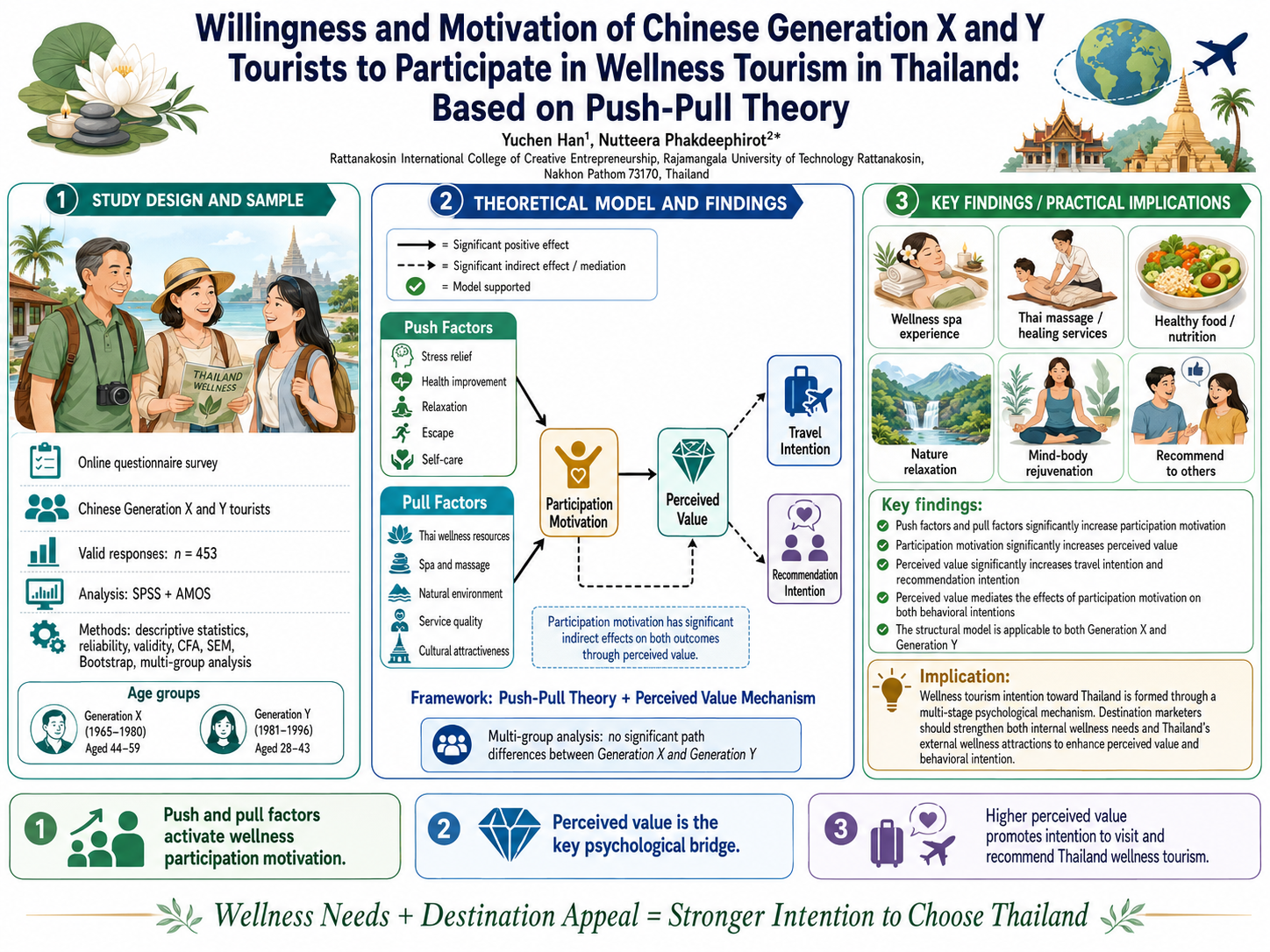
Based on Push–Pull Theory and perceived-value research, this study examines the formation mechanism of behavioral intention toward wellness tourism in Thailand among Chinese Generation X and Y tourists. An online questionnaire survey was conducted through the Questionnaire Star platform, and 453 valid responses were collected. SPSS and AMOS were used to conduct descriptive statistical analysis, reliability analysis, validity analysis, confirmatory factor analysis, structural equation modeling, Bootstrap analysis, and multi-group analysis. The results show that both push factors and pull factors have significant positive effects on participation motivation. Participation motivation has a significant positive effect on perceived value, and perceived value further has significant positive effects on travel intention and recommendation intention. Bootstrap analysis showed that participation motivation had significant positive indirect effects on travel intention and recommendation intention through perceived value, supporting H6a and H6b. Multi-group analysis showed no significant structural path differences between Generation X and Generation Y, suggesting that the proposed model is generally applicable to both groups. The findings indicate that behavioral intention toward wellness tourism in Thailand is formed through a multi-stage psychological mechanism involving push factors, pull factors, participation motivation, and perceived value. This study extends the explanatory scope of Push–Pull Theory by incorporating perceived value as an indirect psychological mechanism in wellness tourism research.
References
Ajzen, I. (1991). The theory of planned behavior. Organizational Behavior and Human Decision Processes, 50(2), 179–211. https://doi.org/10.1016/0749-5978 (91) 90020-T
Chen, C.-F., & Chen, F.-S. (2010). Experience quality, perceived value, satisfaction and behavioral intentions for heritage tourists. Tourism Management, 31(1), 29–35.https://doi.org/10.1016/j.tourman.2009.02.008
Crompton, J. L. (1979). Motivations for pleasure vacation. Annals of Tourism Research, 6(4), 408–424. https://doi.org/10.1016/0160-7383 (79) 90004-5
Dann, G. M. S. (1977). Anomie, ego-enhancement and tourism. Annals of Tourism Research, 4(4), 184–194.https://doi.org/10.1016/0160-7383 (77) 90037-8
Dann, G. M. S. (1981). Tourist motivation: An appraisal. Annals of Tourism Research, 8(2), 187–219. https://doi.org/10.1016/0160-7383 (81) 90082-7
Gan, T., Zheng, J., Li, W., Li, J., & Shen, J. (2023). Health and wellness tourists’ motivation and behavior intention: The role of perceived value. International Journal of Environmental Research and Public Health, 20(5), 4339. https://doi.org/10.3390/ijerph20054339
Gardiner, S., Grace, D., & King, C. (2014). The generation effect: The future of domestic tourism in Australia. Journal of Travel Research, 53(6), 705–720.https://doi.org/10.1177/0047287514530810
Hussey, I., Alsalti, T., Bosco, F., Elson, M., & Arslan, R. (2025). An Aberrant Abundance of Cronbach’s Alpha Values at .70. Advances in Methods and Practices in Psychological Science, 8(1),25152459241287123.https://doi.org/10.1177/25152459241287123
Li, X., Li, X. R., & Hudson, S. (2013). The application of generational theory to tourism consumer behavior: An American perspective. Tourism Management, 37, 147–164. https://doi.org/10.1016/j.tourman.2013.01.015
Mueller, H., & Lanz Kaufmann, E. (2001). Wellness tourism: Market analysis of a special health tourism segment and implications for the hotel industry. Journal of Vacation Marketing, 7(1), 5–17. https://doi.org/10.1177/135676670100700101
NaRanong, A., & NaRanong, V. (2011). The effects of medical tourism: Thailand’s experience. Bulletin of the World Health Organization, 89(5), 336–344. https://doi.org/10.2471/BLT.09.072249
Pan, T., Beckman, E., Kitterlin-Lynch, M., Zhao, J., & Cheng, M. (2021). Exploring the motivations and repeat behavioral intentions of Generation X and Y Chinese cruise tourists. Journal of China Tourism Research, 17(4), 512–531. https://doi.org/10.1080/19388160.2021.1972070
Podsakoff, P. M., MacKenzie, S. B., Lee, J.-Y., & Podsakoff, N. P. (2003). Common method biases in behavioral research: A critical review of the literature and recommended remedies. Journal of Applied Psychology, 88(5), 879–903. https://doi.org/10.1037/0021-9010.88.5.879
Voigt, C., Brown, G., & Howat, G. (2011). Wellness tourists: In search of transformation. Tourism Review, 66(1), 16–30. https://doi.org/10.1108/16605371111127206
Wolf, E. J., Harrington, K. M., Clark, S. L., & Miller, M. W. (2013). Sample Size Requirements for Structural Equation Models: An Evaluation of Power, Bias, and Solution Propriety. Educational Psychological Measurement, 76(6), 913-934. https://doi.org/10.1177/0013164413495237
Zeithaml, V. A. (1988). Consumer perceptions of price, quality, and value: A means–end model and synthesis of evidence. Journal of Marketing, 52(3), 2–22. https://doi.org/10.1177/002224298805200302